☕ Support Us
[🇧🇩] - Textile & RMG Industry of Bangladesh | Page 40 | PKDefense

[🇧🇩] Textile & RMG Industry of Bangladesh

Reply (Scroll)
Press space to scroll through posts
G Bangladesh Defense
[🇧🇩] Textile & RMG Industry of Bangladesh
397
15K
More threads by Saif

newagebd.net/post/apparel/282228/rmg-exports-to-the-eu-see-13pc-growth

RMG exports to the EU see 13pc growth
Staff Correspondent 15 November, 2025, 22:39

1763257729008.webp


Bangladesh’s exports of readymade garments to the European Union countries grew by 13.17 per cent year-on-year in the January-September 2025 period, reaching €15.26 billion, according to Eurostat data released recently.

The export earnings were €13.48 billion in the same period of 2024.

Bangladesh’s monthly exports to the EU in September of 2025 also grew by 15.47 per cent to €1.78 billion, compared with €1.54 billion in September of 2024.

RMG exporters said that, although the exports to the EU market are normal so far, the United States’ tariff policy has significantly impacted the global apparel industry, leading to shrinking demand.

For this reason, China and India have intensified their presence in the EU to offset their losses in the US market, which might increase competition here.

Bangladesh remained the second-largest apparel exporter to the EU after China, consolidating its position with double-digit growth in 2025.

The country’s 13.17 per cent rise outpaced the EU’s overall import growth of 7.14 per cent, reflecting Bangladesh’s competitiveness in terms of price, compliance, and sustainability credentials.

The European Union’s total apparel imports reached €68.47 billion in the first nine months of 2025, marking a 7.14 per cent year-on-year increase from €63.90 billion in the same period of 2024.

The EU’s imports also surged by 3.17 per cent to €8.57 billion in September 2025.

Among the major exporters, China, while maintaining its dominance, recorded 9.86 per cent growth during the first nine months of 2025, with export earnings rising to €19.77 billion from €18 billion in the same period of 2024.

However, its exports dropped slightly by 4.55 per cent in September 2025 to €2.87 billion, down from €3 billion a year earlier.

Despite securing third place, Turkey also experienced one of the sharpest declines among major suppliers in the EU market.

The country’s apparel exports to the EU fell to €6.42 billion in January-September 2025, a 9.8 per cent drop from €7.12 billion in the same period of 2024, Eurostat data added.

Turkey’s monthly apparel exports to the EU in September 2025 also fell to €704 million, an 8.48 per cent drop from €770 million in the same month of 2024.

India recorded 10 per cent growth to €3.76 billion in January-September 2025, up from €3.40 billion in the same period of 2024.

In September 2025, the South Asian country posted a narrow growth of 0.22 per cent to €308 million, which was €307 million in September 2024.

Cambodia emerged as the strongest performer, registering the highest growth rate among major EU apparel suppliers in the first nine months of 2025, said the Eurostat data.

The country’s apparel exports to the EU rose by 22.51 per cent in January-September 2025 to €3.37 billion, which was €2.97 billion, while cumulative exports for the January-September period surged by 25.9 per cent to €2.74 billion in the mentioned period.

Vietnam and Pakistan also showed solid performance in the EU market, with apparel exports rising by 14.24 per cent and 13.77 per cent, respectively, in January-September of 2025, to €3.26 billion and €2.9 billion, respectively.

Vietnam’s growth was usually driven by its expanding synthetic apparel and sportswear industries and its preferential access under the EU–Vietnam Free Trade Agreement.

Mohammad Hatem, president of the Bangladesh Knitwear Manufacturers and Exporters Association, said that as the US tariff policy changed the global apparel market, China and India have intensified their presence in the EU.

‘This may increase competition in Europe and in this regard, Bangladesh should resolve several domestic factors, including gas and electricity shortages and challenges related to banking and customs,’ he added.

Mohiuddin Rubel, former director of the Bangladesh Garment Manufacturers and Exporters Association, said the scenario in Europe has changed significantly over the last three months.

‘Countries like China, Cambodia, Vietnam, and Pakistan increased their presence in EU markets to offset their losses in the US. Their exports to the EU increased more than the average in the last three months, although Bangladesh remained at its usual position,’ he added.

Bangladesh has started losing its share in Europe due to competitors’ aggressive presence, he added, saying the country should focus on product diversification, resolving domestic issues, and innovation to sustain its position there.

In 2024, Bangladesh exported apparel worth over €17 billion, according to Eurostat data.​
 

Trade paradigm shift over US high-tariff regime
Bangladesh garment export to EU confronting crowding-out effect

Monira Munni

Published :
Nov 16, 2025 08:15

1763342907632.webp


Bangladesh's garment export to the European Union faces crowding-out effect as major competitors, hitting US tariff walls, are making forays into the country's largest shipment destination, exporters say.

China, Vietnam, Cambodia and Pakistan have incrementally raised their concentration on the European Union (EU) market for a decade while they, mainly trade-major China, now intensify trade race as new US tariff regime comes into effect.

The ramped-up reciprocal tariffs force the players to diversify their shipment destinations to the 27-nation bloc in Europe.

Data analysis shows that China shipped garments, on average, worth of 1.87 billion euros each month from January to June of 2025 while the average shipments rose to 2.82 billion euros in July-September period of the current calendar year. The turnover takes China's overall garment shipments to the EU to 19.76 billion euros during the first nine months of 2025, according to Eurostat data.

On the other hand, Bangladesh's average single-month apparel-export earnings during the July-to-September period stood at 1.64 billion euros while the average monthly receipt was 1.71 billion euros during the first six months of 2025.

The country started 2025 with 1.91 billion euros in January, while the highest income worth of 2.11 billion euros was in March 2025. Export performance continued falling since April, save July and September, data analysis shows.

Apparel exports from the country fetched 15.25 billion euros, recording a 13.17-percent growth, during the last January-September period, in a rise from 13.47 billion euros in the corresponding period of 2024.

However, the single-month earnings missed the March mark.

Experts and exporters say constrained by American tariffs, supplies have been diverted to other key destinations, such as Japan, and Canada and mostly to the EU.

With Bangladesh holding over 20-percent share in the EU apparel market, this diversion could intensify price competition, squeezing margins and undermining profitability, they opine.

Asked about the latest trade situation, Fazlul Hoque, former president of Bangladesh Knitwear Manufacturers and Exporters Association (BKMEA), says data reflect Bangladesh's overall competitiveness gap with that of China.

"China's competitiveness is far better than that of Bangladesh with more efficient ports, no energy disruptions and uncertainty over political situation and national elections as here in the country while Bangladesh has low productivity, high lead time and cost of production," he explains.

"China, despite high wages there, is more competitive and able to instantly cope with the challenges, like as US tariff, with its high productivity, availability of raw materials like fabrics and no production disruption to diversify its destination, mostly to the EU," he told The Financial Express about the comparative advantages and disadvantages.

"Bangladesh can't compete only with cheap production-hub status."

Talking to the FE writer, Mohiuddin Rubel, a former director of Bangladesh Garment Manufacturers and Exporters Association (BGMEA), says though the average export growth of Bangladesh to the EU was good, the performances of other competitors, including China, Cambodia, Vietnam and Pakistan, were higher.

The last three moths' average shipment situation, especially after the new US tariff regime taking effect, has changed the overall market dimensions. On average, each month China shipped higher volumes of garments worth of 1.0 billion euros.

"In comparison, Bangladesh's average shipments during last three months since July rather decreased," he says, adding that competitors, mostly China, are entering the EU market aggressively by lowering prices significantly.

EU's apparel imports increased 7.14 per cent by value to 68.46 billion euros and 13.80 per cent by volume to 3.54 billion kilograms, showing a 5.86-percent decline in unit price during the January-to-September period of 2025 compared to that of 2024, statistics show.

Citing data, Mr Rubel says Indian apparel exports amounted to 3.76 billion euros during the first nine months of 2025, recording a 10.62-percent growth in value and 16.01-percent growth in volume, showing a 16.01-percent price fall.

Pakistan received 2.90 billion euros during the period, marking 13.77- percent rise in value, driven by 15.90-percent growth in volume and a 1.83-percent reduction in unit prices.

Cambodia posted particularly strong performance, with exports surging to 3.37 billion euros recording 22.51 per cent and 39.65 per cent growth in value and volume respectively.

Unit prices for Cambodia-made garments fell by 12.27 per cent, reflecting an assertive strategic shift towards the EU amid weaker conditions on the US market, he notes.

Unit price of Vietnamese garments, however, witnessed a 2.65-percent rise, he says, attributing their high value-added items.

"While these countries achieved robust volume and value growth, the broad-based decline in average prices highlights the intense competitive pressure within the EU apparel market as well as buyers' focus on cost containment in an inflationary environment," Mr Rubel, also additional managing director of Denim Expert Ltd, notes.​
 

RMG export growth slows amid global headwinds: BB
Staff Correspondent 29 November, 2025, 00:13

1764380880601.webp


Exports from readymade garments have been facing growing headwinds from trade policy shifts and global demand fluctuations in the first quarter of the current financial year 2025-26, which have slowed export growth, according to Bangladesh Bank data.

The central bank stated that the sector would step into the rest of FY26 amid challenges shaped not only by demand dynamics in key markets but also by geopolitical and trade risks, such as new high US tariffs and related trade tensions, which might create uncertainty regarding order flows and place pressure on competitiveness.

According to the BB’s Quarterly Review of Readymade Garments, Bangladesh’s RMG sector earned $9.93 billion, recording a year-on-year growth of 4.34 per cent, in the July-September period of FY26, higher than that of $9.51 billion earned in the same period of FY25.

The earnings in the reporting period were 8.88 per cent higher than that of $9.11 billion recorded in the preceding quarter, April-June period, of the FY25.

During the first quarter of FY26, import value of raw materials, like raw cotton, synthetic or viscose fibre, synthetic or mixed yarn, cotton yarn, textile fabrics and accessories for garments was $3.84 billion, accounting for 38.66 per cent of total RMG export earnings.

In other words, the net exports from this sector amounted to $6.08 billion, or 61.34 per cent of total RMG exports, in the July-September quarter of FY26.

The net exports were 17.62 per cent higher than those of the preceding quarter (April-June of FY25), which were $5.18 billion, and 8.37 per cent higher than those of the same quarter of the previous fiscal year, which were $5.62 billion, the central bank data stated.

During July-September of FY26, Bangladesh’s RMG exports were primarily directed to nine major destinations, including the US, Germany, the United Kingdom, Spain, France, the Netherlands, Italy, Canada and Belgium.

Export earnings from these countries amounted to $7.94 billion during the reporting period, accounting for over 90 per cent of the total RMG exports.

During FY25, the RMG sector contributed 8.52 per cent to Bangladesh’s nominal GDP.

The total RMG export earnings for FY25 stood at $39.35 billion, indicating a higher growth of 8.90 per cent as compared to that of the preceding fiscal year’s $36.13 billion, the Bangladesh Bank report added.

According to the quarterly report, the government and the Bangladesh Bank have taken several measures to facilitate the production and export of the RMG sector, including pre-shipment credit, incentives for export expansion, and funds for export green transformation, export facilitation and export development.

The report also stated that during the first quarter of FY26, Bangladesh’s RMG industry continued to demonstrate its vital role.

‘Despite facing a complex global environment marked by trade policy uncertainties, high input costs and fluctuating consumer demand, the sector managed to sustain a modest but steady growth in export earnings,’ the report added.

It also said that this performance reflected the industry’s strong production capacity, resilience and adaptability to shifting international market dynamics.

The report suggested enhancing trade negotiations and technological upgrades through strategic policy support to sustain export momentum.

‘Strengthening value addition through backward linkage industries, improving labour productivity and ensuring environmental and social compliance would be critical to maintaining Bangladesh’s competitive edge in the global apparel market,’ the report added.

Regarding the value addition, Inamul Haq Khan, senior vice president of the Bangladesh Garment Manufacturers and Exporters Association, said that they were always trying to increase value addition for competitiveness.

He also said that the sector focuses on producing high-value products, innovation, and research and development, urging governmental policy supports in this regard.​
 

RMG exporters eye strong rebound next year
Christmas shipment, however, faces a slowdown

1764554192983.webp


Local garment exporters are expecting a strong rebound in shipments next year, despite a slowdown in exports to the US before the Christmas peak due to higher reciprocal tariffs.

The outgoing year has been marked by uncertainty caused by tariff changes and volatility in the global supply chain. Market conditions began stabilising after the US finalised tariff rates for individual countries in August.

The Trump administration imposed a 20 percent reciprocal tariff on Bangladeshi goods in August. Combined with the existing 16.15 percent Most Favoured Nation (MFN) duty, Bangladesh's exports to the US now face a total tariff of 36.15 percent.

Earlier in April, the US had proposed reciprocal tariffs for several countries and introduced a 10 percent baseline tariff for all imports.

During the negotiation period, US-based clothing retailers and brands stocked up on Bangladeshi garments between April and August to benefit from the lower 10 percent tariff.

Because of this early stocking, Bangladesh's garment exports declined in August, September, October, and November, particularly to the US market.

"When store inventories start to shrink after the Christmas sales in December, imports will begin to rise again from January through March," said Faruque Hassan, managing director of Giant Group, a garment exporter.

He added that exports may not rebound immediately but are expected to grow gradually from March. "Clothing sales in the US have also fallen short of earlier forecasts because prices went up following the higher reciprocal tariff," Hassan said.

Hassan also noted that export prices to the European Union (EU) are declining as major exporters — Bangladesh, India, China, Pakistan, and Vietnam — compete in the same market.

"Due to the higher tariff in the US market, most garment-exporting countries have shifted more of their focus to the EU," he said.

MARKET REVIVING AFTER TARIFF IMPACTS

Sharif Zahir, managing director of Ananta Group, echoed Hassan's views. "Our factories are full of work orders from retailers and brands up to June 2026, even though the outgoing year was only stable after the impacts of the reciprocal tariffs," he said.

Tapan Chowdhury, former president of the Bangladesh Textile Mills Association (BTMA), who also exports garment items, said, "Our company experienced a slowdown in exports because of the reciprocal tariffs. Retailers and brands delayed placing work orders, but now the market is reviving, and they are coming back."

He added that international buyers are closely monitoring Bangladesh's political situation. "The government should hold more interactions with businessmen so that business challenges can be resolved through discussions and by creating a business-friendly environment," Chowdhury, also managing director of Square Pharmaceuticals Ltd, said.

"It was not that healthy," said MA Jabbar, managing director of DBL Group, another garment exporter. "We were suffering from lower work orders. But good days are coming, and business is picking up after the US settled tariff rates with different countries."

Anwar-Ul-Alam Chowdhury (Parvez), former president of the Bangladesh Garment Manufacturers and Exporters Association (BGMEA), said, "Christmas shipments were not that strong in August, September, October, and November.

"However, sales in the US market are expected to pick up during the Christmas season, and demand for Bangladeshi garments in the US should rise afterwards. Buyers are now closely monitoring the Bangladeshi market."

According to Export Promotion Bureau (EPB) data compiled by BGMEA, garment exports to the US grew only 5.14 percent to $2.58 billion during July-October. Apparel exports to the EU increased by 0.46 percent to $6.25 billion in the same period.​
 

Bangladesh’s RMG exports hit hard by global demand slump
Saddam Hossain 06 December, 2025, 23:58

1765072466034.webp

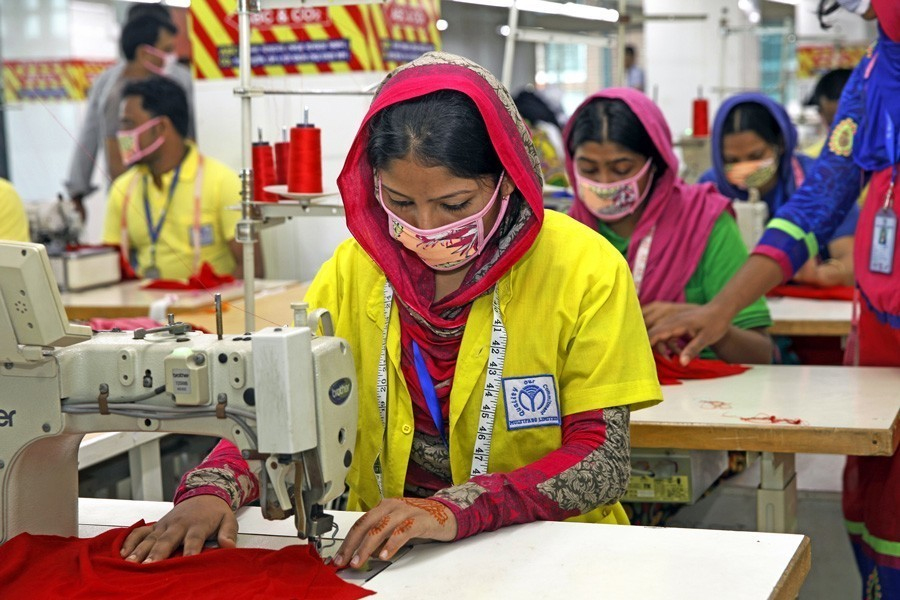
A file photo shows workers sewing clothes at a RMG factory in Narayanganj. | New Age photo

Bangladesh’s readymade garment export has been hit hard as global demand slows amid economic sluggishness across major markets, exporters and experts said.

They said the slowdown has deepened following the revival of Trump-era tariff policies in the United States, which have reshaped global trade by raising costs across the value chain and heavily impacting fashion.

Buyers have been forced to scale back orders for apparel as consumers prioritise essential spending over discretionary items like clothing, they added.

Moreover, fluctuating inflation in key markets — especially the US, Europe, and the United Kingdom — has reduced consumers’ appetite for new apparel, forcing retailers to move from placing large orders to making smaller, more cautious purchases.

According to Export Promotion Bureau data, RMG exports declined for four consecutive months.

In November 2025, the sector earned $3.14 billion, a 5 per cent fall from $3.30 billion in November 2024. In October 2025, receipts dropped to $3.00 billion, an 8.39 per cent decline from $3.30 billion in October 2024.

In September 202,5, exporters shipped apparel worth $2.84 billion, down 5.66 per cent from $3.01 billion in September 2024. In August 2025, receipts were $3.17 billion, a 4.75 per cent fall from $3.32 billion in August 2024.

Speaking to New Age, Sparrow Group managing director Shovon Islam said the December–March period typically brings higher export volumes as factories ship summer and spring collections, but this year orders were visibly lower.

‘Orders have declined by at least 5–10 per cent so far, and the impact has hit knitwear and basic-item manufacturers the hardest,’ he said.

He added that orders from the EU, UK, and US have dropped sharply as the global trading environment is in turmoil following the imposition of the US tariff.

‘Prices went up after the tariff, but buyers’ budgets did not, so they simply reduced purchase volumes. If they used to buy three units, now they opt for one,’ he said.

He said the demand contraction has been most pronounced in basic and mid-tier segments, while sales of children’s wear, women’s wear, and high-value items have remained relatively stable.

Exporters warned that if the pattern continues, the industry could face tighter margins and employment pressures, particularly among small and mid-sized factories dependent on low-margin basic products.

McKinsey & Company, in its State of Fashion 2026 Outlook, said challenges in the fashion sector persist, with concerns over consumer confidence.

The report noted that 70 per cent of respondents saw consumer confidence and appetite to spend as significant risks throughout 2025, and that similar concerns, including geopolitical instability (67 per cent), economic volatility (32 per cent), and inflation (28 per cent), would persist into 2026.

The report also said that fashion markets in the US, EU, and China have been growing at only low single-digit rates as consumer sentiment remains weak, a trend that could continue into 2026.

In 2025, the US government introduced expansive new import duties that hit apparel and leather products especially hard; trading partners have responded with countermeasures, leaving global supply chains in flux.

The report added that brands are optimising efficiency to offset margin pressures by renegotiating supplier terms, consolidating shipments, streamlining assortments, and improving logistics.

Bangladesh Bank’s quarterly data also noted that RMG exports are facing growing headwinds from trade policy shifts and fluctuations in global demand.

Fazlee Shamim Ehsan, executive president of the Bangladesh Knitwear Manufacturers and Exporters Association, said the impact of the US tariff is already visible in EU markets.

‘Global demand for RMG has declined, affecting most exporters. Consumers have changed their buying practices,’ he told New Age.

He added that discount events in destination markets, such as Black Friday, have shifted buying practices as consumers on tight budgets postpone or concentrate purchases on sales.

Exporters also said that Indian and Chinese firms are pushing into EU markets, intensifying competition and squeezing Bangladesh›s market share.

Inamul Haq Khan, senior vice-president of the Bangladesh Garment Manufacturers and Exporters Association, said buyers are cutting back on orders and that Chinese and Indian exporters are redirecting shipments to Europe to avoid US tariffs.

This, he said, has put additional pressure on Bangladeshi exporters.

A head of business development at a multinational buying agency, speaking on condition of anonymity, told New Age the US tariff has reshaped global buying practices and reduced overall imports.

‘Consumers curtailed their clothing expenses, which forced us to place fewer orders. Inflation and economic pressures in the US, UK and EU have made us go slow,’ the official said.

Professor Mustafizur Rahman, a distinguished fellow of the Centre for Policy Dialogue, said that global growth has been weakening, negatively affecting trade.

The UN’s World Economic Situation and Prospects report (released in May) described the global economy as passing a “nervous time”. It revised the world growth forecast for 2025 down to 2.4 per cent from an earlier 2.8 per cent projected in January.

‘This is not a recession, but the slowdown is affecting most countries and regions,’ said Shantanu Mukherjee, director of the Economic Analysis and Policy Division of UN DESA.

Professor Mustafizur said Bangladesh must improve productivity, competitiveness, and efficiency to attract orders that may shift from competitors.

‘The government and manufacturers must focus on increasing competitiveness given the global economic outlook,’ he added.

Shovon Islam urged the government to restore particular policy supports.

‘We used to get 4 per cent incentives for exporting to new markets; that has been reduced to 2 per cent. If we had the earlier rate, we could offer discounts and other facilities to potential buyers,’ he said.

Exporters said Bangladesh needs to focus on competitiveness, innovation, and market and product diversification to remain competitive.

Mohiuddin Rubel, additional managing director of Denim Expert Limited and former director of BGMEA, said that despite fluctuations in global demand, Bangladesh has managed to maintain its position.

‘However, the decline in orders in the knitwear segment is giving us a clear warning, without exploring new markets, diversifying products, and investing in technology, it will be difficult to sustain future growth,’ he added.

In FY25, Bangladesh exported RMG worth $39.34 billion to global destinations, an 8.84 per cent increase from $36.15 billion in FY24.​
 

Climate change reducing RMG productivity
Finds BIDS study

1765156099592.webp

File photo of a garment factory/Star

Climate change is already denting production in Bangladesh's garment factories as rising temperatures reduce worker productivity, according to a study presented today.

The research, titled "Global Value Chains and Climate Change Governance: Garment Producers' Futures", said excessive heat inside factories poses a major barrier to social upgrading.

Mohammad Harunur Rashid Bhuyan, senior research fellow at the Bangladesh Institute of Development Studies (BIDS), carried out the work with Rachel Alexander. He presented the findings at a session of the Annual BIDS Conference on Development in Dhaka.

The study noted that climate refugees are increasingly taking up jobs in the garment sector. As their numbers rise, more may enter the workforce, which "may have negative impacts on wages".

Moreover, it said climate pressures could heighten gender-based violence and harassment as productivity falls and socio-economic vulnerability increases.

The global garment industry is a major emitter of greenhouse gases (GHG), releasing between 1.025 billion and 3.29 billion tonnes of CO2e. This represents 2 percent to 7 percent of total worldwide emissions.

Fossil fuel-based energy across apparel production stages remains the main source of emissions, according to the study.

It said fertiliser and pesticides used in cotton farming and the production of polyester contribute heavily. During manufacturing, emissions are generated by sewing machines, production lines, and heating, ventilation and air conditioning systems.

The study said pressures to cut emissions may support environmental improvements in factories, although the shift to green energy in Bangladesh remains slow.

The government has pledged to produce at least 30 percent of electricity from renewable sources by 2041. Yet only 1.4 percent of Bangladesh's electricity in 2019 came from renewables.

The study said factories depend almost entirely on the national grid, which needs to be "green for environmental upgradation of this sector".

The government's Industry Policy 2022 encourages cleaner industrial practices by promoting effluent treatment plants, central ETPs, and assistance for industries seeking to apply clean development management to control greenhouse gases.

Producers, however, face steep costs, limited access to finance, technical constraints, and inadequate information and equipment, according to the study.

'UNIONISED WORKERS EARNING MORE'

A separate study at the event examined wage patterns among manufacturing workers. Mahmudul Hasan, research associate at BIDS, said unionised workers consistently earn higher wages across all model specifications.

The study found that even after full controls, unionisation remains a strong determinant of earnings.

For garment workers, wages are 19 percent to 22 percent higher due to stronger compliance, formal structures, and higher skill intensity.

The research found no significant wage difference between unionised and non-unionised garment workers once characteristics and compliance were taken into account.

Within the RMG sector, unions advocate for both unionised and non-unionised staff. Spillover effects and compliance norms help lift garment workers' wages above those in non-RMG industries.

Unionised RMG workers earn markedly more than both non-unionised RMG staff and non-unionised workers in other sectors, the study said.

It added that 11.35 percent of manufacturing workers are unionised overall, earning about 10 percent more than non-unionised workers. Higher wages in RMG may reflect stronger compliance, more effective unions, formal structures, and greater skill intensity.

'TECHNOLOGY LIFTING PRODUCTIVITY'

The third study assessed technology use across industrial sectors.

Kazi Zubair Hossain, research associate at BIDS, said annual productivity growth in the garment sector reached 4.19 percent for 2014-2023 due to technological improvements.

RMG firms producing jackets recorded the fastest growth at 6.59 percent a year. Knit-lingerie followed at 6.43 percent and sweater production at 6.05 percent.

Home textiles grew by 5.58 percent, and T-shirt production by 4.39 percent. In contrast, woven shirts rose by 3 percent, woven trousers by 1.15 percent, and denim by 1.81 percent over the same period, the study said.

BIDS Research Director Mohammad Yunus moderated the session.​
 

Brazil becomes Bangladesh’s top cotton supplier, surpassing India
1765243329412.webp


Brazil has emerged as the main supplier of raw cotton for Bangladesh, one of the world's top cotton importers and the second-largest garment exporter, surpassing neighbouring India, according to a US Department of Agriculture (USDA) report.

In the marketing year 2024–25 (MY25), beginning in August, Bangladesh imported 8.28 million bales of raw cotton. Brazil supplied about 1.9 million bales, accounting for 23 percent of total imports.

Google News LinkFor all latest news, follow The Daily Star's Google News channel.
India was the second-largest supplier with 1.4 million bales, followed by Benin (1.06 million bales), Cameroon (616,538 bales), and the United States (595,902 bales).

The USDA report said that Brazilian cotton has become popular among Bangladeshi spinners due to its competitive pricing, wide availability during harvest, and stable supply.

In MY24, India was the top supplier, exporting 1.79 million bales (23 percent share). Bangladeshi importers mainly bought Indian cotton for shorter shipment times via the Kolkata and Benapole ports, despite higher prices and some quality issues.

For the current marketing year, MY26, the USDA forecasts Bangladesh's cotton imports at 8.4 million bales, a 1.4 percent increase from MY25, driven by higher usage by local spinners. This is 5.2 percent higher than the 7.8 million bales imported in MY24.

The report highlighted that cotton imports remained stable throughout MY25, despite early disruptions in RMG production following the formation of a new interim government in August 2024 after former prime minister Sheikh Hasina fled amid a student-led uprising in July.

Domestic cotton production is, however, expected to remain unchanged at 153,000 bales, limited by land scarcity and the long growing period, with cotton cultivated on 45,000–46,000 hectares.

Bangladesh's textile industry has the capacity to consume about 15 million bales annually, depending on raw material availability, power supply, and yarn demand.

Currently, only half of this capacity is being used, with raw cotton consumption estimated at 8.3 million bales in MY25. The USDA projects consumption will rise to 8.5 million bales in MY26, a 2.4 percent increase, driven by higher expected imports.

The spinning industry uses raw cotton to produce cotton and blended yarn, with yarn production expected to increase to 1.9 million tonnes in MY26 from 1.7 million tonnes.

Despite rising raw cotton imports and usage, Bangladesh's readymade garment industry is still expected to import more yarn and fabric.

India remains the largest supplier of cotton yarn to Bangladesh due to its large spinning industry, shorter shipment times, and lower logistics costs, while China is the top fabric exporter, followed by Pakistan and India.​
 

BGMEA seeks Chinese investment in man-made fibre

1765501875546.webp


Leaders of the Bangladesh Garment Manufacturers and Exporters Association (BGMEA) today sought cooperation from the Chinese investors for joint-venture investment in manmade fibre (MMF), chemical and renewable energy.

The request was made during a meeting between the BGMEA officials and a visiting Chinese delegation held at the BGMEA office in Dhaka.

China, the largest garment exporter globally, currently holds over 30 percent of the international garment market, though its share has declined in recent years.

The country is also the largest supplier of MMF products and is exploring alternative production destinations in other countries to reduce costs.

At the meeting, Inamul Haq Khan, senior vice-president of BGMEA, said Bangladesh is focusing on technology upgrades, advanced machinery, and MMF-based production to remain competitive in global markets.

He urged Chinese investors to explore joint ventures in MMF textiles, chemicals, and renewable energy, which he said would reduce costs and shorten lead times for apparel exporters.

Khan also highlighted cooperation opportunities in AI-driven manufacturing, integrated supply chain systems, 3D photo production, and digital product passports as critical for Bangladesh's post-LDC graduation challenges.

BGMEA Director Faisal Samad emphasised the need for frequent engagement between businesses of both countries, proposing a coordination meeting in January supported by Betttex Industries.

He also suggested signing a memorandum of understanding (MoU) with the Cheung Kong Graduate School of Business (CKGSB) to enhance collaboration in education and research.

Samad noted that since Bangladesh imports a significant volume of fabrics from China, business disputes occasionally arise.

Having a Chinese law firm available for dispute resolution, he said, would benefit companies on both sides by providing a reliable platform for settling commercial issues.

The Chinese delegation expressed interest in joint investments in renewable energy and other emerging sectors.

They also invited BGMEA leaders to visit major fabric-manufacturing hubs in China and agreed to meet again in January.

Key members of the Chinese delegation included information technology (IT) and supply chain specialists Yi Shanwei, chairman of Weihai Bettex, and Yi Ran, project manager; Luo Fei, chairman of Beijing Mofeng Technology; and Gao Bin, president of Nanjing Zhiyi Network Technology.

From the textile and fabrics sector, attendees included Shen Hanxin, CEO of Fast Powder; Luan Rundong, executive director of Changzhou Jinhe Investment; and Quan Shouli, general manager of Suzhou Youwo Rui New Materials Technology.

Currently, China remains Bangladesh's largest source of imported raw materials, including fabrics, chemicals, and accessories for export-oriented garment items.

Many Chinese investors are exploring opportunities in Bangladesh due to higher US tariffs on Chinese products, while global brands are increasingly relocating some work orders from China to countries such as Bangladesh, Vietnam, Thailand, and Myanmar to reduce production costs and mitigate supply chain risks.​
 

Members Online

Latest Posts

Latest Posts