Bangladesh Defense
Saif
Senior Member
- Jan 24, 2024
- 21,561
- 9,760
- Nation

- Residence
- Axis Group


Does the US-Bangladesh trade deal mirror colonial economics?
One might hear this and think it is history. But move forward 150 years to twenty-first-century Bangladesh, and the same story appears to be repeating itself.
Does the US-Bangladesh trade deal mirror colonial economics?
Moshahida Sultana Ritu
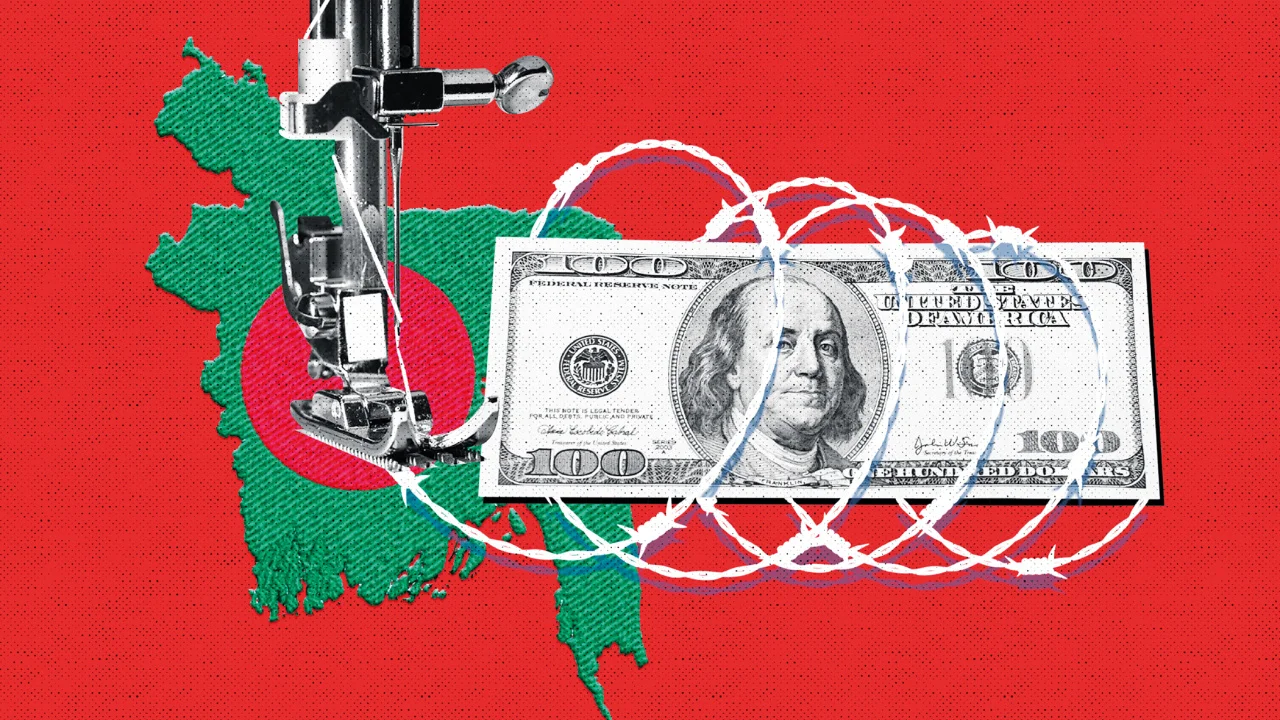
Imagine a cotton farmer standing in a field somewhere in nineteenth-century India. The sun overhead, cotton plants in the soil, yet control over his life is not in his hands. How much land tax he must pay, at what price he can sell cotton, how much rail freight he must pay to carry cotton to the port—these are decided in distant offices, on the tables of policymakers in London and Calcutta.
Under British rule, raw cotton, jute, and various other raw materials flowed out of India across the seas toward the mills of Lancashire and Manchester. Inside those mills, the engines of the Industrial Revolution turned raw cotton into thread and cloth. Through this process, Britain built its capital, advanced its technology, and consolidated its class power.
What happened next? The cloth made in Lancashire, shipped by sea and rail straight to Indian towns, ports, and marketplaces, came back to India. Tariffs and rail fares were deliberately structured to prevent domestic weavers and local industries from competing. Murshidabad muslin and regional weaving traditions were gradually destroyed, replaced by British cloth as the default. Indian farmers were reduced to cheap raw-material suppliers and Indian consumers to a captive market, while real profits and control flowed to Lancashire factories.
One might hear this and think it is history. But move forward 150 years to twenty-first-century Bangladesh, and the same story appears to be repeating itself.
Now imagine a garment factory in Tongi, Narayanganj, or Gazipur. Thousands of workers, large knitting and dyeing units, pressure from export orders, production running round the clock—the heartbeat of Bangladesh’s largest export sector. On paper, this sector is an important part of the global value chain. Then a new condition appears: a trade agreement with the United States.
Even if names are not mentioned, the message is clear: steer clear of Russia and China. Bit by bit, Bangladesh’s defence purchases are nudged towards a single ecosystem—American platforms, American ammunition, American software and encryption, American spare parts—each stage subject to U.S. export licences, with public funds flowing into American defence firms.
The condition sounds attractive: “We will import ready-made garments from Bangladesh at zero tariff—but on one condition: those garments must be made from cotton and fibres produced by us.” On paper, it looks like a great opportunity—zero tariffs mean lower prices in the U.S. market, more orders, and more employment.
But look a little deeper and the shadow of the old story appears. An exporter now calculates that if it uses cotton from Africa, Brazil, or India, the garment will face a 19% tariff; if it uses U.S. cotton, the tariff is zero. Mathematically, it quickly becomes clear that, without using U.S. cotton fibre, the risk of losing market access is high. Gradually, Bangladesh’s spinning mills, fabric suppliers, and logistics chains begin to orient themselves toward U.S. raw materials. Market pressures push suppliers away from other sources of cotton or fibre.
What does this mean? The tremendous labour, investment, and skills accumulated in Bangladesh’s garment sector now increasingly depend on U.S. cotton and U.S. agricultural policy—how much they produce, the subsidies they offer, the markets they serve, and the prices they set. If those policies change one day, if cotton shifts to other markets, or if new conditions are imposed, the shock will hit Bangladeshi factories, workers’ jobs, and bank loans directly.
Just as nineteenth-century Lancashire–India ties turned India into a supplier of raw materials and a captive market for finished goods, today’s “zero duty, but you must use our cotton” type agreements are tying Bangladesh’s largest export sector to the upstream supply chains of U.S. agricultural and corporate interests. Today the name is a trade agreement and the framing is “partnership”, but the underlying story is not unfamiliar. Just as Lancashire’s mills once determined the fate of Indian cotton, agricultural-industrial policy emerging from Washington and Texas today can shape the future of Bangladesh’s garment factories.
Imagine the late nineteenth-century British Empire boasting, “We are protecting India.” The British Raj showcased red-coated soldiers, polished police, and gleaming barracks as proof that the empire had brought “order” to a supposedly troubled land.
Publicly, it is about “maritime security” and “threat response”. But the budget books reveal the old colonial logic in a modern uniform: a dependent state’s foreign-exchange reserves used to secure profits for foreign arms companies. The louder the talk of “shared security”, the more money drains from Dhaka into distant corporate headquarters.
Official reports rarely spelt out another truth: who paid for that “order” and whose pockets were being filled. When the British Indian Army needed guns, orders did not go to a craftsman in Meerut or a workshop in Calcutta. They went to Birmingham and Enfield. When uniforms were stitched, the cloth came from British mills. Contracts to build or repair railway wagons and steamers for military transport landed on the desks of British companies. Money left India’s treasury but did not vanish into thin air; it circulated back into the hands of British arms manufacturers and suppliers—ostensibly to sustain Britain’s military power in Asia.
On paper, it was all about “security”. In reality, it was a pipeline: Indian taxpayers’ money flowed in at one end, while British weapons manufacturers and suppliers collected the profits at the other. The more the British spoke of “security”, the deeper the empire’s commercial roots dug themselves in.
Times and places have changed. Bring the scene to Dhaka today. The words are different now—“strategic partnership”, “interoperability”, “regional stability”. Uniforms and flags are different. But listen beneath the rhetoric, and the old script speaks in a new tongue.
Modern trade and defence agreements carry subtle but sharp pressures—buy more American surveillance systems, communications gear, and precision munitions. Diplomatic language may hint, sometimes bluntly, that certain suppliers should be avoided. Even if names are not mentioned, the message is clear: steer clear of Russia and China. Bit by bit, Bangladesh’s defence purchases are nudged towards a single ecosystem—American platforms, American ammunition, American software and encryption, American spare parts—each stage subject to U.S. export licences, with public funds flowing into American defence firms.
Publicly, it is about “maritime security” and “threat response”. But the budget books reveal the old colonial logic in a modern uniform: a dependent state’s foreign-exchange reserves used to secure profits for foreign arms companies. The louder the talk of “shared security”, the more money drains from Dhaka into distant corporate headquarters.
And the story does not stop at weapons.
Consider trade rules: Bangladeshi garments may enter duty-free, provided the cotton and fibres used are produced in the United States. At first glance, this may seem generous—imperial preference, reversed. Unlike colonial times, zero duty on garment products is presented as a special trade advantage granted to poorer countries. But beneath the headline, the same imperial trade strategy is at work. The language has changed and contracts are digital, but the plot is familiar: behind the mask of security and market access runs another project—one that empties a nation’s treasury into corporate rent abroad.
Just as nineteenth-century Lancashire–India ties turned India into a supplier of raw materials and a captive market for finished goods, today’s “zero duty, but you must use our cotton” type agreements are tying Bangladesh’s largest export sector to the upstream supply chains of U.S. agricultural and corporate interests. Today the name is a trade agreement and the framing is “partnership”, but the underlying story is not unfamiliar. Just as Lancashire’s mills once determined the fate of Indian cotton, agricultural-industrial policy emerging from Washington and Texas today can shape the future of Bangladesh’s garment factories.
By the late nineteenth century, when steam engines first began chuffing into life, they did more than carry passengers—they carried an entire system. Carriages, engines, and military equipment made in London were bought outright. Indian revenues paid for them, and British industry profited.
When a newly purchased Boeing aircraft arrives and people cheer on the runway at Hazrat Shahjalal International Airport, that celebration may mask a new chain of dependency. The deal comes as a package—the aircraft, training, a servicing network, and dollar-denominated financing—driven partly by political leverage as much as by commercial need. For a poor country, such a purchase means long-term foreign-currency debt, with instalments and interest paid in dollars. These obligations divert budget resources away from health, education, and local infrastructure. Often, cheaper purchasing or leasing alternatives are available elsewhere, or the new aircraft may not even be essential for the main routes and level of demand.
Buying a Boeing appears on paper as “advanced aviation” and “a modern fleet”. In reality, these deals are priced in dollars, taken on through long-term loans or leases, and tied indefinitely to American parts, software, maintenance, and training. Even before such contracts fully take effect, Bangladesh’s imports of aircraft engines from the United States have already risen from Tk 137 crore to Tk 1,852 crore. Even if passenger forecasts prove wrong or the national airline becomes corrupt or inefficient, loan repayments will continue, forcing the public to bear the losses and draining foreign-currency reserves. For a debt-burdened economy, this is literally a recipe for a debt trap.
British policy hollowed out local textile mills—tariffs, credit rules, and infrastructure were arranged to favour imported goods, so even where laws did not explicitly bar competitors, the market was structured for the convenience of British cloth. Indian weavers sat idle. Their skills gradually began to disappear, and British cloth became, for most consumers, the only practical choice. What began as trade slowly evolved into a system of dependence.
A century and a half later, under a U.S. trade deal, Bangladesh is now obliged to buy $15 billion worth of LNG from the United States over 15 years. According to the National Board of Revenue (NBR), imports from the United States during January–April approximately doubled, while 83% of the total import bill was spent on only ten specific products worth Tk 15,884 crore. At the top of that list is LNG (Tk 4,913 crore), followed by LPG (Tk 3,105 crore). Meanwhile, the price of a 12-kg LPG cylinder in Bangladesh’s local market rose twice and is now Tk 599 higher than it was in March, reaching Tk 1,940. People with low incomes are already bearing the burden.
Bangladesh is already gas-dependent and burdened with foreign debt. The LNG import obligation will not stop at buying fuel: financing will also be needed for pipelines and regasification terminals. Once that infrastructure is in place, it will be difficult to escape LNG dependence over a 15-year horizon. It will also make the expansion of cheaper alternatives or renewables harder, politically riskier, and more costly. The deal will steer incentives—determining which power plants are built, which industries grow, and which technologies receive investment—thereby narrowing policymakers’ real options for choosing cheaper fuels.
Long ago, British rulers shaped India’s economy so that resources produced in India and markets within India would ultimately secure profits for British factories. Today’s trade deals replay that old political-economic logic—only the name has changed; the strategy remains the same. On paper, there is independence and voluntary agreement; in practice, there is a subtle technique for keeping the economies of less powerful countries effectively captive over the long term.
Legally, the world is no longer what it was in the colonial era. Bangladesh today is a sovereign state. But from a political-economic perspective, the resemblance to colonial times is disquieting. Like colonial treaties, these agreements reflect asymmetric power relations, deep dependence, and long-term compulsory purchases. Even without formal colonisation, trade deals with the United States effectively mortgage Bangladesh’s future policy independence to serve U.S. commercial and geopolitical interests—and that is where today’s trade agreements echo colonial-style pacts. Treating such agreements with reverence is tantamount to welcoming a new colonial chain.
Dr. Moshahida Sultana is an Associate Professor in the Department of Accounting at the University of Dhaka.
Moshahida Sultana Ritu
Imagine a cotton farmer standing in a field somewhere in nineteenth-century India. The sun overhead, cotton plants in the soil, yet control over his life is not in his hands. How much land tax he must pay, at what price he can sell cotton, how much rail freight he must pay to carry cotton to the port—these are decided in distant offices, on the tables of policymakers in London and Calcutta.
Under British rule, raw cotton, jute, and various other raw materials flowed out of India across the seas toward the mills of Lancashire and Manchester. Inside those mills, the engines of the Industrial Revolution turned raw cotton into thread and cloth. Through this process, Britain built its capital, advanced its technology, and consolidated its class power.
What happened next? The cloth made in Lancashire, shipped by sea and rail straight to Indian towns, ports, and marketplaces, came back to India. Tariffs and rail fares were deliberately structured to prevent domestic weavers and local industries from competing. Murshidabad muslin and regional weaving traditions were gradually destroyed, replaced by British cloth as the default. Indian farmers were reduced to cheap raw-material suppliers and Indian consumers to a captive market, while real profits and control flowed to Lancashire factories.
One might hear this and think it is history. But move forward 150 years to twenty-first-century Bangladesh, and the same story appears to be repeating itself.
Now imagine a garment factory in Tongi, Narayanganj, or Gazipur. Thousands of workers, large knitting and dyeing units, pressure from export orders, production running round the clock—the heartbeat of Bangladesh’s largest export sector. On paper, this sector is an important part of the global value chain. Then a new condition appears: a trade agreement with the United States.
Even if names are not mentioned, the message is clear: steer clear of Russia and China. Bit by bit, Bangladesh’s defence purchases are nudged towards a single ecosystem—American platforms, American ammunition, American software and encryption, American spare parts—each stage subject to U.S. export licences, with public funds flowing into American defence firms.
The condition sounds attractive: “We will import ready-made garments from Bangladesh at zero tariff—but on one condition: those garments must be made from cotton and fibres produced by us.” On paper, it looks like a great opportunity—zero tariffs mean lower prices in the U.S. market, more orders, and more employment.
But look a little deeper and the shadow of the old story appears. An exporter now calculates that if it uses cotton from Africa, Brazil, or India, the garment will face a 19% tariff; if it uses U.S. cotton, the tariff is zero. Mathematically, it quickly becomes clear that, without using U.S. cotton fibre, the risk of losing market access is high. Gradually, Bangladesh’s spinning mills, fabric suppliers, and logistics chains begin to orient themselves toward U.S. raw materials. Market pressures push suppliers away from other sources of cotton or fibre.
What does this mean? The tremendous labour, investment, and skills accumulated in Bangladesh’s garment sector now increasingly depend on U.S. cotton and U.S. agricultural policy—how much they produce, the subsidies they offer, the markets they serve, and the prices they set. If those policies change one day, if cotton shifts to other markets, or if new conditions are imposed, the shock will hit Bangladeshi factories, workers’ jobs, and bank loans directly.
Just as nineteenth-century Lancashire–India ties turned India into a supplier of raw materials and a captive market for finished goods, today’s “zero duty, but you must use our cotton” type agreements are tying Bangladesh’s largest export sector to the upstream supply chains of U.S. agricultural and corporate interests. Today the name is a trade agreement and the framing is “partnership”, but the underlying story is not unfamiliar. Just as Lancashire’s mills once determined the fate of Indian cotton, agricultural-industrial policy emerging from Washington and Texas today can shape the future of Bangladesh’s garment factories.
Imagine the late nineteenth-century British Empire boasting, “We are protecting India.” The British Raj showcased red-coated soldiers, polished police, and gleaming barracks as proof that the empire had brought “order” to a supposedly troubled land.
Publicly, it is about “maritime security” and “threat response”. But the budget books reveal the old colonial logic in a modern uniform: a dependent state’s foreign-exchange reserves used to secure profits for foreign arms companies. The louder the talk of “shared security”, the more money drains from Dhaka into distant corporate headquarters.
Official reports rarely spelt out another truth: who paid for that “order” and whose pockets were being filled. When the British Indian Army needed guns, orders did not go to a craftsman in Meerut or a workshop in Calcutta. They went to Birmingham and Enfield. When uniforms were stitched, the cloth came from British mills. Contracts to build or repair railway wagons and steamers for military transport landed on the desks of British companies. Money left India’s treasury but did not vanish into thin air; it circulated back into the hands of British arms manufacturers and suppliers—ostensibly to sustain Britain’s military power in Asia.
On paper, it was all about “security”. In reality, it was a pipeline: Indian taxpayers’ money flowed in at one end, while British weapons manufacturers and suppliers collected the profits at the other. The more the British spoke of “security”, the deeper the empire’s commercial roots dug themselves in.
Times and places have changed. Bring the scene to Dhaka today. The words are different now—“strategic partnership”, “interoperability”, “regional stability”. Uniforms and flags are different. But listen beneath the rhetoric, and the old script speaks in a new tongue.
Modern trade and defence agreements carry subtle but sharp pressures—buy more American surveillance systems, communications gear, and precision munitions. Diplomatic language may hint, sometimes bluntly, that certain suppliers should be avoided. Even if names are not mentioned, the message is clear: steer clear of Russia and China. Bit by bit, Bangladesh’s defence purchases are nudged towards a single ecosystem—American platforms, American ammunition, American software and encryption, American spare parts—each stage subject to U.S. export licences, with public funds flowing into American defence firms.
Publicly, it is about “maritime security” and “threat response”. But the budget books reveal the old colonial logic in a modern uniform: a dependent state’s foreign-exchange reserves used to secure profits for foreign arms companies. The louder the talk of “shared security”, the more money drains from Dhaka into distant corporate headquarters.
And the story does not stop at weapons.
Consider trade rules: Bangladeshi garments may enter duty-free, provided the cotton and fibres used are produced in the United States. At first glance, this may seem generous—imperial preference, reversed. Unlike colonial times, zero duty on garment products is presented as a special trade advantage granted to poorer countries. But beneath the headline, the same imperial trade strategy is at work. The language has changed and contracts are digital, but the plot is familiar: behind the mask of security and market access runs another project—one that empties a nation’s treasury into corporate rent abroad.
Just as nineteenth-century Lancashire–India ties turned India into a supplier of raw materials and a captive market for finished goods, today’s “zero duty, but you must use our cotton” type agreements are tying Bangladesh’s largest export sector to the upstream supply chains of U.S. agricultural and corporate interests. Today the name is a trade agreement and the framing is “partnership”, but the underlying story is not unfamiliar. Just as Lancashire’s mills once determined the fate of Indian cotton, agricultural-industrial policy emerging from Washington and Texas today can shape the future of Bangladesh’s garment factories.
By the late nineteenth century, when steam engines first began chuffing into life, they did more than carry passengers—they carried an entire system. Carriages, engines, and military equipment made in London were bought outright. Indian revenues paid for them, and British industry profited.
When a newly purchased Boeing aircraft arrives and people cheer on the runway at Hazrat Shahjalal International Airport, that celebration may mask a new chain of dependency. The deal comes as a package—the aircraft, training, a servicing network, and dollar-denominated financing—driven partly by political leverage as much as by commercial need. For a poor country, such a purchase means long-term foreign-currency debt, with instalments and interest paid in dollars. These obligations divert budget resources away from health, education, and local infrastructure. Often, cheaper purchasing or leasing alternatives are available elsewhere, or the new aircraft may not even be essential for the main routes and level of demand.
Buying a Boeing appears on paper as “advanced aviation” and “a modern fleet”. In reality, these deals are priced in dollars, taken on through long-term loans or leases, and tied indefinitely to American parts, software, maintenance, and training. Even before such contracts fully take effect, Bangladesh’s imports of aircraft engines from the United States have already risen from Tk 137 crore to Tk 1,852 crore. Even if passenger forecasts prove wrong or the national airline becomes corrupt or inefficient, loan repayments will continue, forcing the public to bear the losses and draining foreign-currency reserves. For a debt-burdened economy, this is literally a recipe for a debt trap.
British policy hollowed out local textile mills—tariffs, credit rules, and infrastructure were arranged to favour imported goods, so even where laws did not explicitly bar competitors, the market was structured for the convenience of British cloth. Indian weavers sat idle. Their skills gradually began to disappear, and British cloth became, for most consumers, the only practical choice. What began as trade slowly evolved into a system of dependence.
A century and a half later, under a U.S. trade deal, Bangladesh is now obliged to buy $15 billion worth of LNG from the United States over 15 years. According to the National Board of Revenue (NBR), imports from the United States during January–April approximately doubled, while 83% of the total import bill was spent on only ten specific products worth Tk 15,884 crore. At the top of that list is LNG (Tk 4,913 crore), followed by LPG (Tk 3,105 crore). Meanwhile, the price of a 12-kg LPG cylinder in Bangladesh’s local market rose twice and is now Tk 599 higher than it was in March, reaching Tk 1,940. People with low incomes are already bearing the burden.
Bangladesh is already gas-dependent and burdened with foreign debt. The LNG import obligation will not stop at buying fuel: financing will also be needed for pipelines and regasification terminals. Once that infrastructure is in place, it will be difficult to escape LNG dependence over a 15-year horizon. It will also make the expansion of cheaper alternatives or renewables harder, politically riskier, and more costly. The deal will steer incentives—determining which power plants are built, which industries grow, and which technologies receive investment—thereby narrowing policymakers’ real options for choosing cheaper fuels.
Long ago, British rulers shaped India’s economy so that resources produced in India and markets within India would ultimately secure profits for British factories. Today’s trade deals replay that old political-economic logic—only the name has changed; the strategy remains the same. On paper, there is independence and voluntary agreement; in practice, there is a subtle technique for keeping the economies of less powerful countries effectively captive over the long term.
Legally, the world is no longer what it was in the colonial era. Bangladesh today is a sovereign state. But from a political-economic perspective, the resemblance to colonial times is disquieting. Like colonial treaties, these agreements reflect asymmetric power relations, deep dependence, and long-term compulsory purchases. Even without formal colonisation, trade deals with the United States effectively mortgage Bangladesh’s future policy independence to serve U.S. commercial and geopolitical interests—and that is where today’s trade agreements echo colonial-style pacts. Treating such agreements with reverence is tantamount to welcoming a new colonial chain.
Dr. Moshahida Sultana is an Associate Professor in the Department of Accounting at the University of Dhaka.