Donate ☕
[🇧🇩] - The U.S.A.---A Strategic Partner of Bangladesh | Page 9 | PKDefense

[🇧🇩] The U.S.A.---A Strategic Partner of Bangladesh

⤵︎
Reply (Scroll)
Press space to scroll through posts
G Bangladesh Defense
[🇧🇩] The U.S.A.---A Strategic Partner of Bangladesh
127
6K
More threads by Saif


Uncle Sam wants you and your social media accounts

1754183201579.webp

Gone are the days when immigration checks were about smuggling muri ghonto in your suitcase. Now, it’s about whether your digital persona is spicy. VISUAL: MAHIYA TABASSUM

They say love means never having to say you're sorry, and apparently, visiting America means having to say, "Here's my Instagram, Facebook, Twitter, LinkedIn, TikTok, Reddit, YouTube, Pinterest, MySpace revival fan page."

Because in 2025, if you're a bright-eyed Bangladeshi student dreaming of the Ivy League or just hoping to pose with a pumpkin spice latte on a New England campus, you'd better come armed not just with academic transcripts or SAT scores, but with public social media profiles, sparkling clean and whiter than the visa officer's poplin shirt.

Yes, the land of freedom, fireworks, and filtered liberties has spoken: your feed shall be examined, dissected, and judged like a reality show contestant who dared to post #DeathToHomework in 2019. It's all part of the US State Department's new diplomatic love language: "I trust you…but let me check your digital footprint anyway."

Under the new rules, all F, M, and J visa applicants—from Fulbright scholars to exchange students—must make their social media public. Because nothing establishes "national security" like trawling through someone's 2018 throwback to a Baishakh selfie with the caption "Dhaka heat is not for the weak."

And what are they looking for, exactly? Evidence of "hostility towards American values." Which is funny, considering how many Americans seem hostile to those same values these days. But I digress.

To be fair, we Bangladeshis know a thing or two about surveillance. We come from a land where criticising the wrong tree on Facebook might lead to a phone call from the forest department. But at least we were subtle about it. The Americans, bless them, are now just upfront: "You want our visas? Strip for the algorithm."

Gone are the days when immigration checks were about smuggling muri ghonto in your suitcase. Now, it's about whether your digital persona is spicy. Did you share a meme that made fun of Trump in 2017? That might be a problem. Did your cousin post a rant about American drone strikes and tag you by mistake? Ruh-roh. Did you once like a reel featuring Palestinian keffiyehs and sad violin music? Pack your bags.

Naturally, the US Embassy in Dhaka has chimed in, reminding Bangladeshi applicants to make their accounts public "to facilitate vetting." Because God forbid someone use their private settings to, you know, protect their privacy. In 2025, privacy is the new profanity. And don't even think of deactivating your account—that's the digital equivalent of setting fire to your fingerprints.

Some say this is just bureaucracy gone wild. Others say it's the globalisation of paranoia, where every border post now doubles as a behavioural psychologist, data analyst, and moral judge. Either way, it's ironic that the same country that gave us Facebook is now penalising us for using it freely.

And what about the geopolitics of it all? Let's be honest: had this rule applied to American tourists going the other way, entire flights to Bali would be grounded over their spring break antics alone. But alas, the power dynamics are clear: we post, they pry.

The Bangladeshi student, once a symbol of ambition and soft diplomacy, is now a walking, talking Excel sheet of hashtags, likes, and filtered sunsets. You are no longer just a human being—you are a risk profile. Did you post too much? You're suspicious. Too little? Also suspicious. Only shared cat videos for five years straight? Definitely hiding something. And let's not even get into the heartbreak of losing your right to "Close Friends" stories.

But take heart, dear applicants. All is not lost. This too shall be archived. Until then, smile, sanitise your timeline, and say a little prayer to the algorithm gods. Because in this new age of diplomacy, your social media isn't just your highlight reel—it's your visa application.

Barrister Noshin Nawal is an activist, feminist, and a columnist for The Daily Star.​
 
Analyze

Analyze Post

Add your ideas here:
Highlight Cite Fact Check Respond

Trump’s budget proposal could leave 200,000 Bangladeshi immigrants without healthcare
Tofazzal Hossain from New York
Updated: 09 Aug 2025, 13: 54

1754791821818.webp

US Capitol Hill Reuters

US President Donald Trump’s ‘One Big Beautiful’ bill could put more than 2 million (20 lakh) low-income Americans and immigrants at risk of losing access to healthcare.

As a result, around 200,000 (2 lakh) Bangladeshi immigrants living across various US states could be affected directly or indirectly. Under this bill, the budget of 2026–27 fiscal year includes cuts of around USD 1 trillion (USD 1 lakh crore) in the healthcare sector.

The proposed major budget cuts to Medicare and Medicaid would hit low-income families and immigrants the hardest. In particular, undocumented individuals would lose access to healthcare. In the United States, it is not possible to purchase medicine without a doctor’s prescription.

The proposed budget provides no guidance or allocation for people with partial mental illness. Many could also lose their jobs in the healthcare sector. Out of the 1,116 pages of the ‘One Big Beautiful’ bill, 48 are devoted to healthcare and pharmaceuticals, meaning many still lack a clear understanding of its full scope.

Sunny Khan, a Bangladeshi immigrant living in the US, said that more than 400,000 Bangladeshis reside in different states including New York, New Jersey, California, Florida, Texas, and Michigan.

Majority of them are engaged in middle and low-income jobs and depend on government assistance for healthcare. Workers in home care, ride-sharing, restaurants, delivery services, and taxi driving would all be affected in various ways.

Dilip Nath, district leader of Assembly District 25, told Prothom Alo about the severity of the proposed budget, saying that around USD 1 trillion (USD 1 lakh crore) would be slashed from the healthcare sector.

Cuts would include USD 793 billion (USD 79,300 crore) from Medicaid and the Supplemental Nutrition Assistance Program (SNAP) for low-income individuals, USD 300 billion (USD 30,000 crore) from the Affordable Care Act, and USD 50 billion (USD 5,000 core) from Medicare.

This would put the healthcare of some 23 million (230 lakh) Americans and between 200,000 and 250,000 (2 to 2.5 lakh) Bangladeshi immigrants at risk. Many home care agencies, day-care centres, and even hospitals could shut down.

In the US, many people aged over 65 live depending on Medicaid. They receive home care, nursing care, and medication costs from government Medicaid funds.

Gias Ahmed, head of Immigrant Elder Home Care, somewhat praising the budget, said that people aged 19 to 64 who have the means but do not work at least 20 hours a week would lose access to Medicaid. For senior citizens aged over 65, there would be no change of services.

“I believe,” Gias added, “that those who work for cash and do not pay taxes regularly, or those who live entirely on government assistance without working, should not have the right to receive government healthcare.”​
 
Analyze

Analyze Post

Add your ideas here:
Highlight Cite Fact Check Respond

US Commercial Counselor meets FBCCI Administrator

BSS
Published :
Aug 19, 2025 18:59
Updated :
Aug 19, 2025 18:59

1755647459600.webp


US Commercial Counselor in Dhaka Paul G. Frost met Administrator of the Federation of Bangladesh Chambers of Commerce and Industry (FBCCI) Md. Hafizur Rahman on Tuesday.

During the meeting held today at the FBCCI office in the capital’s Motijheel area, they discussed issues relating to enhancement of bilateral trade relations, market expansion and mutual cooperation between Bangladesh and the United States.

At the beginning of the discussion, FBCCI Administrator Md. Hafizur Rahman highlighted the longstanding trade relations between Bangladesh and the United States.

Mentioning that the US is one of the largest markets for Bangladesh’s export products, especially ready-made garments, he said this is high time to strike a trade agreement between the two countries to capitalize on trade potentials and supply chain advantages, said an FBCCI press release.

Hafizur also thanked the US government for reducing reciprocal tariffs on Bangladeshi products.

During the meeting, US Commercial Counselor Paul G. Frost stressed the need for strengthening mutual relations, business networks and mutual ties between the US and Bangladeshi entrepreneurs.

He also invited Bangladeshi entrepreneurs and businesses to participate in the upcoming Investment Summit to be held in the United States.

Alongside reinforcing bilateral trade relations, Frost also laid special emphasis on enhancing mutual cooperation between the two countries.

FBCCI Secretary General Md. Alamgir, Head of FBCCI’s International Affairs Wing Md. Zafar Iqbal and Head of the FBCCI Safety Council Brigadier General (retd.) Abu Nayeem Md. Shahidullah were present, among others, on the occasion.​
 
Analyze

Analyze Post

Add your ideas here:
Highlight Cite Fact Check Respond

Washington just rewrote the geopolitical rules. Is Bangladesh ready?

1766193664978.webp

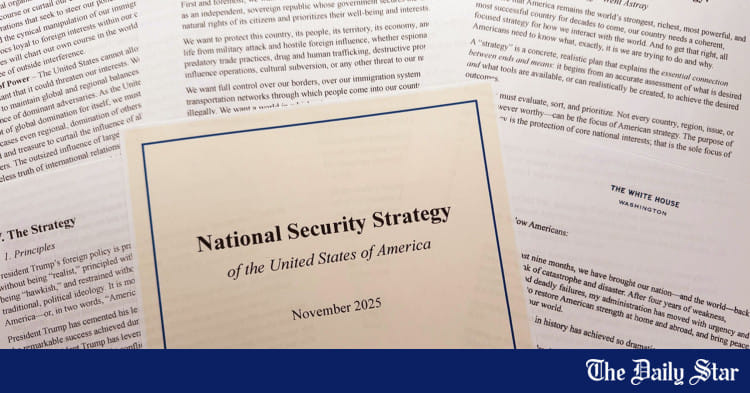
The National Security Strategy of the USA released in November 2025. PHOTO: COLLECTED

In November 2025, Washington did something extraordinary, silently codifying the end of the world order that had shaped global politics since the end of the Cold War. The Trump administration's National Security Strategy (NSS) is not just another policy document; it is a demolition notice—and Bangladesh is standing in the rubble wondering where the exit sign went. It also marks the beginning of a phase of geoeconomic warfare that will hit export-dependent democracies the hardest.

For 30 years, we navigated international politics under the convenient assumption that America's self-interest broadly aligned with promoting democracy, open trade, and rules-based institutions. We could hedge between powers, court Chinese investment while exporting to Western markets, and assume Washington would maintain the basic architecture of globalisation. As Henry Kissinger famously observed, "Power is the ultimate aphrodisiac," and we have been happily hedging between suitors. That world is over, and so is our pendulum swing between suitors.

The Biden administration's 2022 Indo-Pacific Strategy (IPS) promised a region that was "free and open, connected, prosperous, secure, and resilient." It explicitly tied US engagement to democracy, human rights, and international norms. This is basically the language we had learned to speak—and manipulate—for three decades. But the NSS opens by calling that entire project a catastrophic mistake. It accuses post-Cold War elites of betting on globalism and "so-called free trade" that apparently gutted America's factories and allowed US interests to be manipulated by international institutions. This is not campaign rhetoric; it is now official doctrine.

The document also defines American strategy in starkly simple terms: protecting core national interests, period. Foreign policy will be judged by what it delivers to American workers and factories, not by how many democracies Washington "supports" or how many international norms it upholds. Democracy promotion, deradicalisation, humanitarian intervention, and the progressive power of international law are all quietly sidelined, at least for now.

The IPS relied on multilateral frameworks as force multipliers. The NSS, by contrast, describes many of these bodies as infected by "transnationalism" and "anti-Americanism". Every relationship is assessed through a cost-benefit lens: who pays for defence? Who maintains trade surpluses with America? The slogans of "fairness", "no free-riding", and "pro-American worker" appear throughout like a tax accountant's fever dream.

Even on China—where Biden and Trump agree on the threat—the approaches diverge significantly. The Trump administration's strategy is openly mercantilist, featuring tariffs, industrial policy, and geo-economic tools for technology, energy, rare earths, and supply chains.

I wrote in an AMCHAM Bangladesh journal in 2021 that the line between geopolitics and geo-economics was rapidly blurring, with economics becoming a primary tool of strategic defence. That future has now arrived, and frankly, it has come on schedule. The NSS affirms America's economy, industrial base, and technological edge as the core of its national power, asserting that economic security is inseparable from national security. The US has the right to defend that principle, and Alexander Hamilton's warning about dependency, as cited in the NSS, captures a truth every state should heed.

The NSS calls for "balanced trade", rejects what it terms "faith in unfettered globalisation", and signals that tariffs and investment screening will be the primary strategic tools. Interdependence is something to be weaponised or unwound, not a pacifying force. For export-dependent economies like ours, this means interdependence is no longer a guarantee of mutual benefit. So, we'd better get our acts right!

The strategy even embraces what it calls "flexible realism", affirming that there is nothing hypocritical about maintaining close ties with non-democracies if they serve American interests. That candour is refreshing. But it also means that Washington will work with anyone who advances its industrial goals, regardless of their democratic credentials.

For Bangladesh, 2026 will be a complicated concoction of post-LDC graduation, the global rise of protectionism, and intensifying US-China economic rivalry. It is like graduating from school only to discover your degree is worthless—and the economy has collapsed. For the private sector, the tariff threat remains real. We export billions of dollars' worth of garments to America, built on wafer-thin margins and competitive access. Our export model is acutely vulnerable.

For the government, the China dilemma intensifies. Our infrastructure bears deep Chinese footprints in ports, power plants, and telecom networks, while our export engine runs on Western markets. Washington is likely to press for reduced reliance on Chinese technologies. This we cannot afford to comply, but we cannot afford not to comply either. It is the geopolitical equivalent of choosing between your lungs and heart.

As for non-governmental priorities, climate, refugees, and democracy risk becoming blind spots. For one of the world's most climate-vulnerable states, the NSS's rejection of "Net Zero" ideologies is deeply troubling. If US climate finance dries up, we face greater adaptation pressure with fewer resources. And reduced scrutiny over democracy could mean unchecked political realities, whether it be in the form of extremist populism or more refugees waiting at the borders of states.

Clearly, the comfortable era of "friend to all, enemy to none" is ending. We are entering what I described at a recent event in Phnom Penh as "Engage All, Alliance with Balance". A world of geo-economic blocs will be unforgiving. Bangladesh must therefore move from reactive hedging to deliberate strategic statecraft. Yes, that means making difficult decisions. The way I see it, it requires three fundamental shifts.

First, treat economic policy as security policy. Trade agreements, supply chains, digital standards, and port operations are now security concerns. We need a coherent vision for Bangladesh's place in emerging supply chains.

Second, engage major powers without becoming their subordinate. Build coalitions with other middle powers to keep rational options open. Professionalise strategic communication with Beijing, Islamabad, Delhi, and Washington to establish clear red lines on sovereignty and strategic autonomy, and think creatively about new regionalism beyond mere geographical proximity. The NSS, after all, allows Washington to court both Delhi and Islamabad simultaneously: Delhi to share the security "burden" in the Indo-Pacific, and Islamabad for its access to Middle and Central Asia.

Third, upgrade strategic thinking at home. Our 20th-century debates about non-alignment, aid dependency, and reliance on a narrow export basket are no longer sufficient. We need a genuine political and social consensus that places economic transformation and technological upgrading at the centre of foreign and economic policy.

The 2025 NSS delivers a Machiavellian truth: states will increasingly abandon the idea that values, norms, and interests can comfortably coexist. Liberal internationalism is giving way to transactional multipolarity, and weaker states will have to navigate without the shelter of protective norms. For Bangladesh, 2026 will determine whether it adapts or suffers the consequences of pretending otherwise. The old rulebook offered shelter in international law and multilateral institutions. The new one offers specific, conditional, and revocable deals. Bangladesh must learn to negotiate them.​
 
Analyze

Analyze Post

Add your ideas here:
Highlight Cite Fact Check Respond
54.8% Bangladeshi immigrants get US govt benefits: Trump

Trump released an immigrant welfare list on Truth Social on Monday

1767748500511.webp


US President Donald Trump has claimed that 54.8 percent of Bangladeshi immigrant families living in the United States receive government benefits.


On Sunday, Trump released a list on his social media platform, Truth Social, titled "Immigrant Welfare Recipient Rates by Country of Origin", showing which countries' immigrant populations receive the highest levels of government assistance.


In the list of 120 countries, Bangladesh ranks 19th.

The list includes four other countries from South Asia -- Bhutan, ranking first (81.4 percent); Afghanistan, ranking sixth (68.1 percent); Pakistan, 60th (40.2 percent); and Nepal, 90th (34.8 percent).


According to Pew Research Center's 2025 report, the Bangladeshi Population in the US has grown significantly over the past two decades. From 40,000 in 2000, it skyrocketed to 270,000 in 2023, a 569 percent growth.

Countries with the highest rates of government benefit usage: Bhutan, Yemen (75.2 percent), Somalia (71.9 percent), Marshall Islands (71.4 percent), Dominican Republic (68.1 percent), Afghanistan (68.1 percent), Congo (66 percent), Guinea (65.8 percent), Samoa (63.4 percent), and Cape Verde (63.1 percent).

Countries and regions with the lowest rates of government benefit usage: Bermuda (25.5 percent), Saudi Arabia (25.7 percent), Israel/Palestine (25.9 percent), Argentina (26.2 percent), South America (26.7 percent), Korea (27.2 percent), Zambia (28 percent), Portugal (28.2 percent), Kenya (28.5 percent), and Lithuania (29.2 percent).​
 
Analyze

Analyze Post

Add your ideas here:
Highlight Cite Fact Check Respond
What is visa bond, who will pay it, key features of the US programme

Abu Hurairah
Updated: 07 Jan 2026, 20: 31

1767833698432.webp


The US State Department has announced that travellers from 38 countries will need to deposit a bond of up to USD 15,000 (around Tk 1.9 million) before entering the United States. This measure was introduced in mid-last year as part of the Trump administration’s tough, anti-immigration policy. Bangladesh and 24 other countries were added to the list most recently.

Just a week after seven countries were included in the list of nations that require bonds, the State Department added several more yesterday, Tuesday. Previously, six countries had already been added.

This 12-month pilot programme began on 20 August and applies to B-1 (business) and B-2 (tourist) visas. The US introduced this initiative after imposing travel restrictions on 12 countries and implementing new fees for US visa holders. For the newly added countries, the visa bond will take effect from 21 January, except for a few.

According to the temporary final rule published on 5 August in the US Federal Register, the programme targets citizens of countries whose visa holders have historically high rates of overstaying in the United States.


A State Department notice in August, citing various government reports, said: “Since 2000, many foreign nationals enter the US on visas but their departures are not tracked. This shows that every year thousands of non-immigrant visitors do not comply with visa terms and fail to leave the country on time.”

Percentage of visa overstays among immigrants

A report submitted to Congress by the US Department of Homeland Security shows that in the 2023 fiscal year, nearly 390 million visa holders were expected to depart. However, around 400,000 remained in the country after their visa expired.

The US-based Migration Policy Institute notes that a large proportion of illegal immigrants in the country have overstayed their visas, contributing to the overall rise in undocumented residents.

1767833742320.webp


Analysing data from the 1990s, the US Immigration and Naturalization Service (INS) reported in 2002 that nearly 41 per cent of illegal immigrants had overstayed their visas. In 2003, new INS analysis showed that 33 per cent of illegal immigrants in 2000 had overstayed.

More recent research by the Center for Migration Studies indicated that in 2014, about 42 per cent of people residing illegally in the US had overstayed their visas. The same rate was reported for 2024.

Next, let’s take a closer look at what a visa bond is and some key features of the US-announced programme:

Countries under the programme

The US State Department has made visa bonds mandatory for citizens of the following countries, with the bond’s effective date mentioned in brackets:

Bangladesh (21 January 2026), Algeria (21 January 2026), Angola (21 January 2026), Antigua and Barbuda (21 January 2026), Benin (21 January 2026), Bhutan (1 January 2026), Botswana (1 January 2026), Burundi (21 January 2026), Cape Verde (21 January 2026), Central African Republic (1 January 2026), Ivory Coast (21 January 2026), Cuba (21 January 2026), Djibouti (21 January 2026), Dominica (21 January 2026), Fiji (21 January 2026), Gabon (21 January 2026), Gambia (11 October 2025), Guinea (1 January 2026), Guinea-Bissau (1 January 2026), Kyrgyzstan (21 January 2026), Mali (20 August 2025), Mauritania (23 October 2025), Namibia (1 January 2026), Nepal (21 January 2026), Nigeria (21 January 2026), Sao Tome and Principe (23 October 2025), Senegal (21 January 2026), Tajikistan (21 January 2026), Tanzania (23 October 2025), Togo (21 January 2026), Tonga (21 January 2026), Turkmenistan (1 January 2026), Tuvalu (21 January 2026), Uganda (21 January 2026), Vanuatu (21 January 2026), Venezuela (21 January 2026), Zambia (20 August 2025) and Zimbabwe (21 January 2026)

What is a visa bond?

A visa bond is a type of financial guarantee. Some countries require such a bond or assurance before issuing temporary visas to certain foreign nationals, ensuring that they comply with visa conditions, particularly the permitted length of stay.

Every year, the United States issues thousands of temporary non-immigrant visas to students, tourists and workers. The duration of these visas can range from a few weeks to several years.

If a non-immigrant visa holder remains in the US beyond the authorised period, it is considered a visa overstay.

Most countries require proof of sufficient funds to obtain a visa. However, they do not have a system that allows entry in exchange for a refundable bond.

1767833848311.webp

US President Donald Trump speaks in the Roosevelt Room of the White House in Washington, DC, on 3 March, 2025. AFP

New Zealand once introduced visa bonds to control overstays, but this is no longer in effect. In 2013, the United Kingdom attempted to introduce visa bonds for travellers from certain “high-risk” countries, but later scrapped the initiative.

During his first term in office in 2020, the Trump administration also tried to launch a US visa bond programme. However, it was never fully implemented due to the global reduction in travel caused by the COVID-19 pandemic.

Legal basis of the visa bond

The conditions and obligations of a visa bond are detailed under Section 221(g) (3) of the Immigration and Nationality Act (INA) and the Temporary Final Rule (TFR) designed to implement this pilot programme.

The overstay rate, which measures how many citizens remain in the United States beyond their visa expiry, is determined using B1 and B2 category data from the Department of Homeland Security’s Entry/Exit Overstay reports.

Bond amount and who must pay

Any passport holder or citizen of the listed countries, eligible for a conditional B1/B2 visa, must pay the bond. The bond amount may be USD 5,000, USD 10,000 or USD 15,000, and will be determined during the visa interview.

A consular officer will set the bond amount, taking into account the applicant’s personal circumstances, including the purpose of travel, occupation, income, skills and educational qualifications.

According to the temporary final rule published on 5 August in the US Federal Register, the programme targets citizens of countries whose visa holders have historically high rates of overstaying in the United States.

In some cases, the bond requirement may be waived, such as for travel by US government employees or for urgent humanitarian reasons.

Applicants must submit Form I-352 to the Department of Homeland Security and provide consent to the bond conditions through the US Treasury Department’s online payment system, Pay.gov.

These rules apply uniformly, regardless of where in the world the visa application is submitted.


Important Precautions

Applicants must submit Form I-352 to deposit the bond only after instructions from a consular officer.

To pay the bond, applicants will receive a direct link to Pay.gov. Under no circumstances may a third-party website be used for this payment.

Any payment made outside the systems designated by the US government will not be the responsibility of the United States.
1767834016999.webp

US State Department logo
US State Department logoReuters
If anyone deposits the fee or bond without instructions from a consular officer, the money will not be refunded.

Submitting a visa bond does not guarantee that a visa will be issued.

Designated entry and exit points

Under the visa bond programme, visa holders who pay the bond must enter and exit the United States through only the following three airports, known as the ports of entry: Boston Logan International Airport (BOS), John F Kennedy International Airport (JFK) and Washington Dulles International Airport (IAD).

Entry or exit through any other location may result in the revocation of permission to enter the United States or may prevent the departure from being properly recorded.

1767834058558.webp


When the bond will be refunded

The conditions of the visa bond are mentioned in the bond form (Department of Homeland Security Form I-352 Immigration Bonds) and on the Travel.State.Gov website. The bond will be cancelled and the money automatically refunded in the following situations:

• If the visa holder leaves the United States on or before the authorised date of stay and the Department of Homeland Security records the departure; or
• If the visa holder does not travel to the United States before the visa expires; or
• If the visa holder applies to enter through a designated US port of entry and their entry is denied.

Violation of bond conditions

If a visa holder is believed to have violated the visa bond conditions, the matter will be referred from the Department of Homeland Security to the US Citizenship and Immigration Services (USCIS). USCIS will determine whether the bond has indeed been violated. Situations that may be considered a breach of conditions include, but are not limited to:

• Leaving the United States after the authorised period of stay has expired
• Remaining in the United States beyond the authorised period
• Applying to change non-immigrant status, including seeking asylum

Final note

The visa bond is essentially a new measure to strengthen US immigration control. For certain categories of Bangladeshi applicants, it also sends an important message—financial and behavioural credibility will now carry greater weight in the visa process.

In this context, the safest course for travellers is to comply with visa conditions, depart the country on time, and avoid any unofficial channels for payments.

(Source: Al Jazeera, The Independent, and the US Department of State travel website)​
 
Analyze

Analyze Post

Add your ideas here:
Highlight Cite Fact Check Respond
National security adviser on US visit: election and trade on agenda

Diplomatic Correspondent Dhaka
Published: 08 Jan 2026, 19: 40

1767919825367.webp

National Security Adviser Khalilur Rahman File photo

At the start of the new year, US President Donald Trump has taken tougher decisions on remittances, visas and travel. Like several other countries, Bangladesh is viewing two strict measures by the Trump administration as a new source of pressure.

Against this backdrop, National Security Adviser Khalilur Rahman travelled to Washington yesterday, Wednesday, on a five-day visit.

Diplomatic sources in Dhaka and Washington confirmed the visit to Prothom Alo, saying that ahead of the national election scheduled for next month, the election itself and the broader political situation, particularly the process of democratic transition, will be prioritised during the visit.


The agenda will also include a review of decisions taken in discussions with the United States on supplementary tariffs.

The diplomatic sources told this correspondent that, the national security adviser is due to arrive in the US capital on the morning of 7 January local time. Preparations have been made for several meetings over the following two days, on 8 and 9 January.

Sources at the Bangladesh Embassy in Washington said that, according to the draft itinerary, Khalilur Rahman is scheduled to meet Alison Hooker, US Under Secretary of State for Political Affairs.

The meeting will also be attended by Paul Kapur, US Assistant Secretary of State for South and Central Asia, and Sergio Goro, the US Ambassador to Delhi and Special Envoy for South and Central Asia.

In addition, a separate meeting is planned between Brendan Lynch, the US Assistant Trade Representative and national security adviser Khalilur Rahman.

Diplomatic sources from both countries said that US Ambassador-designate to Dhaka Brent Christensen is scheduled to take the oath of office at the US State Department on 9 January. The oath will be administered by either US Secretary of State Marco Rubio or Deputy Secretary of State Christopher Langdahl.

National Security Adviser Khalilur Rahman may attend the ceremony. The new US ambassador to Bangladesh is expected to arrive in Dhaka on 12 January.​
 
Analyze

Analyze Post

Add your ideas here:
Highlight Cite Fact Check Respond
My wife and I are thrilled to return to this country: US ambassador-designate Brent Christensen
Diplomatic Correspondent Dhaka
Updated: 12 Jan 2026, 22: 23


Foreign ministry officials welcome the US ambassador-designate Brent Christensen at Hazrat Shahjalal International Airport, Dhaka on 12 January 2026

1768265686143.webp

Foreign ministry officials welcome the US ambassador-designate Brent Christensen at Hazrat Shahjalal International Airport, Dhaka on 12 January 2026Courtesy US embassy

United States (US) ambassador-designate to Bangladesh Brent T. Christensen expressed his joy upon arriving in Dhaka today, Monday, ahead of formally assuming his diplomatic assignment.

He was accompanied by his wife, Deanne Dao.

He was welcomed by the officials of the foreign ministry and the US embassy.

“It is an honor for me to serve the United States as the 19th ambassador to Bangladesh. I look forward to strengthening the ties between our two countries to advance peace and prosperity in the region. My wife and I are thrilled to return to a country that holds many fond memories for us,” he said.


Ambassador Christensen most recently served as the senior official performing the duties of under secretary of state for arms control and international security from January to October 2025, overseeing global efforts on security cooperation, security assistance, counterterrorism, counternarcotics and nonproliferation.

A career member of the senior foreign service, he previously served as foreign policy advisor to the commander of United States Strategic Command and as counselor for political and economic affairs at the US embassy in Bangladesh.

His overseas assignments also include postings to US missions in the Philippines, El Salvador and Vietnam.

In Washington, he has held a range of senior roles, including deputy director of the Office of Regional Security and Arms Transfers in the Bureau of Political-Military Affairs, Special Assistant to the Special Representative for North Korea Policy, fellow on the US House Committee on Foreign Affairs, and Bangladesh Country Officer in the Bureau of South and Central Asian Affairs.

US ambassador-designate to Bangladesh Brent T. Christensen arrived in Dhaka on 12 January 2026 accompanied by his wife, Deanne Dao

1768265795639.webp

US ambassador-designate to Bangladesh Brent T. Christensen arrived in Dhaka on 12 January 2026 accompanied by his wife, Deanne Dao Courtesy US embassy

Christensen also served as one of two career Foreign Service members on the Foreign Service Impasses Disputes Panel under the U S Federal Labor Relations Authority.

A distinguished graduate of the National War College, he holds a Master of Science in national security strategy, a Master of Science in Statistics from Texas A&M University, and a Bachelor of Arts in Economics and Managerial Studies from Rice University.

He speaks Spanish, German and Vietnamese, and has studied French, Japanese and Portuguese. Prior to joining the US Foreign Service in 2002, Christensen worked as a management consultant in Houston and New York City.​
 
Analyze

Analyze Post

Add your ideas here:
Highlight Cite Fact Check Respond

Members Online

Latest Posts

Latest Posts

Post