Donate ☕
[🇧🇩] - A Tale of British Bengal | PKDefense

[🇧🇩] A Tale of British Bengal

Reply (Scroll)
Press space to scroll through posts
G Bangladesh Defense
[🇧🇩] A Tale of British Bengal
5
1K
More threads by Saif

Saif

Senior Member
Joined
Jan 24, 2024
Messages
16,326
Likes
8,086
Nation

Axis Group

Steam Power and Scientific Knowledge in Early British Bengal
1716161059099.webp

Photo 2 : Detail from "Chandpaul Ghaut. Steam Engine. Supreme Court," by William Wood, A Series of Twenty-Eight Panoramic Views of Calcutta (1833), Plate 1; from the British Library Archive shelfmark 1781.c.22

In Europe, steam power evolved gradually and uncertainly over the course of the eighteenth century, with innovative peaks and long plateaus, from Thomas Savery's steam pump (1698) via Thomas Newcomen's reciprocating atmospheric engine (1712) to James Watt and Matthew Boulton's double-acting rotative steam engine with a separate condenser (1765-90). The first steamer to complete the journey from England to India, the Enterprize (an "auxiliary" paddle ship equipped with sails), left Falmouth on August 16, 1825 and arrived in Calcutta via the Cape of Good Hope a disappointing 113 days later, of which (due to bad weather and exhausted fuel) only 62 were under steam. Between 1822 and 1837, the number of steam engines working in Bengal rose from 2 to 67, and by 1845, according to the Bengal Hurkaru newspaper, there were 150 engines in use (mostly imported). By the end of this period, in 1844, the journalist J.H. Stocqueler could report that "On approaching Calcutta, the smoking chimneys of steam-engines are now seen in every direction, on either side of the river, presenting the gratifying appearance of a seat of numerous extensive manufactories, vying with many British cities."

During the early year of the 19th century, Bengal was becoming the epicenter of an imperial imagination in which steam in particular was firmly fixed as an engine that would diffuse European civilization. The public history of steam power in India begins with three remarkable scenes from the 1820s.

Golak's engine was displayed at the Society's annual exhibition on January 16 at Calcutta's Town Hall. In its report, the Society further emphasized that Golak designed and built the engine "without any assistance whatever from European artists upon the mode, of a large Steam Engine belonging to the missionaries at Serampore," for which the "ingenious blacksmith" was awarded a prize of 50 rupees.

First, just north of Calcutta in the Danish colony of Serampore (Srirampur), on March 27, 1820 the English Baptist missionaries staged a demonstration of their new engine imported from Messrs. Thwaites and Rothwell of Bolton to assist with paper production for the mission press: "The 'machine of fire,' as they called it, brought crowds of natives to the mission, whose curiosity tried the patience of the engineman imported to work it; while many a European who had never seen machinery driven by steam came to study and to copy it."

1716161160062.webp

Photo 1: The Asiatic Journal in London

The second high-profile stationary engine in Bengal went into operation two and a half years later, on November 1, 1822, in Calcutta at Chandpal Ghat to supply water from the Hugli river via aqueducts to the streets of the city's "White Town" in order to keep down the dust.

In the following summer, "At exactly nine minutes past four on Saturday afternoon (12th July) the first steam vessel, which ever floated on the waters of the East," the Diana Packet, "left the stocks at Kyd's Yard, Kidderpore," with a more public launch following on the morning of August 9, when the Diana departed from Chandpal Ghat, "stemming the rapid freshes of the river with a velocity perfectly astonishing." Bearing a party including Colonel Jacob Krefting, Governor of Serampore, and his suite, the Diana steamed to Chinsurah against a strong tide, making the journey in six to seven hours and then returning by way of Serampore, where an "elegant entertainment" had been "prepared for the occasion," arriving back in Calcutta on the next morning.

Here is the account reproduced by The Asiatic Journal in London from The Calcutta Journal in Bengal: (See Photo 1)


All the terms of the Romantic sublime are there, so we expect the minds of the beholders to be awed and elevated, yet their wonder is "stupid," their fears "superstitious," their amazement or astonishment, whether "silent" or "loud," indifferently a sign of utter incomprehension. For Edmund Burke in his famous Enquiry into the Origin of Our Ideas of the Sublime and Beautiful (1757) and, especially, for Immanuel Kant in The Critique of Judgment (1790), what we call sublime does not reside in the object so described but rather in the mind that apprehends it. Kant is explicit that "the judgement upon the Sublime in nature needs culture (more than the judgement upon the Beautiful)": "That the mind be attuned to feel the sublime postulates a susceptibility of the mind for ideas … In fact, without the development of moral ideas, that which we, prepared by culture, call sublime presents itself to the uneducated man merely as terrible." Unprepared by culture, the crowds of natives who gather to see the Baptist missionaries' "machine of fire" in 1820 experienced only an irritating curiosity, while now in 1823 "the more ignorant natives" experience only terror.

Having already noted that "Almost all the heathen temples were dark," Burke, in fact, denominated darkness and blackness themselves as intrinsically terrible objective properties, citing the example of a boy who "saw a black object," which "gave him great uneasiness," and then "some time after, upon accidentally seeing a negro woman, … was struck with great horror at the sight." In accounts of steam as sublime, accordingly, it is the European viewer whose mind is elevated and "admitted … into the Counsels of the Almighty by a consideration of his works." Thus elevated, the European mind is prepared, as The Calcutta Journal concludes its depiction of the Diana Packet, to "promote the cause of science and the arts, and add to the sum of human enjoyments." The native, on the contrary, like a dark, heathen temple, can be an object, not a subject, of the sublime.

During the early years of the 19th century, Bengal was becoming the epicenter of an imperial imagination in which steam in particular was firmly fixed as an engine that would diffuse European civilization.

The crowds that came to witness the Diana dispelling the darkness recall the contrast established in the account of the Serampore engine between collective and childlike native curiosity, which "tried the patience of the engineman," and the individualized and mature curiosity of "many a European who … came to study and to copy it." One Indian not only came to study and copy it, however, but then proceeded to build a working engine based on its design. We do not know if Golak Chandra, blacksmith of Titagarh, immediately opposite Serampore, crossed the river on March 27, 1820 to join the "crowds of natives" curious about the new machine. But he did cross the river to study it many times thereafter: at its meeting on January 9, 1828, the Agricultural and Horticultural Society of India resolved, "at the suggestion of the Rev. Dr. Carey, that permission be given to Goluk-chundra, a blacksmith of Titigur, to exhibit on Wednesday next, a Steam Engine made by himself without the aid of any European artist." Golak's engine was then displayed at the Society's annual exhibition on January 16 at Calcutta's Town Hall. In its report, the Society further emphasized that Golak designed and built the engine "without any assistance whatever from European artists upon the mode, of a large Steam Engine belonging to the missionaries at Serampore," for which the "ingenious blacksmith" was awarded a prize of 50 rupees. A contemporaneous account in the Calcutta Gazette echoed the phrase "without any assistance whatever from European artists" while adding its own praise for the "native ingenuity" and "imitative skill" of the "ingenious Blacksmith."

1716161230433.webp

Photo 4 : Photograph of the model of steam engine preserved at Serampore

The story of Golak Chandra's engine, for scientist and scholar Professor Amitabha Ghosh, demolishes a myth, making the "plotting of Indian dependence as a function of technological incapability even in the era of steam a spurious fabrication." But something else is at stake too in the early nineteenth century. If we zoom out to the context in which this engine was exhibited in 1828, at an exhibition of the Agricultural and Horticultural Society, we find, according to the Society's Prospectus, written by the Baptist missionary William Carey on April 15, 1820, a mere three weeks after the demonstration of the Mission's new steam engine, that "It is peculiarly desirable that Native gentlemen should be eligible as members of the Society, because one of its chief objects will be the improvement of their estates, and of the peasantry which reside thereon. They should therefore not only be eligible as members, but also as officers of the Society in precisely the same manner as Europeans." A further reason why it was peculiarly desirable to associate "Native Gentlemen of landed estates with Europeans who have studied this subject" was that "we should gradually impart to them more correct ideas of the value of landed property, of the possibility of improving it, and of the best methods of accomplishing so desirable an end." Such "improvements" would bring about "the gradual conquest of the indolence which in Asiatics is almost become a second nature, – and the introduction of habits of cleanliness … in the place of squalid wretchedness, neglect, and confusion." Through the diffusion of western science to the native members of the Society, "industry and virtue" would replace "idleness and vice."

In this light, the insistence that Golak's ingenuity was a form of "imitative skill" and the emphasis here on the "improvement" of native estates (Britons being forbidden from owning land) reveal a tension in the period between what historian Kapil Raj has called the later historiographical perspectives of "diffusionism" and "relocationism" with respect to the creation and transmission of scientific knowledge. According to the dominant diffusionist model, science is developed in the West and then spread to the East as "the embodiment of basic values of truth and rationality, the motor of moral, social, and material progress, the marker of civilization itself." Knowledge and technologies are fundamentally stable in function and significance, adapting the new location to the universal values and progress they bear while remaining themselves unmodified by local environment or experience. The alternative "relocationist" perspective proposed by Raj, on the contrary, rooted in the New Imperial History's emphasis on asymmetric circulation and the mutual constitution of Britain and its empire, suggests that "South Asia was not a space for the simple application of European knowledge" but rather "was an active, although unequal, participant in an emerging world order of knowledge … [T]he contact zone was a site for the production of certified knowledges which would not have come into being but for the intercultural encounter between South Asian and European intellectual and material practices."

On the one hand, then, Golak is a "mimic" engineer, copying a European imported prototype and demonstrating the native capacity, in the well-known language of Macaulay's "Minute on Indian Education" (1835), to become "English … in intellect." And the same goes for the 500 native members of the Agricultural and Horticultural Society over the remainder of the nineteenth century, who, for Macaulay, would join the "interpreter" class – "a class of persons, Indian in blood and colour, but English in taste, in opinions, in morals, and in intellect" – prepared "to refine the vernacular dialects of the country, to enrich those dialects with terms of science borrowed from the Western nomenclature, and to render them by degrees fit vehicles for conveying knowledge to the great mass of the population."

1716161298851.webp

Photo 3 : The Enterprize departed Falmouth on August 16, 1825, bound for India. Despite high hopes, its journey to Calcutta via the Cape of Good Hope took a disappointing 113 days, marking the first steamship voyage from England to India.

On the other hand, the activities and language of the Society work against its diffusionist ideology: the "first endeavours" of the Society "would be directed to the obtaining of information upon the almost innumerable subjects which present themselves," and "Native Gentlemen" would thus be essential not just to the civilizing process by which they would receive communicated European science but to the Society's own acquisition of a hybridized "stock of knowledge": "the methods employed to raise crops, and conduct the other parts of rural economy must so vary with soil, climate, and other local circumstances, as to make it impossible for any individual to be practically acquainted with them all. Too much praise can scarcely be given to local establishments whether public or private." Carey, Professor of Bengali, Sanskrit, and Marathi at the College of Fort William and as devout a practical botanist as a Particular Baptist, was far less invested in assimilation and anglicization than the evangelical wing of the Church of England associated with Charles Grant, Zachary Macaulay, and the Clapham Sect, or than Alexander Duff of the Scottish Church Mission: above all, for Carey local circumstances (and languages) were always paramount. And finally, in a moment of reverse-diffusionism, the Agricultural and Horticultural Society of India, founded in 1820 and shaped by intercultural encounter, translation, and local practices, then formed the model for the Royal Agricultural Society of England, founded in 1838.

As the convergence of steam power, science, and colonialism in early British Bengal shows, the relocation of technology undermined the equation between stable knowledge and the transfer of civilization from West to East. From the effect of the Diana's "triumph of science over the elements, on some of the more ignorant natives" to the display of Golak's engine before the annual exhibition of the Agricultural and Horticultural Society of India, the production of knowledge in the contact zone was always a form of hybridization bearing the marks of specific and unequal relationships of power.

Daniel E. White is Professor of English at the University of Toronto, Canada. His new book, Romanticism, Liberal Imperialism, and Technology in Early British India: "The all-changing power of steam," is forthcoming from Palgrave.​
 
Analyze

Analyze Post

Add your ideas here:
Cite Fact Check Highlight Respond

An Iconic History of Bengal
1721085682264.webp

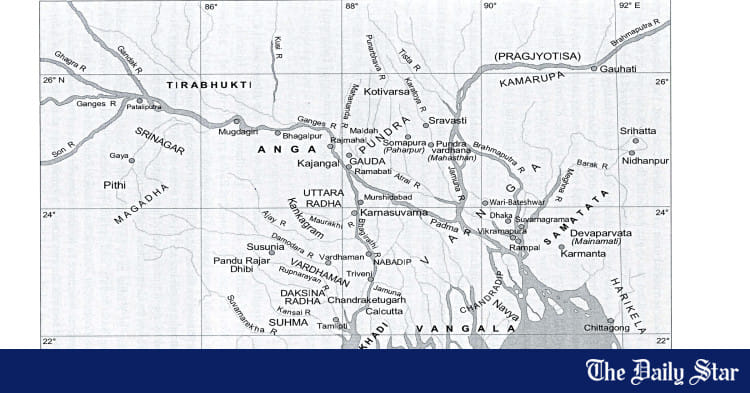
Ancient Map of Bengal. Source: History of Bangladesh, Asiatic Society of Bangladesh, 2018.

In the sixties of the last century, I earned my primary degree with majors in Philosophy and Indian Studies and became a secondary school teacher. The somewhat recently established Indian Studies Department at the University of Melbourne was a very fraternal institution, one with which it was easy to maintain relations even after graduation. The Chairman of the Department was the very reserved Sibnarayan Ray; the Belgian Indologist, Dr. Joseph Jordens, oversaw the classical offerings of the curriculum; and Mr. (soon to be Dr.) Atindra Mojumder, a man of apparently boundless energy and enthusiasm, managed everything else. Atindra-babu told me about a former teacher of his named Dr. Niharranjan Ray and some of his works, including a history of the Bengali people. He suggested that my Bengali was a lot better than I believed and persuaded me to translate Bangalir Itihas or History of the Bengali People and submit it as a footnote to a thesis on its author. After a year, the undertaking was upgraded to a doctoral project, and a few years after that, Bengali Vernacular Historiography: Niharranjan Ray – A Case Study emerged successfully. Almost immediately, the translation was snapped up by Orient Longman; the thesis part took a bit longer to find a publisher (It was published by Sahitya Akademi in Calcutta in its Makers of Indian Literature series).

Bangalir Itihas does, indeed, bring kings, for example, into the scheme of things, though not so much in their own right; rather, royal worthiness is assessed by what kingship might have done for society as a whole, and that obviously includes the common people. So, Ray's History soon came to be known as 'history from the bottom.'

I first met Niharranjan Ray in, I think, 1978. I was staying at the Ramakrishna Mission Guesthouse in Golpark, and from the roundabout in front of the stately building runs Purna Das Road, off the far end of which, near Rashbehari Avenue, ran a lane where the Ray family home stood. So, one Sunday after lunch, I set off with Atindra Mojumder's letter of introduction to meet the great man. I found the house easily and rang the doorbell. I was about to leave after the third ring when the door was opened by an elderly and evidently sleepy man wearing a lungi and a slightly tattered genji. I asked the servant if I might see Dr. Ray, and with a warm smile and a soft voice, the servant replied, "I am Dr. Ray." I had yet to learn of one of the best bad habits of the Bengalis - the after-lunch snooze, especially on a Sunday.

1721085731564.webp

Niharranjan Ray (1903-1981)

He welcomed me into his living room and, having learned that I had translated nothing of any magnitude before, proceeded to offer me some advice, the essence of which was not to try to translate literally. Rather, I should read a paragraph, think about it, and, as though I had concocted it myself, write it in English as I might have written it in the first place. I felt that this was more than a little outrageous. After all, who was I to equate myself in any way at all with such a great man? I made a mental note to look for opportunities to compromise.

And so, once I had returned to Melbourne, I started work on this exciting project. Atindra-babu had said that if I translated only a page a day, I could get a first draft done in less than a year and a half. This was quite persuasive encouragement, but there were times when a page a day was asking too much of myself. This was my first extensive piece of translation, and Bengali is quite different from any European language I have had anything to do with. I was visiting Atindra-babu for a checking session every second weekend or so, and those sessions proved very helpful. Still, I would have to be patient. And then, after a year, the project was upgraded to Ph.D. status.

1721085763315.webp

Title page of Bangalir Itihas : Adi Parba

Of course, the translation would be simply an appendix to the thesis. The major part of the whole work – major in importance, though certainly not in magnitude – would take quite some time after the translation had been finished. I was prepared for this and not particularly urged by any need to hurry, having become part of Niharranjan's ancient Bengali world, as it were; quite frankly, I liked it there and felt remarkably comfortable in it. I had no urge to get out of it.

Having achieved some familiarity with Bangalir Itihas (whose title I translated literally as History of the Bengali People), I needed to start thinking of Niharranjan Ray as a historian. I remembered, as an earnest schoolboy, finding comfort in the simplicity of Thomas Carlyle's dictum declaring history to be the story of great men and their deeds. Now, having read Niharranjan Ray's history, I was troubled by two words: "great men." I was prompted to wonder if there had been no great women in the past and whether greatness was really necessary to attain historical worthiness.

Some years before Ray came to write his History, G. M. Trevelyan turned English historiography on its head with his English Social History, a monumental work that gave central historical roles to hosts of players from the non-privileged classes. Bangalir Itihas does, indeed, bring kings, for example, into the scheme of things, though not so much in their own right; rather, royal worthiness is assessed by what kingship might have done for society as a whole, and that obviously includes the common people. So, Ray's History soon came to be known as 'history from the bottom' as distinct from Carlyle's 'history from the top'.

1721085797970.webp

Cover page of the English translation of Bangalir Itihas : Adi Parba

This distinction extended from subject matter to sources. The major players in 'history from the top' wrote documents – edicts, treaties, memoirs, and the like. However, most of the stars of 'history from the bottom' could neither read nor write, so their later historians would not be able to lose themselves in documents dealing with their roles in history. Of course, documentary sources that had a pan-Hindu (and, a little later, Buddhist and Jain) pertinence and were as significant to the history of the Bengalis as to the rest of the broader Hindu community were naturally used by Ray wherever it was appropriate. However, he was quick to respect the notion that records of people's lives did not have to be documentary to make them historically significant, nor was the story told by documentary sources necessarily superior to whatever could be gleaned from less orthodox sources. Agricultural implements and rudimentary tools, for example, came to tell many stories, as did artistic items such as engravings on a variety of surfaces, relief sculptures, and icons. And folkloric 'literature' – children's rhymes, folksongs, and stories passed down in oral tradition – bore a wealth of mysteries from the past for perceptive modern scholars to unravel. Ray's History of the Bengali People and his fresh historiography helped to usher in a new era of historical scholarship.

A truly notable feature of Ray's History is its literary value. The prose is incisive, decorative without being flowery, elegant, and at times majestic in style. But its most prominent strength is its content, for in his selection, arrangement, and treatment of subject matter, Niharranjan enables the long-past adi parva of his beloved Bengal to flourish again in the pages of his classic work. He introduces us to the earliest Bengalis he can find. He describes the land that gave them sustenance and which they learned to use to make themselves and successive generations thrive. He shows us how they developed an economy, first as agriculturalists, then as craftsmen and traders. He describes how they ordered their society and provided for its accommodation in villages and towns. He helps us to share, albeit from a great temporal distance, their everyday lives, their pleasures, and their creativity. And he interprets their contemplative life and their reaching out to the spiritual beyond. In all, it is a recreation of the fabulous richness of a distant world, yet one that forms the foundation of what many revere as contemporary Bengali nationalism.

It is interesting to observe that Niharranjan Ray started his adult life as a librarian and ended it as one of India's eminent polymaths. Indeed, given the sumptuous variety of the substance of his History of the Bengali People, it should be no surprise that the man's own mind encompassed a luxuriant range of academic and artistic interests. A quick glance at his immense bibliography reveals an expert understanding of Indian sculpture, Mughal miniature painting, East Indian bronzes, art in Burma, Hinduism, Buddhism, Sikhism, the life and literature of Tagore, and much more. In a world in which so many people continue to see increasingly narrow specialization as a worthy writer's raison d'être, the contribution of Niharranjan Ray to modern India and Bangladesh's understanding and appreciation of themselves is an incandescent reminder of the existence of much further-flung boundaries in the pursuit of the humanities.

References

History of the Bengali People, Orient Longman, Calcutta, 1994; second edition, Orient BlackSwan, New Delhi, 2013.

Niharranjan Ray, Makers of Indian Literature, Sahitya Akademi, Calcutta, 1997.

Dr. John W. Hood is a film critic, translator, and former teacher.​
 
Analyze

Analyze Post

Add your ideas here:
Cite Fact Check Highlight Respond

Cartographic Imagination and Colonial Landscape Paintings in and around Bengal


1721085990785.webp

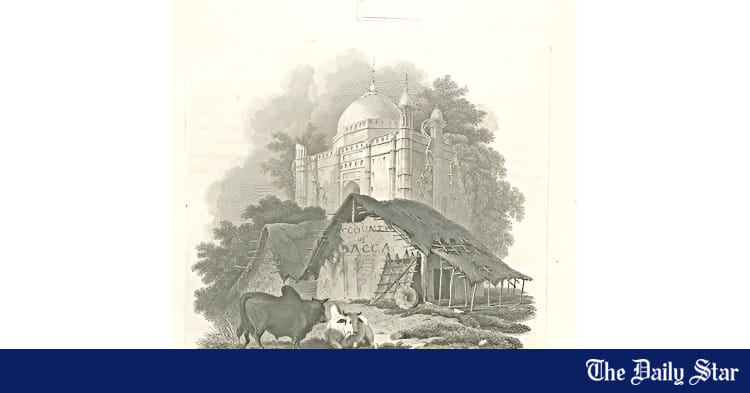
A hut beside a tomb by George Chinnery. Plate 1 in Charles D'Oyly's Antiquities of Dacca. (Image courtesy: The British Library)

Cartography in India might have had its roots in this expansionist ambition but went on to achieve much more than this. Rennell's Map of Hindostan, published by an act of Parliament in 1782, inaugurated the cartographic identity of modern India for the first time on the world stage. It geographically integrated the eastern entrepot all the way to the Himalayan hinterlands and the north western Punjab-Sind, reorienting existing land into a fresh geo territorial unit heavily dependent on its eastern delta for overseas commerce. This is not to say that this outlying terrain was unexplored for exactly these reasons. Earlier regimes and powers, both local and foreign, had their stakes all over the Bengal littoral region, making it one of the most coveted and strategic locations in the world for a very long time. However, it was the British East India Company which was responsible for the territorial transformation of the region as the fulcrum of power.

With James Rennell's surveying operations surging outwards across India while being focalized in Calcutta, large parts of India which were thus far outside the scope of the colonial information grid were fast brought under detailed observation. The utility of a panoptic knowledge of routes that was sought from the administrative class was stressed by Rennell in his book, A Description of the Roads in Bengal and Bahar (1788). Rennell lists four major centers, Calcutta, Murshidabad, Patna, and Dacca: "the first being the seat of government, and the others either the capital military stations, or factories or both." Since the grant of the Dewani to the English East India Company by the Mughal Emperor Shah Alam II in 1765, the seat of power shifted from Murshidabad to Calcutta, which now needed to be connected with all major stations throughout the region. The British colonial regime, with its growth of mercantile capital, commercial manufacture, and a drive towards the monetization of social relations, transformed the existing circulatory practices. The decline in commerce and attrition of urban centers in the early phase of British colonization of India was therefore generally seen as a breakdown of an earlier circulatory regime. Many of the arguments foregrounding the importance of transport infrastructure, roadways, navigation, and later on the railways in British India, were based on this foresight of bringing products and capital into a disciplined and efficient system of circulation.

1721086029957.webp

Cover of the author's book, published by Routledge in 2021.

Cartographic practices were not limited to academic mapping alone. Pictorial representations flourished in abundance as riverine landscape paintings became a popular medium to portray journeys into the subcontinent. William Hodges and the Daniells were major forerunners in initiating the genre, making landscape paintings popular and lucrative for later European traveling artists to participate. From the late eighteenth century onwards, many amateur artists in the East India Company's service explored innumerable opportunities to record the sights of India. Among the most productive of amateur artists in India was probably Sir Charles D'Oyly (1781-1845). Son of a senior Company official, John Hadley D'Oyly, the Company's Resident to the Nawab Babar 'Ali at Murshidabad, Charles was educated in England from where he returned to India in 1797. He held minor posts in the Company at the beginning of his career but gradually rose to higher and more responsible positions in the service. His first major appointment was as Collector of Dacca from 1808 to 1812. Following this, he returned to Calcutta, first as Deputy Collector and then Collector of Government Customs and Town Duties, a post he held until 1821 when he was appointed Opium Agent in Patna. D'Oyly's specific aesthetics are infused with geographical knowledge. In his movement away from riverine landscapes into the mofussils and hinterlands, his art can be seen as depicting 'spatial stories,' which link together, draw itineraries, and hence organize places as though in a map. Be it his paintings of Calcutta, Dacca, or Gyah or his monumental work titled Sketches of the New Road in a Journey from Calcutta to Gyah (1830), a project undertaken on the occasion of the inauguration of a new military road linking the Grand Trunk Road to Calcutta, his drawings contextualise the new colonial circulation evolving from existing routes. His topographic drawings are a kind of spatial practice which narrativise the fresh emergence of space, supplanting the space and network of the ancien regime. D'Oyly's The Sketches of the New Road celebrated the initiation of the idea of geographical improvement and mobility as the signpost of British triumph. The areas surveyed by the artist's eye were brought under cartographic surveillance and military order. The Sketches simulated an ideal tour through a coherent visual experience. In this series, D'Oyly adopted the European style of the 'prospect,' by then a widely accepted format, for his panoramic views. A bird's eye view of an entire terrain, the style could include with fields, forests, roads and rivers, sometimes towns and cities, travelers on the road, tiny as against the scenic landscape. The road interlaced with semaphore towers, as it were, paved the way to India's modern future.

In Views of Calcutta and its Environs, D'Oyly ventured away from the banks of the Ganges into the black town in search of local experiences: the streets, bazaars, huts, rituals, fairs, and festivals of the locals. In 1808, when he was appointed Collector of Dacca, he promised Warren Hastings that he would offer "as companions a few of the ruins of the city of Dacca which […] are exquisite for their magnificence and elegance and are calculated to tempt the pencil of an artist." The result was the drawings for Antiquities of Dacca (1830), planned as a joint venture with another professional artist, George Chinnery (1774-1852). His sketches and paintings dealing with Dacca were brought out from 1823 onwards in the form of folios from London. Each of these folios had about four to five sketches or paintings in it together with topical and historical descriptions of them. These brief explanatory notes were submitted by an acclaimed historian, Persian scholar, and artist, Military Surgeon James Atkinson (1780-1852). The roping together of image and accompanying explanatory letterpress was a relatively established convention at the time. D'Oyly granted greater significance to the vernacular and public architecture of an erstwhile important port township. He insisted on replacing the established hierarchical distinction between places, largely through preceding artistic ventures of Hodges and the Daniells, with a more fundamental equivalence. The Dacca paintings share a similar format with the Calcutta paintings and capture mofussil life in its plebeian detail. Most depict Mughal architecture then in ruins, hovering atop dense oppressive vegetation taking root in it, exuding a sense of decadence and a passing away of an old order. Also depicted are roads, rivers, and nullahs (streams) fallen into disuse.

1721086117407.webp

Measuring of Calcutta Base Line with trig point in the background for mapping. Sketch by James Prinsep, 1832. (Wikimedia Commons)
D'Oyly starts off by recalling the strategic location of Dacca not only because it had once been the capital of Bengal, which rose to pre-eminence during the time of Aurangzeb, but also because of the presence of other European powers prior to the coming of the British and the East India Company:

Long before the English settled at Dacca, the Dutch had established a factory there, and transacted their business through native agents; [...] The English factory at Dacca, having been preceded by that which Tavernier terms "a tolerably good one", was rebuilt about a century ago by Mr. Stark, with the permission of Iltizam Khan, [...] previous to which native agents had been employed to purchase cloths, and convey them for sale to Calcutta. It was not till the year 1742 that the French succeeded in getting permission to rebuild a factory here, which is now, as well as that erected by the Dutch, a heap of ruins.

In both his Dacca and Behar paintings, D'Oyly reinforces his identity as an administrative officer in the colonial service by commenting on the state of decay and administrative lapse the regions had suffered in the recent past. The Antiquities deal with descriptions and depictions mainly of the architectural past and present, and there is inevitably an attempt to draw comparisons between past elegance and the poverty-stricken present.

Thus Ducca for more than half a century was the capital of Bengal, and continued to be enriched by the multitudes which crowded to the courts of its governors. The stupendous remains of gateways, roads, bridges, and other public works, which present themselves on every side, sufficiently prove the former grandeur and magnificence of the city.

1721086151522.webp

Paugla Pool by Charles D'Oyly. Part of his Antiquities of Dacca. (Image courtesy: The British Library)

While correcting earlier records such as that by the French traveller, Tavernier, D'Oyly takes credit for his own 'discovery', his detailed research and production of original knowledge:

It would appear from this account by Tavernier, that almost the whole of Dacca at that time consisted of habitations built of mud, straw, wood, matting, and bamboo, such as are constructed by the common people at present. He mentions no public buildings excepting those of the Europeans; although the Great Kuttra, a most magnificent edifice, as well as the Mosque of Syuff Khan, had been erected many years before, and the small Kuttra more recently; but still several years before the celebrated French traveller visited Ducca. These splendid buildings, as well as several others, seem to have eluded the observation, or escaped the memory of Tavernier.

To read the rest of the news, please click on the link above.
 
Analyze

Analyze Post

Add your ideas here:
Cite Fact Check Highlight Respond

A forgotten chapter in the intellectual movement of Bengali Muslims
90 years after Anwarul Quadir's Amader Dukkho

1722208630526.webp

Cover of the novel Abdullah, published by Bangla Academy

Anwarul Quadir (1887-1948) was a key literary figure whose work significantly influenced the intellectual movement of Bengali Muslims in late colonial Bengal. He is best known for completing the novel Abdullah after the death of its original author, Kazi Imdadul Huq (1882-1926). Abdullah is recognized as a pioneering work in Bengali literature by Bengali Muslim writers, addressing several contentious social issues. Additionally, Quadir published his only essay collection, Amader Dukkho, in 1934, which compiled his writings from various periodicals. Now 90 years old, this seminal book addressed pressing issues of its time that remain relevant today.

Born in 1887 in Port Blair, Andaman Islands, as his father was posted there as a headmaster of a government school, Anwarul Quadir held the family title of Kazi, and their family originally hailed from the village of Paygram Kasba in Khulna. He completed his entrance exam at Jessore Zilla School and earned his BA from Presidency College. Quadir pursued a career in teaching and obtained his MA in English Literature in 1928. He also served as an assistant to Mr. Steplan, who was specially assigned to the proposed Dhaka University. Quadir passed away from cancer in 1948 at Presidency General Hospital in Calcutta. He was awarded the title of Khan Sahib for his lifelong service in education. Anisuzzaman noted that Quadir was an ideal figure among his students and colleagues, with his significant contributions to the formation and operation of the Muslim Sahitya Samaj being highly valued.

Anwarul Quadir was the senior-most author among the seven key writers of the Muslim Sahitya Samaj, which is better known as Shikha Gosthi, with their publication Shikha, the leading progressive writers' association of Bengali Muslims in Dacca at the time. This association played a crucial role in awakening the newly educated minds among Bengali Muslims, injecting a fresh literary and intellectual spirit into the stagnant society of East Bengal's main city.

Mustafa Nur-Ul Islam described Dhaka during the emergence of the Shikha Gosthi and the free intellect movement, popularly known as the Buddhir Mukti Andolan:

"At the top is the Nawab family of Dacca, an impregnable fortress of conservatism. Dacca, in that period, was far removed from the modernity of free liberal thought. A university was just being established on the outskirts of Ramna Green and the Dacca Inter area, and Jagannath College was located near Sadarghat in the main town. In this limited and often hostile environment, a small group of individuals championed the cause of 'free intellect,' founded institutions, and published periodicals. Remarkably, most of these young reformers were from outside Dacca and lacked significant local support or patronage."

1722208692153.webp


An invitation card for a lecture on Hindu-Muslim issues by Anwarul Quadir, organized by the Muslim Sahitya Samaj. The event was scheduled for December 26, 1926, but was postponed due to the killing of Hindu revivalist movement leader Swami Sraddhananda by a Muslim named Abdul Rashid. Courtesy: Purba, 2024.
Historians note that after C.R. Das's death in 1925, communal tensions intensified in Bengal, with Dhaka frequently witnessing Hindu-Muslim riots. Amid this volatile atmosphere, the group introduced a new vision in Dhaka. As the most senior writer in the group, Anwarul Quadir believed it was not just the responsibility of political leaders but also of writers and thinkers to guide the nation in the right direction.

Although poet Kazi Nazrul Islam was not directly involved with the Dhaka-based literary association, he was invited to its inaugural conference in 1927 due to his prominence among young Muslim intellectuals in Bengal. He traveled from Kolkata to open the conference and expressed his enthusiasm with these words:

"Today, I am thrilled to make a joyous announcement at this conference. For the first time in a long while, I enjoyed a peaceful night's sleep. I see that a new movement among Muslims has begun here, and I intend to spread this message far and wide. Furthermore, I once thought I was the only heretic, but now I am convinced that virtuous individuals like Maulavi Anwarul Quadir are the true dissenters. My circle of supporters has expanded; beyond this solace, I seek nothing more."

Nazrul was inspired by the new association's activities and lauded Anwarul Quadir as a leading thinker within the group. With a hint of sarcasm, he called both himself and Quadir "Kafir" or "infidels" to underscore their challenge to traditional views.

As noted earlier, a significant contribution of Anwarul Quadir was completing the novel Abdullah. He wrote chapters 31 to 41 based on the original draft, and the complete version was published in 1932. Kazi Abdul Wadud remarked on their differing styles:

"Kazi Imdadul Haque is primarily a painter, whereas Anwarul Quadir is more of a psychologist, a difference reflected in their writing styles. Notably, Quadir's contributions shine in two chapters: one depicting Saleha's death and the other describing Mir Sahib's final days. While Imdadul Haque portrays Saleha as nearly lifeless, overly constrained by her father's rigid principles, Quadir introduces a touch of compassion to her character and adds a hint of novelty and affection to Abdullah's otherwise mundane life."

Wadud notes that Anwarul Quadir brought a more dynamic and humanistic dimension to Saleha, the lead female character, who was largely passive in Kazi Imdadul Haque's original portrayal.

Anwarul Quadir's another major contribution is Amader Dukkho, an essay collection. Originally published in Calcutta, the prose work was reprinted twice, first in 1990 and again in 2010.

The title Amader Dukkho (Our Sorrows) underscores the urgent issues Anwarul Quadir critically examined during his time. This period was marked by intense and unresolved Hindu-Muslim conflicts, which eventually led to the Partition of Bengal. Quadir noted that leaders of these competing groups adopted narrow, self-serving views driven by religious biases, failing to unite for the nation's benefit. The government officials were more concerned with their own positions and perks, with their salaries rising while the common people's suffering worsened.

He presented a critical analysis of the socio-economic and political climate, which was increasingly polarized between Hindus and Muslims. This growing distrust approached a state of near-separation, with each side accusing the other of grievances. Quadir found Hindu accusations of Muslims destroying temples and desecrating idols to be largely exaggerated, just as he saw Muslim fears that Hindus would eliminate them after achieving independence as overstated.

Quadir argued that both Hindus and Muslims faced significant poverty and criticized inherent issues within each community. He found the Hindu caste system incompatible with modern democratic values and noted that Muslims were often more conservative and resistant to change, sometimes practicing their religion in a way that seemed bigoted and misaligned with Islam's core principles. Instead of focusing on religious differences, Quadir emphasized shared problems like severe poverty, food shortages, and inadequate clothing. He questioned whether the country's leaders would understand these issues or continue to follow antagonistic policies.

Nazrul was inspired by the new association's activities and lauded Anwarul Quadir as a leading thinker within the group. With a hint of sarcasm, he called both himself and Quadir "Kafir" or "infidels" to underscore their challenge to traditional views.

Anwarul Quadir's lecture, titled "Bangli Musalmaner Samajik Galad" ("The Social Faults of Bengali Muslims"), appeared in the first issue of Shikha and was later included in his book Amader Dukkho. In this lecture, Quadir explored the challenges and potential of Bengali Muslims. He emphasized, "Without the liberation of the mind, religion cannot be taught. Intelligence is essential for understanding and following religious principles. The true essence of Dharma has been lost due to a lack of intelligence, leading to a dominance of orthodoxy in our practice."

In the essay collection, Quadir also critiqued the thinking of influential educational and social leaders, such as the respected chemist and educationist Prafulla Chandra Ray (1861-1944). Ray remarked that the narrowness of the Hindu caste system had driven lower-caste people to seek refuge in the "kindheartedness of Islam," resulting in over 50 percent of Bengal's population becoming Muslim, which he perceived as a misfortune for India. Quadir questioned how a slight majority of Bengal seeking refuge in the "kindheartedness of Islam" led to the wreckage of the entire country. He believed Ray might have been trying to provoke Hindus into rejecting the caste system. However, Quadir doubted that divisions wouldn't have developed within Hinduism if people hadn't embraced Islam. He argued that the rise of Buddhism and many other sub-sects of Hinduism indicated that oppressed people would have embraced any other sect or religion, even if Islam had not arrived in this land.

Quadir questioned how this shift towards Islam could be blamed for the country's problems, arguing that Ray might have been trying to provoke Hindus into reform but ultimately failed to address the deeper issues. He suggested that divisions within Hinduism would have arisen even without Islam's influence, as evidenced by the rise of Buddhism and various Hindu sects among oppressed people.

He dismissed Ray's conclusion as narrow-minded, arguing that such sectarian blame emerges under subjugation and reflects a form of subservience. He emphasized that if even a respected social leader like P.C. Ray, known for his liberal ideas and acceptance among Muslims, held such views, it would alienate Muslims and lead them to seek a fictitious identity elsewhere, neglecting their place in their own land. He suggested that overcoming such narrow-mindedness requires insight and a fresh perspective, avoiding stereotypical thinking in a colonized state.

1722208740408.webp

Cover of the book Amader Dukkha (1990)

Quadir did not accept that communal issues in India began with the colonial period but pointed to historical examples, such as the exile of 500 Brahmins during Harshabardhan's reign for causing unrest. He believed that widespread communal issues arose from rulers seeking personal benefits, with religion frequently manipulated for these purposes. He criticized the hypocrisy of showcasing religion, which obscured sincere and humble adherence to its practices.

During the final phase of colonial Bengal, the Hindu-Muslim feud intensified as economic opportunities dwindled. Zamindari became less profitable, agriculture stagnated, and competition between the two major religions centered on the limited number of government jobs. These rivalries extended beyond daily economic and social activities and even impacted Bengali literature, where communal biases influenced the portrayal of characters in religious terms. Quadir criticized this environment, claiming it was impossible to produce "honest literature" under such conditions, and expressed hope that literary figures would develop a more harmonious approach in their work.

To read the rest of the news, please click on the link above.
 
Analyze

Analyze Post

Add your ideas here:
Cite Fact Check Highlight Respond

Partition of Bengal: Division and distinction
Reading about the Partition of Bengal in 1947, one is assailed by human stories of separation. But no narrative of Bangladesh is heard in this region about the Partition of Bengal. The Partition of Bengal is viewed here from a new angle in the perspective of Bangladesh
Sayeed Ferdous
Published: 16 Aug 2024, 20: 02

1723856615537.webp

People trekking to West Bengal from East Bengal after partitionCourtesy: The Guardian

Conventionally speaking, the 1947 partition is seen as a painful, unwarranted, disappointing and negative event. We do not say this is untrue. The division of Punjab and of Bengal led to massacres, bloodshed, rape and violence on either side of the borders. There were panic-stricken people, being chased or in fear of being chased. It was humans who were assaulted or the target assault. They fled from their homes, running hither and thither, and finally leaving their homeland.

However, the stories of people being attacked, leaving behind their homesteads and fleeing the country, were not all visible to the same degree in context of place and time. Reading on the Partition of 1947, you do not hear the degree of anguish among the people who left West Bengal, Bihar and Uttar Pradesh as you hear in stories of separation of the people who left East Bengal. Similarly, we also do not hear so much either of the non-Muslims who became a minority in Bangladesh and their predicament brought about by the Partition of Bengal, as we hear about the losses of the non-Muslims who left East Bengal. That is why many will call the conventional narrative of the Partition of Bengal to be a half truth.

Other than these discrepancies, my research over the past few years indicates an absolutely different narrative, other than the one of the Partition smeared with blood and tears. It is imperative that we look into that. In the interests of truth, we must say that on the flip side of the distress, the Partition of Bengal in also ushered in hope. On the flip side of pain, it ushered in joy. It is not that the Partition of Bengal in this land was totally unwarranted. The Partition of Bengal gave birth to aspirations of a new identity for Bengali Muslims.

The repetitive boring and pitiful narrative establishes India as the single victim of Partition. This narrative plays a role in India maintaining moral pressure on its neighbours. That is why Partition studies remain an example of epistemological aggression and hegemony
As a result of the Bengali nation state being founded in 1971, the religion-based identity apparently was diminished, but now it surely does not need to be pointed out that this identity has an important place in society. The conventional studies of Partition have always overlooked the historical importance and far-reaching significance of the emergence of the Muslim identity in East Bengal. That is why it must now be asserted that Partition studies are still India-centric and do not, consciously or unconsciously, take into cognizance the experiences of the varied people, of the diversified land, and even the divided and paradoxical experiences that exist. The repetitive boring and pitiful narrative establishes India as the single victim of Partition. This narrative plays a role in India maintaining moral pressure on its neighbours. That is why Partition studies remain an example of epistemological aggression and hegemony.

The popular understanding of Partition also views another matter as the gospel truth. That is, the Partition was a despicable conspiracy of the British, a toxic manifestation of their 'divide and rule' policy. This canard stands on yet another half-truth. This understanding fails to see that Partition took place as a result of political bargaining. The politicians of undivided India took active part in this. They certainly were not unsuspecting prey to the conspiracy of the British rulers. This half-truth is also blind to the fact that undivided India had long been prepared and readied the political and social realities that prompted Partition.

Take Bengal for instance. No matter how much one talks about a common Bengali culture today, for a long time an indelible difference has grown between the two Bengals and the two main religious communities. It is not at all logical to consider the Partition of Bengal to be the moment that two Bengals broke apart or to hold it responsible for this split. In his biographical writings, Abul Mansur Ahmed points out that long before the Radcliff Line was drawn, the Bangla-speaking Muslims in the remote villages of East Bengal realised at every step that their Bangla-speaking Hindu neighbours did not view them as equals. When writers and thinkers of the calibre of Dr. Muhammad Shahidullah would attend the Bengal literature conference, it was as if they were poor relations invited to the home of the wealthy elite.

The Partition of Bengal in 1947 paved the way for this difference between the two Bengals. This difference later strengthened Bangladesh's own distinct political and cultural journey down history.

In social terms, East Bengal was basically an agricultural society riddled with poverty, the majority being Muslims. They neither had education, nor gentility. The refined Kolkata never looked upon East Bengal and its populace as equals. They viewed "Bangals" as a strange race. Kolkata had the inherent gloss of colonialism. In contrast to the wretched "Bangals", this glittering metropolis became the hub of the newly educated office-going salaried middle-class. So the splitting of Bengal actually took place before Partition. In short, the two Bengals from beforehand were existing in two different historical and sociopolitical planes of reality.

We saw this manifest when seeds of the Pakistan movement were sown. At that time the Bangla-speaking Muslim writers, editors and litterateurs, even those in Kolkata, started exerting their distinctive identity. Rather than India, they committed themselves to constructing the Pakistan vision. But their vision of Pakistan was not that of Jinnah.

Within Pakistan, they wanted to establish the separate East Pakistan vision. In East Pakistan there was the land and the lives of the people awash with the rivers on one hand, and on the other they shrugged off the Kolkata sphere of influence with metaphors and memoirs of Islamic ilk, a distinctive language and literature. The poetry of Farrukh Ahmed is an excellent example of this exercise. Writers like Farrukh Ahmed at time inducted a large amount of foreign elements in the Bangla language.

But the unhappy short-lived marriage of the politicians of the two Pakistan's very rapidly broke up. That linguistic-literary endeavour of East Pakistan never came to fruition. Later when Bengali nationalism was promoted and Bangladesh became an independent state, many viewed the endeavour of their predecessors through the nationalistic lens, seeing it as a regressive "step backwards".

At the time, linguistic nationalism was considered superior to religion-based nationalism. The independent Bangladesh began its literary practice with the belief in Kolkata's academic, cultural and literary supremacy. The debate as to which of the two nationalisms is superior, which is more inclusive, can continue. But the standpoint that Kolkata is ideal and venerable simply serves to discard the question of Bangladesh's linguistic and literary practice. Instead, a celebration of a common Bengali-ism is forced forward.

It is true that once upon a time the literature, music, cinema, etc. of Kolkata had a significant role in the lives of Bangladesh's educated middle class. Our previous generation would listen to Sachin, Jaganmoy and Satinath, would watch Uttam and Suchitra. We too have turned time and again to Sumon, Nachiketa or Sunil, Samaresh, Shirshendu or Joy Goswami. This celebration of Bengali-ism and the lamenting about the divided Bengal is an important element in the discourse on the Partition of Bengal. A wistful reminiscence is cultivated at national circles in Bangladesh and West Bengal, of sighing "if only we two were together as one," or "if only there was no border." But we fail to probe into the fact that despite speaking in the same language, the two Bengals diverged down different paths very long ago, the two Bengals were never one.

We do not even stop to think that in 2011 when the two Bengals (actually two states, India and Bangladesh) commemorated 150 years of Rabindranath together, exactly at that moment perhaps Falani had been shot at the border and was dying. Other than a very, very few, our advanced scholar friends in West Bengal did not utter a word of protest. What sort of Bengali unity is this? What is this lamenting about not being able to live together?

Clearly, West Bengal and Bangladesh are bound together in a culturally disparate relationship of superiority and inferiority complexes. These complexes have emerged through historical differences. No one from either side or the Bengals can deny these differences.

Added to this inequality on a state and political sphere, is a moral burden -- the debt for the 1971 liberation war. India's policymakers, politicians, even the public, never forget to remind the people of Bangladesh at regular intervals that India had helped Bangladesh in the 1971 liberation war and that Bangladesh should remain eternally grateful and indebted to India. It must be remembered that when it comes to war and politics, no country does anything out of altruism. The fact that Bangladesh broke away from Pakistan and became independent in 1971, gave India significant advantages in regional politics.

Surrounding Bangladesh on three sides, India paved the way for imbalance in relations, whether it was in the sharing of common river waters, rail transit and all sectors. In recent times, by supporting Sheikh Hasina's unelected autocratic rule, and sheltering her after the fall of her government, India has taken a stance against the aspirations of the Bangladeshi people.

It was because of all these reasons that an anti-Indian mindset grew in the minds of the people of Bangladesh over the past one and a half years. In recent times when India lost to Australia in World Cup cricket, the people of Bangladesh celebrated effusively. The Indian media and analysts reacted sharply to this, shocked at Bangladesh's "ingratitude".

It is from this anger in their minds that the people of Bangladesh want to make their distinct identity clear. The Partition of Bengal in 1947 paved the way for this difference between the two Bengals. This difference later strengthened Bangladesh's own distinct political and cultural journey down history. And through that, the project for a common Bengali-hood gradually became defunct.

* Syed Ferdous is a professor of anthropology at Jahangirnagar University and a researcher on Partition.​
 
Analyze

Analyze Post

Add your ideas here:
Cite Fact Check Highlight Respond

H. H. Risley and Bengal, 1873-1911
Anthropology, Colonialism and the Bhadralok

1737933561745.webp

A group of sutars (carpenters) from Bengal, identified as Mongolo-Dravidian type. Featured in Sir H.H. Risley’s book The People of India (1908).

Sir Herbert Hope Risley (1851-1911) – who signed himself 'H. H. Risley' – was a member of the Indian Civil Service (ICS) who became British India's pre-eminent anthropologist. How anthropologists and sociologists understand a society is always influenced by the people they come to know best, as well as their own preconceptions, and this was as true of colonial anthropologists as it is of their post-colonial contemporaries. For Risley, who started his ICS career in Bengal in 1873, the most important group of people was the bhadralok, the English-educated, urban, professional middle class, whose members were almost all Hindus from the high-status Brahman, Baidya and Kayastha castes. In Bengal, most Indian subordinate government officials and clerks, as well as other professionals, such as teachers and lawyers, belonged to the bhadralok; so, too, did the leaders and supporters of the Indian National Congress, which was founded in 1885. Risley's relationship with the bhadralok and his attitude towards it, were very ambivalent, but he still had a particular affinity with its members that initially owed much to his early life in England.

Risley was born in Buckinghamshire, the son of a Church of England village parson. He was educated at Winchester College, the oldest elite public school, followed by New College, Oxford. His uncle, grandfather and great-grandfather were Anglican priests like his father, and all four had been students at Winchester and New College. They all owed their priestly livings and college places to family connections or other forms of patronage. But in the 1850s, both colleges underwent reform and Herbert Risley was awarded scholarships at them because he was successful in their new entrance examinations. In 1855, too, an open competitive examination for the ICS was introduced to replace the old nomination system. Risley therefore belonged to the first generation of Englishmen whose education and professional employment depended not on patronage but meritocratic success. Nonetheless, old ideas about divinely-ordained, hierarchical society still persisted in rural southern England. The landed gentry, allied with the clergy, virtually ruled the countryside and the mass of agricultural labourers subsisted in extreme poverty. Risley, who was always aware of his own elevated class status, probably found inequality and traditional hierarchy in India quite familiar.

Rather like Risley, many members of the bhadralok came from an ancient landholding and priestly gentry that traditionally respected education and learning. By the late nineteenth century, they also lived in a modern world in which an individual's education and employment were increasingly allocated by competitive examinations and bureaucratic rules. Hence there was a kind of class affinity between Risley and the bhadralok, and his inconsistent disposition towards it was a critical factor in how he understood India, both as an anthropologist and a civil servant.

The Anthropology of Caste

Bengal, the largest province in British India in the late nineteenth century, included present-day Bangladesh, and West Bengal, Bihar, Jharkhand and parts of Odisha in India. Risley started as a junior district officer in rural Midnapore district in 1873-75. In 1876, he was transferred to the Bengal government's secretariat in Calcutta for three years. In his next posting in 1880-84, he was a district officer in Manbhum district in Chota Nagpur, which had a large population of Adivasi Santals and Bhumijs. This was his last period as a district officer, except for six months in Darjeeling district in 1889. Unlike most ICS officers, who spent longer in the districts, almost all Risley's career after 1889 was in the Bengal or Indian secretariats. Because the great majority of the secretariats' Indian staff belonged to the Bengali Hindu high castes of the bhadralok, Risley came to know them best. He was also fairly well acquainted with some tribal communities, but not with the mass of ordinary, middle- and low-caste villagers in lower Bengal, or with the province's large Muslim population.

1737933656256.webp


Risley conducted an ethnographic inquiry into the province's castes and tribes in 1885-88. District officers and their staff, who made up Risley's roster of 188 'correspondents', sent him most of his ethnographic information, especially on caste and marriage, and 'social precedence' or caste ranking. Among the correspondents, there were 129 named Indians, 26 Europeans and 33 men listed only by their positions. Of the named Indians, 102 were definitely or probably Brahmans, Baidyas or Kayasthas, 18 were other Hindus and nine were Muslims. Hence the majority of correspondents belonged to the bhadralok. Risley also collected anthropometric data to investigate the racial composition of the Bengali population and to try to show that caste status was correlated with racial admixture.

Risley's findings were published in The Tribes and Castes of Bengal in 1891. Its two ethnographic volumes contained a glossary with entries on individual tribes and castes, and their subdivisions, preceded by an introduction on 'caste in relation to marriage'. He had hoped to produce 'tables of precedence of castes', but could not do so because there were countless variations and disagreements in his correspondents' voluminous evidence. The glossary had a male gender bias and curiously little material on Muslims. It also described the Brahmans, Baidyas and Kayasthas as the three 'highest and most intelligent' castes, a patent expression of the glossary's elitist bias, which combined Risley's English class prejudice against the uneducated lower orders with the bhadralok's Brahmanical outlook. Thus he and his correspondents all conceptualised castes as discrete, reified groups that could be clearly ranked with Brahmans at the top. Nonetheless, despite its defects and biases, the work contained a great deal of valuable ethnographic evidence and it brought Risley recognition as British India's leading anthropologist.

1737933682247.webp


In 1898, Risley was promoted to the government of India and one year later was seconded as the 1901 census commissioner. He wanted ethnographic inquiry to be central in the census and also decided that castes should be classified by 'social precedence', rather than occupation as in 1891, so that he instructed provincial census superintendents to collect comparative data on caste ranking. But because he moved to the Home department in 1902, Risley could not finish the census report, although he did write the chapter on caste, tribe and race, which he edited for his 1908 book, The People of India.

Risley had argued in 1891 that the caste system originated in the racial inequality between the more 'advanced', fair-skinned Aryans and more 'primitive', darker non-Aryans, primarily Dravidians, and also that social precedence was correlated with race because the highest castes had predominantly Aryan ancestry and the lowest predominantly Dravidian. A decade later, however, he doubted whether the 'Aryan race' ever really existed and modified his theory to contend – more like a modern social scientist – that caste originated in the fiction that skin colour differences indicated distinctions of race and social status. On the other hand, despite copious census evidence that caste ranking varied regionally and was always disputable, Risley never acknowledged that it could not be specified in 'tables of precedence'. Criticism of this and other flaws in his work, especially his wrongheaded racial theory, has generally overshadowed Risley's significant contributions to the anthropological understanding of caste.

Combating Indian Nationalism

Between 1891 and 1898, Risley was the secretary of the Bengal government's Financial and Municipal departments. One important issue he handled with was a contentious bill to reorganise Calcutta's municipal administration by reducing the powers of its elected commissioners, including the bhadralok Congress politicians among them, who allegedly blocked any effective decision making. These powers were diminished further when Curzon intervened to make the bill more radical after he became the viceroy in 1899. In 1902, Curzon selected Risley as the imperial government's Home secretary. In this powerful position, Risley played a vital role in formulating policy on numerous major issues, including higher education reform, which was especially urgent in Calcutta University, whose senate was reportedly controlled by 'politicised lawyers' and absentee members with no academic qualifications. Congressmen, however, insisted that the government was really seeking to oust its supporters from Calcutta's university, much as it previously did in the municipality. Soon afterwards, in late 1903, Risley announced the proposals for the 'reconstitution' of Bengal and Assam. The Partition of Bengal, which was completed in 1905 after Risley drew up the final plan, was the most controversial of all Curzon's policies, and it especially infuriated bhadralok members of the Congress, who saw it as an assault on Bengali society and culture, as well as a stratagem to weaken the organisation by separating its leaders and supporters in east Bengal from those in the west. Risley admired Curzon and shared his hostility to Indian nationalism and the Congress, but unlike the viceroy he had considerable sympathy for the bhadralok's position in society and never poured contempt on 'babus' and the class as a whole.

In the end, the Partition of Bengal was a political failure. The swadeshi movement against it developed into wider hostility to British rule after partition was implemented, although many Muslims in east Bengal favoured the new arrangement. But the Partition also created separate Hindu- and Muslim-majority provinces, which tended to worsen relations between the two groups and indirectly engendered the communal violence that blighted Bengal for decades. When Minto replaced Curzon as the viceroy in 1905, Risley stayed on as Home secretary and introduced further repressive measures to quash anti-British protests and 'sedition'. But John Morley, the secretary of state, insisted on reform as well. In negotiating the Morley-Minto legislative councils reform enacted in 1909, Minto and Risley acknowledged, unlike the diehard Curzon, that some concessions to 'moderate' Congressmen were politically necessary. Thus the proposals for the new councils were intended to satisfy the 'educated classes', such as the bhadralok, as well as 'loyalist' landlords and Muslim opponents of the Congress, who were granted separate 'class electorates'. Risley expediently justified them for Muslims by asserting that they formed 'an absolutely separate community', even though ethnographic data, as he knew, showed they did not. In general, though, partly because he knew too little about them, Risley tended to be less sympathetic to Muslim interests than Minto or many British officials.

When the new viceroy's council first convened in 1910, Risley introduced a revised Press Act to further deter newspapers from inciting 'sedition'. It was his last official action before retiring from the ICS and returning to London, where he worked in the India Office before his death in 1911. In his council speech, he vigorously defended British rule and insisted on the need for 'cordial and intimate' relationships between the government and the 'educated community'. And he also justified the new law with illustrations likely to strike a chord in the council members from the bhadralok, the group of people who shaped his understanding of Indian society and politics throughout his long career.

Chris Fuller is Emeritus Professor of Anthropology at the London School of Economics and Political Science. He is the author of Anthropologist and Imperialist: H. H. Risley and British India, 1873-1911, published by Social Science Press in New Delhi in 2023.​
 
Analyze

Analyze Post

Add your ideas here:
Cite Fact Check Highlight Respond

Members Online

Latest Posts

Latest Posts