โ˜• Support Us โ˜•
[๐Ÿ‡ง๐Ÿ‡ฉ] - Forces Goal 2030 | Page 2 | PKDefense

[๐Ÿ‡ง๐Ÿ‡ฉ] Forces Goal 2030

Reply (Scroll)
Press space to scroll through posts
G Bangladesh Defense
[๐Ÿ‡ง๐Ÿ‡ฉ] Forces Goal 2030
63
4K
More threads by Saif


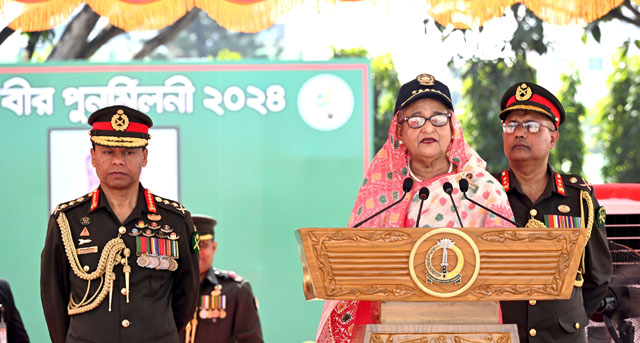
Govt enabling armed forces to face any situation: PM


image-176445-1709366648.jpg


RAJSHAHI, March 2, 2024 (BSS) - Prime Minister Sheikh Hasina today said her government has been making armed forces of the country as modern and time-befitting to make them capable to face any situation as various development projects are being implemented for the purpose.

"We want our armed forces to be competent to face any situation arisen in our country," she said speaking as chief guest at the Bangladesh Infantry Regiment (BIR)-2024 third reunion at the Bangladesh Infantry Regimental Center in Rajshahi Cantonment.

Briefly describing various projects taken for the development of the armed forces, the premier said her government has been implementing different projects to build the armed forces as modern and time-befitting.

She said, "We have built several Infantry divisions, brigades, units and training institutes for the development of the armed forces since assuming power".

Sheikh Hasina has highly praised the armed forces for brightening the country's image at home and abroad by their good works.

"Our armed forces have not only earned reputation at home, but also in the international arena by making huge contribution to the United Nations peacekeeping missions," she said.

The prime minister said the armed forces acquired the confidence and trust of the people through their works wherever they go.

She said her government has been building Bangladesh Armed Forces in line with the Forces Goal-2030 which was formulated following the Defence Policy of 1974 adopted by the Father of the Nation.

The premier thanked the armed forces personnel for standing by the people in especially any natural disaster.

She also said the armed forces have also been contributing immensely to the country's advancement by taking part in the infrastructure development during the Awami League government across the country.
"So, our target is to take our country forward towards prosperity in a collective manner," she said.

Sheikh Hasina said her government is committed to transforming the country into a developed, prosperous and Smart Bangladesh free from poverty as the Father of the Nation's dream by 2041.

She continued that Bangladesh is now branded as the model of development on the global stage due to her government's massive development programmes.

"No one can neglect Bangladesh now. We will move around the world keeping our heads high with due dignity," she said.

Referring to the Covid-19 pandemic and Russia-Ukraine war, the prime minister said Bangladesh has also been facing its impacts like the world.

"So, we will have to make sure that no single inch of (fallow) land remains uncultivated," she said.

1711177847323.jpeg


The prime minister inspected the parade of the regiment riding on an open jeep and later took state salute as she was accorded a guard of honour.

She also laid wreath at the 'Bir Gaurav' monument erected in memory of the martyrs of the Bangladesh Infantry Regiment.

She attended the Darbar of the regiment as well.

Earlier, on her arrival at the venue, the prime minister was received by Chief of Army Staff General S M Shafiuddin Ahmed and Commandant of Bangladesh Infantry Regimental Centre and PAPA BIR Major General Khandakar Md Shahedul Emran.

Cabinet members, PM's defense adviser, chiefs of the three services, members of the parliament, senior civil and military officials, among others, were present at the function.​
 
เฆจเฆคเงเฆจ เฆ•เฆฐเง‡ เฆธเฆ‚เฆถเง‹เฆงเฆจ เฆนเฆฌเง‡ เฆซเง‹เฆฐเงเฆธเง‡เฆธ เฆ—เง‹เฆฒ-เงจเงฆเงฉเงฆ เฆฎเฆนเฆพเฆชเฆฐเฆฟเฆ•เฆฒเงเฆชเฆจเฆพ | Ministry of Defense Will add new weapons


Forces Goal 2030 and beyond
by Mohammad Abdur Razzak 09 October, 2024, 00:00

1728438121637.png


FORCES Goal 2030 is a military modernisation programme adopted in 2009 for the Bangladesh army, navy and air force. The programme had a revision in 2017. It will enter its last quarter in 2026. Principal purposes of this programme was to set out development priorities, ensuring consistency in development undertakings, yield the best value for investment in defence and promote indigenous manufacturing. Areas of Forces Goal 2030 were reformation of the forces to have optimum operational sustenance through the interface of horizontal and vertical expansion, defence research, indigenous manufacturing and the acquisition of modern military weapons.

A well designed and a well set out plan together with financial strength were key to this development programme. Financial allocation to support the programme included all current and capital expenditures on the defence ministry and its 26 embodied organisations including the armed forces and departments and agencies engaged in non-combat roles, the operation and maintenance of current inventories, procurement, retirement pensions of personnel, etc. Since the adoption of the programme in 2009, allocation for defence had incremental trend, providing an equilibrium between the plan and actions.

In defence budgeting, inflation is a critical constituent in determining the actual value of the allocation at year end. โ€˜Generally defence inflation is higher than ordinary inflation. The rate of inflation in the navies is higher than armies as naval expenditures are more capital intensive. Among the armed forces, air force has the worst rate of inflation. But due to air forceโ€™s low unit cost compared to navy, politically it is less damaging.โ€™ Besides, geopolitical influence on the market players can exert different degrees of impact, triggering uncontrollable demand pull and cost push inflation. These are built-in intricacies in defence financial systems and market character. Estimating the financial situation 20 years ahead of the time and the possible risks in a defence supply chain demand an extreme analytical ability to see the future where nothing is assured. Inability to foresee the future without exercising such complex mathematics may produce judgmental errors, leading to complaints of insufficient fund allocation.

The armyโ€™s modernisation programme included organisational expansion and transformation of military units. As part of the expansion programme, the army has established three infantry divisions and two are in the making, keeping in mind to establish three independent corp command namely central, eastern and western commands. To increase special operation capabilities, new para commando battalion has been raised. The army aviation groupโ€™s bases at Lalmonirhat and in Chittagong have extended operational reach.

Going with the transformation of units, the army is converting part of infantry battalions into para infantry battalions and mechanised infantry battalions. To obtain optimum operational flexibility, the army has the focus on introducing diverse advanced equipment from night-vision goggles to main battle tanks, anti-tank guided missile systems, artillery systems, guided multiple rocket launcher systems and so forth from a range of countries. A review of acquisitions reveals that the armyโ€™s modernisation is heavily import-dependent and activities linking transformation and indigenisation are missing.

The navyโ€™s principal goal in 2030 was to transform the navy into a three-dimensional force. In this context, the navy has achieved the goal. Since 2009, โ€˜a total of 31 warships, including 4 frigates, 6 corvettes, 4 large patrol crafts, 5 patrol crafts and 2 training ships were added to the fleet.โ€™ The additions also included special warfare diving and salvage command, naval aviation command, submarine command, naval doctrine command, etc.

Given these portfolios, the naval programme seems to be moving on track with great endeavour to come out of the legacy of second-hand, off-the-shelf acquisitions and a fleet dominated by patrol craft. But out of 31 ships, 21 or so are offshore patrol craft/large patrol craft and coastal patrol craft, training ships, etc. A correlational incompatibility between projection, financial analysis and supply chain may be inescapably tying the navy to the old legacy and delaying the building of a fleet around higher combat capable ships. In its magnificent initiative, indigenous manufacturing is found loosely flagged. By the time the navy reaches the target year 2030, its principal combatants will cross the benchmark of combat effective economic service life generally accepted in the naval domain.

Five ships in the frigate flotilla will be 31 years old and two Hamilton Class cutter turned patrol frigates will be 66 years in 2030. All four missile corvettes will be aged between 15 and 20 years. UK-origin four offshore patrol vessels will be 52 to 54 years old. Over all, the fleet could suffer from ageing syndrome after 2030.

The navy acquired two submarines (Type 035G Ming Class) in 2016 from China. These submarines had been in service with the Peopleโ€™s Liberation Army Navy from 1990 to 2016. Before joining the Bangladesh navy, the boats went through upgrade extending the life to 2030. The upgrade included the installation of new sensors, modern computers and communication systems. So, the navy will have to decide before 2030 whether to opt for another life extension or replace them with off-the-shelf purchase or go for a new acquisition. A cost-benefit analysis of available choices should suggest the best possible option.

The Bangladesh air forceโ€™s Goal 2030 is designed to make the force a technologically advanced, well-trained and well-equipped force that can deter any threat to Bangladesh airspace. To efficiently perform duties and responsibilities, the air force has been divided into southern and northern command. New airbases in Coxโ€™s Bazar and Dhaka have been commissioned and two are under construction to widen the forceโ€™s operational reach.

The air force has since 2009 acquired five refurbished C-130J, 21 MI171Sh from Russia, four AgustaWestland AW 139 helicopters from Italy, K-8 trainer and 16 Yak-130 fighter trainers from Russia. It is interesting to observe that the air force had its last acquisition of fighter aircraft in 2013, Chengdu F-7BGI from China. Since then, no new acquisition of fighter aircraft has been reported. Earlier purchases were eight MiG 29 in 2000. The air force seems to be precariously moving forward with its goal in 2030.

The hostile intelligence services instigated the politicisation of MiG 29 purchases immediately after its induction in 2000-2001 and now sanction against Russia may have complicated MiG 29s operational readiness and constrained maintenance of other Russian-built aircraft. Making aircraft is a very high-tech adventure. There has been no noticeable activities on indigenous manufacturing except the forceโ€™s projection of domestically built first-ever trainer aircraft BBT-1 and BBT-2. These were the forceโ€™s encouraging undertakings although they are reported to have had troubled test flight, there is scepticism about their flight worthiness though. Perfection comes from mistakes.

The Forces Goal 2030 has been the first of its kind to advance the future developments in three forces. Optimistically, the initiative should have ensured consistent progress aligned with the national military strategy and objective, economy in defence investment and developed greater understanding among the three forces. The Forces Goals 2030 supposedly has created invaluable learning curb on military planners. But, becoming a maker of warship or tank and artillery or fighter aircraft will remain ever challenging because of meagre heavy industrial engineering and technology capacity nationally. A national collective strategy should show the way to become a โ€˜makerโ€™. Last but not least, defence offset contracting could be a win-win option to become a โ€˜maker of military hardware and software.โ€™

Mohammad Abdur Razzak (safera690@yahoo.com), a retired commodore of Bangladesh navy, is a security analyst.​
 
Bangladesh Emerges as a Fearsome Military Power in 2025!


Well - fearsome maybe a bit overstepping it.

We still don't have modern subs, modern frigates in sufficient numbers and of course no 5th Gen (or even 4th Gen) MMCA.

We have started developing an ab-initio trainer aircraft and have some basic tactical missiles.

If we need really capable tanks, MBT 2000 ain't it. One could argue getting tanks may be a waste, given how cheap ATGM's are - but we don't make/assemble those either.

"Mota dagey" these are basic wants and needs. I am sure I'm forgetting something...
 

Revisiting โ€˜Forces Goal 2030โ€™: Bangladeshโ€™s Military Modernization Plan Under the New Government
Every major step taken during the Hasina administration is now subject to change โ€“ including Bangladeshโ€™s first formalized military modernization blueprint.
By Khandakar Tahmid Rejwan
December 06, 2024
Credit: Wikimedia Commons/ Shadman Samee

1738718452773.png


Prime Minister Sheikh Hasina in a popular mass uprising has changed the strategic, political, and social dynamics of South Asiaโ€™s second-largest economy. Given the countryโ€™s pacifist foreign policy motto, it often gets overlooked that Bangladesh has the third most powerful armed forces in the region, only behind nuclear-armed India and Pakistan. Thus, Bangladesh is militarily the most powerful non-nuclear weapons state in South Asia.

Given its policy of non-alignment and strategic balancing with international and regional powers, a military with professional manpower and modern equipment has always been a crucial ambition for enhancing Bangladeshโ€™s deterrence. However, the emphasis given to economic development โ€“ and the resulting lack of funds in the defense budget โ€“ meant that military ambition never materialized.

This changed in 2009, when, under Hasinaโ€™s direction, Dhaka initiated its first formalized military modernization plan, Forces Goal 2030. This plan โ€“ revised in 2017 โ€“ created a historic groundwork to meet the Bangladesh Armed Forcesโ€™ demand to transform into a sophisticated 21st century military. After more than 15 years of this initiative, the Armed Forces of Bangladesh (AFB) have been substantially upgraded.

With Hasinaโ€™s 15-year reign now over, the new interim government of Muhammad Yunus has initiated plans to reform key sectors and institutions of the country, including the police, judiciary, and constitution. Every major step taken during the previous administration is now subject to change. Therefore, it is not beyond question that the successes and limitations of Forces Goal 2030 may also undergo a reassessment by the current government.

Bangladeshโ€™s shuffled geopolitical landscape and shifting security priorities in the post-Hasina period may require revisiting the current military modernization plan. This will also require securing deeper strategic ties with Dhakaโ€™s primary arms sellers, such as China and Turkiye.

AFB Modernization Under Forces Goal 2030

The primary objective of Forces Goal 2023 is to modernize all three arms of the AFB, namely the Army, Navy, and Air Force. The plan calls for the reconfiguration of military formations, increasing manpower, creating new units, including of modern weapons with adequate training, revising military doctrine, and increasing the defense industrial base (DIB) for indigenous production, including transfers of technology. Given these goals, it can be termed as a holistic strategy to develop the AFB into a 21st century capable force.

Under Forces Goal 2030, the AFB has been renovated significantly. The Bangladesh Army acquired modern Russian BTR-80 and Turkish Otokar Cobra Armed Personnel Carrier (APCs) for its newly formed mechanized infantry units. Sophisticated MBT-2000 tanks and VT-5 light tanks were introduced to the Armored Corps from China. The Artillery Corps was inducted with multiple launch rocket systems (MLRS) like the Turkish TRG-230 and TRG-300 Kasirga alongside the Chinese WS-22. Self-propelled artillery systems like the Serbian Nora B-52 were also added to the inventory. The Air Defense Artillery (ADA) Corps received FM-90 Short Range Air Defense Surface to Air Missiles (SHORAD SAMs), coming out from the legacy of operating only obsolete self-propelled guns for air defense and protection of key point installations. Turkish Bayeraktar TB-2 drones were bought for Army Aviation alongside transport aircraft and multipurpose helicopters from the West and Russia, respectively.

Due to consecutive legal victories against India and Myanmar over maritime boundaries, Bangladesh retains sovereignty over a large chunk of the Bay of Bengal (BoB). This heightened the importance of modernization for the Bangladesh Navy. Dhaka subsequently acquired two Ming-class submarines from Beijing and major ships for its surface fleet like Type 053H3 and Type 053H2 guided missile frigates, and Type 056 stealth-guided missile corvettes. Bangladesh also bought a pair of decommissioned cutters from the United States to enhance its naval presence. In 2011 Bangladeshโ€™s Naval Aviation wing was formed with four German Dornier 228 Maritime Patrol Aircraft (MPA) and two Italian Augusta Westland maritime helicopters.

Subsequently, Dhakaโ€™s focus on enhancing airpower also grew due to Myanmarโ€™s repeated and aggressive breaches of Bangladeshi airspace. The Bangladesh Air Force received fourth-generation fighter trainers like the Russian Yak-130 and Chinese K-8. License-produced F-7BG and F-7BGI fighter interceptors were also introduced into the air fleet. The Air Force also acquired FM-90 SHORAD SAMs for small-area defense and Italian Selex RAT-31DL advanced 3D surveillance radar for land-based early warning systems.

Besides upgrading its inventory, Dhaka also established new formations with increased personnel. The Army raised three new divisions in 15 years, namely the 7th, 10th, and 17th Infantry Divisions, alongside the recently formed Adhoc Army Air Defense Corps. The lone Para-Commando Battalion was also strengthened to a Para-Commando Brigade in 2016. The Bangladesh Navy introduced aviation units, and the Bangladesh Air Force formed mobile SHORAD SAM units.

The AFB also focused on expanding its defense industry through its subsidiary Bangladesh Machine Tools Factory (BMTF) and Bangladesh Ordinance Factory (BOF). The BMTF now produces light vehicles like Arunima utility trucks, and the BOF provides indigenously produced small arms like BD-08 rifles, MANPADs, rockets, and grenades. This equipment is primarily produced indigenously through the technology transfer agreements with foreign partners.

Khulna Shipyard, under the Bangladesh Navyโ€™s jurisdiction, has also successfully produced several small and lightly armed Offshore Petrol Vessels (OPVs) domestically. It intends to build larger vessels like frigates and corvettes, potentially with technical assistance from China or Turkiye, in the future, to bolster domestic manufacturing capacity.

The Rationale for Revisiting the Forces Goal 2030 and Prospective Overhauls

The interim government in Dhaka is now facing additional security challenges amid a new geopolitical reality as well as internal issues. In Rakhine and Chin states of Myanmar, rebels are gaining strongholds, and the Bangladesh-Myanmar border has turned into an active war zone. The Arakan Army (AA) has shot, abducted, and killed Bangladeshis near the Naf River. The violence across the border has also sparked new incursions of Rohingya refugees, as well as illegal border crossings by Myanmar security personnel seeking to avoid capture.

The relationship with India is also strained as anti-Bangladesh sentiment is riding high in India, culminating in a vandalism attack on Bangladeshโ€™s Assistant High Commission in Agartala. Top Indian government officials like Amit Shah have publicly called for forces to ready for war, citing the situation in Bangladesh.

Inside Bangladesh, threats of destabilization are visible from non-state actors like the Kuki-Chin National Army (KNA), which is increasingly growing strong and receiving alleged foreign assistance, including arms, training, and safe haven.

The instability in neighboring Myanmar, war rhetoric propagating from India, and prospects of insurgency in the Chittagong Hill Tracts require the AFB to a build a strong force that is able to deter and counter any external and internal threats. For such purposes, a stronger AFB is mandatory, which will require revisiting the existing force modernization plan.

Dhaka must identify some of its contemporary shortcomings and look to improve the plan. New goals could include diversifying arms imports, acquiring critical weapons systems, prompting defense partners for a wider range of technology transfer deals, countering information warfare from adversaries, formulating an irregular warfare doctrine, and improving intelligence-based operations.

Besides, Dhaka can also integrate its second layer of territorial defense by formulating similar modernization plans for the Border Guard Bangladesh (BGB) and Bangladesh Coast Guard. Integration of these forces is vital as they will fall under the jurisdiction of the Ministry of Defense in case of a national security crisis like war or conflict.

Voluntary basic training can be introduced in tertiary education institutions similar to the countryโ€™s Cadet Colleges. Through such programs, units of the Bangladesh National Cadet Corps can also be expanded for youth participation. This will create future candidates for the AFBโ€™s officer corps and promote youth contribution to national security.

China Dependency and Turkish Alternatives

In recent years, Turkiye has become one of the major suppliers of weapons to Bangladesh. Dhaka is among Ankaraโ€™s top four destinations of military equipment. Dhakaโ€™s interest in acquiring Turkish weapons stems from several factors, such as the poor quality of Chinese equipment, the aim to familiarize the AFB with NATO-grade weapons, a lower price tag in comparison with other Western suppliers, and Ankaraโ€™s willingness to facilitate indigenous production through technology transfers. The Bangladesh-Turkiye strategic partnership has seen significant positive development in recent years, which brings a strong impetus for both to deepen the existing ties.

This has now raised the potential to challenge Chinaโ€™s status as the primary arms exporter to Bangladesh. Arguably, it is hard to replace Chinaโ€™s top position; Beijing accounts for more than two-thirds of total arms sales to Dhaka. The AFBโ€™s officers are well-trained in operating Beijingโ€™s war materiel and have a deeply embedded tradition of using Chinese equipment. Therefore, the possibility of selection bias in procurement cannot be ruled out.

Moreover, Beijingโ€™s ambassador has already launched a charm offensive with major political parties and stakeholders in Bangladesh. A positive image of China and brewing anti-India sentiment in Bangladesh might result in the deepening of a strategic partnership between Dhaka and Beijing. Dhaka might also prefer to purchase critical systems like multi-role fighter aircraft from Beijing given the dire necessity to replenish its air power and strategic deterrence.

Turkiye and China have been Bangladeshโ€™s major suppliers of critical systems. Both countries have also opened new areas of strategic cooperation, like joint military drills and annual defense dialogues, with Bangladesh. Both Turkiye and China promote technology transfers to help develop Bangladeshโ€™s defense industry. Thus, a prudent step for Dhaka will be to strike a balance between both strategic partners and avoid overdependency on any single supplier. This policy will also align with Dhakaโ€™s foreign policy of geopolitical balancing, neutrality, and peaceful coexistence.

As more complex relationships with India and Myanmar develop, the need to revise Bangladeshโ€™s military modernization plan becomes essential. Bangladesh may also opt for cooperation from China and Turkiye in this regard. No matter the internal political outcome, the strategic relationships with Ankara and Beijing seem to be sustainable.

For now, Bangladesh, led by Muhammad Yunusโ€™ interim government, has a spectacular opportunity to revisit Forces Goal 2030. This will bolster Dhakaโ€™s defense capabilities, fulfill contemporary force requirements, and maintain effective deterrence against traditional and nontraditional threats. Such feats are vital for Bangladesh to maintain internal and geopolitical stability.​
 

Members Online

Latest Posts

Latest Posts