Donate ☕
201 Military Defense Forums
[🇧🇩] - Monitoring Bangladesh's Economy | Page 180 | PKDefense
Home Post Alerts Inbox Watch Videos

[🇧🇩] Monitoring Bangladesh's Economy

Reply (Scroll)
Press space to scroll through posts
G Bangladesh Defense
[🇧🇩] Monitoring Bangladesh's Economy
933
24K
More threads by Saif

Restoring investor confidence biggest challenge ahead

Atiqul Kabir Tuhin
Published :
Dec 31, 2025 23:17
Updated :
Dec 31, 2025 23:17

1767229777634.webp

As a new year dawns, an economic post-mortem of the bygone year reflects a story of resilience, reform and recalibration. While public expectations were sky-high at the outset of the interim government, the economy failed to stage a decisive turnaround over the past one and a half years. Nevertheless, a degree of macroeconomic stability has been achieved. Fiscal discipline has been partially restored, along with tighter oversight of the financial sector. The exchange rate has stabilised, and the dollar crisis has largely been brought under control. Inflation has begun to ease, although it remains stubbornly high and continues to erode purchasing power.

However, the most critical driver of economic recovery - investor confidence - has not been restored. The prolonged crisis of trust continues to dampen investment and business sentiment. Political unrest and uncertainty have not subsided. Rather, volatility has intensified. Recent incidents of vandalism targeting private institutions by radical elements, carried out through 'mob justice', have further undermined stability. Therefore, in 2026, maintaining political stability, restoring investor confidence and carrying forward the reform initiatives will be some of the formidable challenges on the economic front.

On the external front, the picture is comparatively brighter. A range of policy measures over the past 18 months has brought considerable relief to the balance of payments. Capital flight appears to have declined significantly. Meanwhile, a sharp rise in remittance inflows, coupled with a modest increase in export earnings, has boosted the supply of dollars in the market. As a result, local currency taka gained strength against dollar. However, authorities have refrained from lowering the dollar price too aggressively to sustain remittance and export growth. Improved dollar liquidity has also reduced the appetite for high-interest foreign borrowing. All recent government loans from external sources have been on concessional terms.

During Sheikh Hasina's authoritarian regime, there were widespread allegations that remittances and export proceeds were diverted through hundi. Moreover, large sums of money were siphoned off under the guise of imports. As a result, the country's foreign exchange reserves were in a free fall. Net foreign exchange reserves had declined to $17 billion. The exchange rate peaked at Tk 132 per dollar. Amid a prolonged dollar crisis, the government had even imposed import restrictions and deferred payments on large-scale foreign loans.

Since then, the free fall in foreign exchange reserves has been halted. The exchange rate has stabilised at around Tk 122 per dollar, and reserves have rebounded to nearly $28 billion. This recovery has been driven mainly by the curbing of looting and money laundering, alongside strong remittance inflows and export growth. Remittances grew by nearly 27 per cent in the last fiscal year and by more than 17 per cent in the current fiscal year up to November. Export earnings increased by 8 per cent in FY2025; however, the sector recorded only marginal growth of 0.62 per cent during July-November of FY2026. Notably, both the export and remittance sectors were on a negative growth trajectory when the interim government took office.

However in recent months, the export sector has come under mounting pressure amid global headwinds and domestic constraints. These challenges have led to a decline in export earnings for four consecutive months. Although the current fiscal year has not yet recorded an outright contraction, export growth during the July-November period has remained below 1 per cent, underscoring the sector's fragility. Of particular concern is the nearly 14 per cent drop in imports of raw materials for export-oriented industries, a trend that points to weaker production and the risk of further erosion in export earnings in the months ahead.

Domestically, the economy remains sluggish. Political instability persists, with incidents of mob violence becoming more frequent. Even though election schedule has been announced, uncertainty continues to cloud the outlook. Entrepreneurs have adopted a wait-and-see approach, focused largely on keeping existing businesses afloat, rather than venturing into new enterprises. Investment has stalled, job creation has slowed and private sector credit growth fell to a historic low of 6.23 per cent in October 2025, reflecting deep-seated investment weakness.

Another major problem for investors is the steep rise in bank lending rates. A persistently tight monetary policy over the past three years, aimed at reining in inflation, has driven up the lending rate from the previous 9 per cent to around 16 per cent. This has significantly increased the cost of doing business.

Foreign direct investment remains modest at under one per cent of GDP, with both new and existing investors reluctant to commit fresh capital. New investment is virtually absent. This is a major concern as Bangladesh urgently needs investment to diversify its economy, raise productivity and create employment. Without restoring investor confidence by ensuring political stability, upholding the rule of law and providing policy certainty, modest macroeconomic gains alone will not be enough to put the economy on a sustainable growth path.

The banking sector, meanwhile, remains under severe strain. Declining public confidence has made it difficult for several banks to mobilise deposits, while non-performing loans (NPLs) continue to surge. As of September 2025, NPLs accounted for 35.73 per cent of total disbursed loans. Unprecedented plundering of bank capital under the guise of loans during the previous regime bled the sector dry. Although such looting has stopped, its scars are becoming increasingly visible as loans linked to willful defaulters continue to turn non-performing. At the end of the Awami League's tenure, NPLs stood at Tk 1.82 trillion; it has now ballooned to Tk 6.44 trillion - an increase of Tk 4.63 trillion in just over a year. It poses a serious threat to financial stability.

Wide-ranging reforms are now underway across the banking sector and the broader economy, and some early gains are already visible. With an election approaching, the pace of change may slow, but there is a broad consensus among economists and development partners that sustained reform under the next government would make these gains far more tangible.​
 
Analyze

Analyze Post

Add your ideas here:
Highlight Cite Fact Check Respond
Macroeconomic management matters
Bangladesh's growth story is unsustainable indefinitely otherwise


N N Tarun Chakravorty
Published :
Dec 31, 2025 22:59
Updated :
Dec 31, 2025 23:14

1767229888076.webp


The danger of macroeconomic mismanagement was aptly highlighted by Paul Krugman (1994) and William Easterly (2001), who cautioned that inefficient resource allocation can undermine the gains from openness and investment, leading to economic stagnation even amid high levels of public spending.

Sound macroeconomic management, which involves prudent fiscal, monetary, and exchange rate policies, builds the foundation upon which growth can occur. What are these sound macroeconomic indicators? Stable prices, manageable debt, and a credible currency. Before domestic and foreign investors plan, invest, and take risks, they look at this stability. In contrast, high inflation, fiscal indiscipline, or currency instability shoo away investor and thus erode savings and distort incentives.

Bangladesh has been experiencing chronic fiscal deficits financed by borrowing from the central bank, have contributed to inflationary pressures. The government's policy of extending subsidies, granting tax exemptions, and allowing non-performing loans (NPLs) to persist in state-owned banks has weakened fiscal discipline and constrained private investment.

Good macro management ensures that resources flow to productive sectors rather than being wasted on rent-seeking or politically motivated projects. Fiscal policy must prioritise infrastructure, education, and innovation over populist subsidies or politically driven spending. Monetary policy must support productive investment by maintaining real interest rates that encourage saving and discourage speculative activities.

In recent times, Sri Lanka appeared to be an example of macroeconomic mismanagement. Sri Lanka's government payroll has expanded dramatically over the decades. Many of these positions were created for political patronage rather than productivity. This distorted resource allocation has diverted fiscal resources from capital investment-in infrastructure, technology, and industrial upgrading-to recurrent expenditures like salaries and pensions.

The Rajapaksa government focused heavily on large-scale infrastructure projects-ports, airports, and stadiums-many financed through Chinese loans. It appeared to be fancy project which was a sheer populist move. This move increased public debt without generating proportionate growth, crowding out more productive investments such as export diversification and SME development. Sri Lanka's chronic fiscal deficits and mounting debt service-largely due to unproductive expenditure-culminated in the 2022 debt crisis, which in turn caused huge public uproar and ultimately, the fall of the government.

Bangladesh's case is slightly different from Sri Lanka's regarding big projects. Bangladesh's big projects are not unproductive meaning that they exerted a positive impact on economic activities leading to higher growth. Secondly, its public debt remained moderate (around 40 per cent of GDP) and external debt was largely concessional, keeping debt service manageable while Sri Lanka's debt exceeded 120 per cent of GDP by 2022) and ultimately, sovereign default.

Bangladesh maintained relatively prudent fiscal policies for much of the past two decades. However, fiscal pressure has been rising in recent years due to mounting subsidies, inefficient state-owned enterprises, and revenue stagnation. Following the COVID-19 shock Sri Lanka went into a crisis triggered by foreign exchange depletion because its overreliance on tourism and remittances. But COVID-19 shock was relatively low Bangladesh as it historically enjoyed a robust current account surplus due to garment exports and remittance inflows, which was not much disrupted by COVID-19.

Sri Lanka's politically motivated currency overvaluation depleted reserves and crippled exports, while Bangladesh's managed float - marked by delayed adjustments and multiple exchange rates since 2022 - reflects a milder, yet increasingly risky, version of the same mismanagement.

Strong macro management means consistent policies, fiscal transparency, independent central banking, rule-based governance and institutional strength. All these are essential for gaining trust, attracting foreign direct investment (FDI) and aid. In Bangladesh the loss of central bank independence and intervention have undermined confidence in economic governance. The recent IMF program itself is a reminder of the cost of delayed adjustment and policy complacency.

Macroeconomic stability is not just about growth rates - it determines whether growth is inclusive and sustainable. In Bangladesh high inflation and fiscal mismanagement have been prevalent. High inflation, low tax-GDP ratio (less than 9 per cent of GDP),cuts in subsidies and allocation for safety nets and spending on health, education, and climate resilience have disproportionately hurt the poor, eroding real incomes and inequality. Fiscal mismanagement limits the state's ability to finance social safety nets and human capital development. These phenomena have prevented redistribution, public investment, and social protection. It has given rise in real poverty and inequality.

We all must keep in mind that good macroeconomic management is not just about balancing budgets or not a technocratic issue; it is deeply political and institutional. It reflects whether a government prioritises long-term national interest over short-term political gain. It's about balancing politics, institutions, and incentives. It creates the stability and confidence that allow entrepreneurship, innovation, and development to flourish.

We have the examples of countries like South Korea or Vietnam achieving sustained rapid growth precisely because they maintained fiscal prudence, export competitiveness, and policy credibility even under political transitions.

The World Bank, in its 2024 and 2025 updates for Bangladesh, has reiterated urgent monetary reform and introduction of a single-rate exchange regime for improving foreign-exchange reserves and taming inflation. It advised to raise revenue earnings (domestic resource mobilisation), so as to free up fiscal space for infrastructure and human-capital investment. It has highlighted the need for bold and urgent reforms particularly in the financial sector. At the moment, Bangladesh's fiscal deficit is around 4.5 per cent of GDP. The WB has projected continuing pressure unless fiscal consolidation, monetary discipline, and structural reforms take place.

As Nobel laureate Robert Solow (1956) showed, long-run growth depends not only on capital and labour but also on the efficiency with which resources are used-something that macroeconomic stability makes possible. Yet, efficiency is rarely discussed in Bangladesh's growth narrative. For decades, the economy has thrived on garments exports, remittances, and a demographic dividend, but this model-built on low-cost labour and export-led production-cannot sustain growth indefinitely. The next phase must focus on innovation-driven development, supported by disciplined macroeconomic management. Building efficiency demands credible institutions, fiscal prudence, and incentives that channel resources toward productive use-through better public finance and banking discipline, reduced corruption and red tape, and greater investment in skills and innovation.

Dr N N Tarun Chakravorty is professor of economics, IUB, and Editor-At-Large, South Asia Journal.​
 
Analyze

Analyze Post

Add your ideas here:
Highlight Cite Fact Check Respond
What a cashless turn means for our economy

1767231514003.webp

VISUAL: FREEPIK

With mobile banking, QR payments, digital wallets, and instant transfers becoming common, Bangladesh is moving steadily towards a cashless economy. Bangladesh Bank has accelerated this shift by launching initiatives for interoperable digital payments and advocating universal adoption. While much of the public debate focuses on convenience, transparency, and financial inclusion, one critical question has received far less attention: how will cashless transactions affect the money multiplier—the banking system's capacity to create credit?

Economic theory around fractional-reserve banking offers a clear mechanism. In a cash-based system, a significant portion of money remains outside the banking system, limiting banks' ability to lend. This "currency leakage" reduces the effective money multiplier, which depends on the proportion of deposits relative to the total money supply. In a cashless economy, people hold less physical cash and more deposits, giving banks a larger base for lending. Lower currency holdings, combined with faster electronic circulation of money, can theoretically raise the multiplier, allowing each unit of base money to generate more broad money in the economy.

Empirical evidence from other countries supports the argument. In Kenya, the introduction of M-Pesa sharply reduced currency in circulation relative to GDP, while the ratio of broad money to base money rose from under five to above 10 within a few years. Similar patterns have been observed in countries adopting widespread digital payment systems, where mobile money and interoperable platforms expand deposit bases and enable banks to create more credit.

In Bangladesh too, between 2018 and 2021, mobile financial services (MFS) transactions contributed approximately 10.88 percent of narrow money (M1) and 11.29 percent of broad money (M2). In absolute terms, roughly Tk 22,219 crore of previously informal cash flowed into the formal banking system through MFS. Through successive rounds of lending and deposit creation, this expanded to Tk 35,723 crore in M1 and Tk 166,218 crore in M2. These figures demonstrate that cashless transactions are not simply a substitute for cash but actively increase the money available for lending, effectively raising the money multiplier.

Moreover, the rapid adoption of mobile banking during Covid-19 accelerated access to formal financial services, particularly in urban and semi-urban areas. QR-based merchant payments, salaries paid directly into digital accounts, and agent-mediated transactions in rural communities are all contributing to a broader deposit base. This suggests that the multiplier effect may grow further as cashless penetration deepens.

However, a higher money multiplier is a double-edged sword. While it can expand credit availability and stimulate economic activity, the benefits depend on how banks deploy these funds. If banks hoard excess reserves due to risk aversion, regulatory constraints, or high levels of non-performing loans, the theoretical gains may not translate into real lending. Similarly, if digital money circulates largely in non-bank wallets rather than formal deposits, the multiplier effect remains limited. Rapid credit expansion without corresponding productive investment can also create inflationary pressures.

Moreover, gaps in digital literacy, mistrust of digital systems, and connectivity problems in rural areas can slow adoption, leaving large segments of the population excluded from the benefits of a higher multiplier.

International experience shows that poorly managed digital money adoption can exacerbate inequality, concentrate financial power, and create systemic vulnerabilities. In Kenya, while M-Pesa boosted deposits and access to credit, it also created regulatory challenges and increased reliance on a few dominant platforms. Bangladesh could face similar risks if integration, oversight, and inclusion are not prioritised.

In sum, Bangladesh's move towards a cashless economy has the potential to increase the money multiplier, supporting greater credit creation, financial inclusion, and economic dynamism. The evidence—more than a 10 percent contribution to both M1 and M2 by mobile financial services—shows that digital finance is already reshaping the banking system.

Yet, whether this outcome is beneficial depends on careful management. A higher multiplier is desirable if it leads to productive lending, inclusive access, and financial stability. It can be harmful if it fuels credit bubbles, reinforces digital inequality, or concentrates economic power in a handful of private platforms. Bangladesh is at a pivotal moment. Cashless payments offer a structural opportunity to enhance credit creation, formalise informal money flows, and strengthen the financial system. But policymakers must ensure that infrastructure, trust, financial literacy, and regulation keep pace.

To manage potential risks and make the cashless transition effective, policymakers need a balanced strategy. Strong digital regulation is essential to ensure transparency, consumer protection, and fair competition among banks and fintech platforms. Bangladesh Bank should closely monitor digital transaction flows and adjust reserve requirements when necessary to keep the money multiplier stable. Expanding digital literacy programmes, improving network reliability, and setting clear rules on data privacy will help build trust, particularly in rural and low-income communities. Creating a unified, low-cost digital payment infrastructure and encouraging banks to link digital deposits with productive lending can ensure that the growth of electronic money genuinely supports economic development. With coordinated action, Bangladesh can enjoy the benefits of a higher multiplier while keeping inflation, financial exclusion, and systemic risks under control.

Md Mominur Rahman is assistant professor at the Bangladesh Institute of Governance and Management (BIGM).​
 
Analyze

Analyze Post

Add your ideas here:
Highlight Cite Fact Check Respond
Can economy turn around in 2026?

1767231775346.webp


After a couple of challenging years, economists are cautiously optimistic about 2026. The national election scheduled for February is expected to boost confidence among entrepreneurs and investors, both local and foreign.

Many hope this political clarity will create the conditions for higher job creation and stronger GDP growth.

Inflation, stubborn through much of 2025, is also expected to ease. Analysts cite softer global food and energy prices alongside stabilisation in the domestic economy. Yet a full economic turnaround may take time, as any new government will need several months to implement policies effectively.

A source of some relief is progress in the balance of payments and foreign exchange reserves. Over the past year, the interim government tried to mend gaps in the macroeconomy and halt the erosion of foreign reserves.

The financial sector also endured a difficult 2025, grappling with mounting non-performing loans. The merger of five struggling banks provides a stronger foundation for lending and financial stability in 2026.

Prof Mustafizur Rahman, distinguished fellow at the Centre for Policy Dialogue (CPD), said that the primary hope for the year is the democratic transition in February.

He added that a new government must channel this political mandate into higher economic growth that is inclusive, equitable, and just.

M Masrur Reaz, chairman and CEO of Policy Exchange Bangladesh, expressed a similar view, saying, "The big hope for next year is the national election."

He said that ongoing reforms, combined with the stability offered by a five-year policy horizon, would give businesses the confidence to invest. Higher investment, he said, would boost employment, purchasing power, and overall growth.

Reaz also mentioned the role of international partners. He said global investors, trade partners, and development agencies are expected to engage more actively if political and economic stability is maintained.

According to him, lower energy and food prices, along with stronger global supply chains, could further support growth, provided no major disruptions occur.

Meanwhile, CPD's Rahman said several challenges from 2025 will continue into the new year. Investment remains sluggish, and creating decent jobs is an urgent task.

He said inflation requires careful management through market oversight and supply-side measures. Rising debt repayments demand stronger domestic revenue mobilisation, which can be achieved through the digitisation of the tax system, reducing VAT leakages, and expanding income tax collection.

He added that income and asset inequalities must also be addressed. Export growth has slowed in recent months, highlighting the need to reduce the cost of doing business, improve turnaround times, and develop specialised industrial parks.

According to economists, product and market diversification has long been discussed, but progress remains limited. As Bangladesh prepares to graduate from LDC club this year, these measures will gain greater urgency.

Reaz listed four priorities for 2026. First is addressing ongoing macroeconomic challenges.

Second, stimulating growth drivers that have slowed, including investment, exports, small businesses, and domestic demand. Third, restoring economic governance across the financial sector, including banks, insurance firms, non-banks, and the capital market. Fourth, rolling out a structured economic reform programme.

He said that despite some improvement, inflation is still high, private investment lags at around 22 percent of GDP, and export and product diversification are weak. Small businesses have received limited targeted support over the last 15 months.

Kamran T Rahman, president of the Metropolitan Chamber of Commerce & Industry, Dhaka (MCCI), said, "All of our focus is on the election. If it is held and a democratic government comes to power, they will address all the economic problems."

He added that a stable democratic government allows people to engage in dialogue and anticipate long-term policy, which in turn boosts the confidence of entrepreneurs. "Once a democratic government is in place, the law-and-order situation is expected to improve," he said.

However, he cautioned that progress will not happen overnight.​
 
Analyze

Analyze Post

Add your ideas here:
Highlight Cite Fact Check Respond
New Year brings no unmixed blessing
Opportunities, challenges in experts' sights in 2026

Jasim Uddin Haroon
Published :
Jan 01, 2026 08:25
Updated :
Jan 01, 2026 08:25

1767314727498.webp


Bangladesh joins the world in hailing 2026 with cautious expectations of a socioeconomic resurgence, as 2025 draws to a close amid historic political developments and unresolved economic strains.

The passing of former prime minister and BNP chairperson Khaleda Zia cast a long shadow over the year, yet the announcement of election schedule and the homecoming of BNP's acting chairman, Tarique Rahman, reshape the country's political landscape.

Juxtaposed together, these events have made the upcoming February polls a single-most consequential moment for Bangladesh's democratic trajectory and economic outlook.

Political analysts and economists agree the credibility and acceptance of the first post-uprising election will determine whether the country enters a period of stability or slides back into uncertainty.

"The biggest and most historic event will be the February election, and everything depends on it," says Dr Zahid Hussain, an independent economist, who had previously served the World Bank.

"If it is accepted by all participating parties, the democratic journey will begin. If not, the opportunity could be lost."

A smooth political transition, the analysts argue, would provide long-awaited certainty to investors and restore confidence in state institutions wrecked by years of political polarisation done by the "fascist" Awami League-led government, toppled through student-mass uprising.

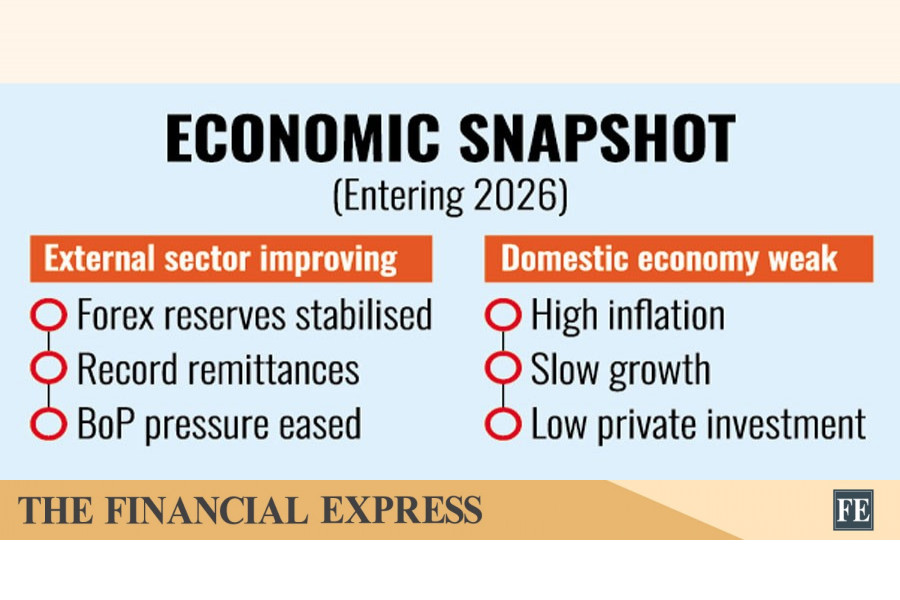
From a macroeconomic perspective, Bangladesh steps in 2026 with a mixed balance sheet, offering, perhaps, no unmixed blessing.

On the external front, conditions have improved to some extent.

Foreign-exchange reserves have stabilised, remittance inflows reached record levels and pressure on the balance of payments has eased, offering a stronger platform for the next elected government.

"I know the external sector -- for example, reserves and balance of payments -- is now in a favourable position, and this is a good foundation for the next government," Dr Hussain notes.

However, the internal economy remains under strain.

Inflation has stayed stubbornly high, eroding purchasing power, growth slowed while private investment has failed to recover meaningfully.

Employment generation has also remained sluggish, particularly in urban areas, adding to social pressures.

"There has been a drought in investment in the country for several years now," Dr Hussain goes on. "It may pick up once a credible, elected democratic government assumes power."

Economists also warn that without renewed investor confidence and policy predictability, growth could remain stymied below potential despite external stability.

The next administration will also inherit a stack of reform proposals prepared by many commissions set up in recent years by the interim government.

Analysts say translating those reports into action will be a critical test of political will.

"The next government will get a series of commission reports," Dr Hussain mentions. "It should prioritise these to strengthen governance and institutions."

Dr M Masrur Reaz, chairman and chief executive of Policy Exchange Bangladesh, echoes the emphasis on political legitimacy, saying that the election would shape the country's reform prospects.

"There is a huge opportunity, and everything depends on the election," he says. "If it fails, the opportunity will be missed."

He mentions that tensions in the financial sector, particularly in banking, have eased to some extent over the past year, but deep-rooted vulnerabilities remain.

"Banks, non-banks and the insurance sector still need much stronger governance," Dr Masrur recommends, citing weak supervision, rising non-performing loans and persistent confidence gaps.

From the business community, expectations are similarly tied to political stability.

Abul Kasem Khan, chairman of BUILD -- Business Initiative Leading Development -- says businesses are hoping for a credible election followed by decisive reforms.

"We hope the next elected government will take reform steps and expedite business activities."

He stresses the need for faster public services through digital platforms, along with reforms in licensing and taxation to make administration more business-friendly.

Logistics and port inefficiencies remain major bottlenecks, he points out, despite reform initiatives taken by the interim government.

"There is scope for much more reform to make domestic trade efficient," Mr Khan told The Financial Express, urging the next government to fast-track the long-delayed Bay Terminal project in Chattogram, which he argues is a major opportunity for the economy.​
 
Analyze

Analyze Post

Add your ideas here:
Highlight Cite Fact Check Respond

Members Online

⤵︎

Latest Posts

Latest Posts