Donate ☕
201 Military Defense Forums
[🇧🇩] - Monitoring Bangladesh's Economy | Page 181 | PKDefense
Home Post Alerts Inbox Watch Videos

[🇧🇩] Monitoring Bangladesh's Economy

Reply (Scroll)
Press space to scroll through posts
G Bangladesh Defense
[🇧🇩] Monitoring Bangladesh's Economy
933
24K
More threads by Saif

Remittances hit record $32b in 2025, shoring up reserves

1767316496352.webp


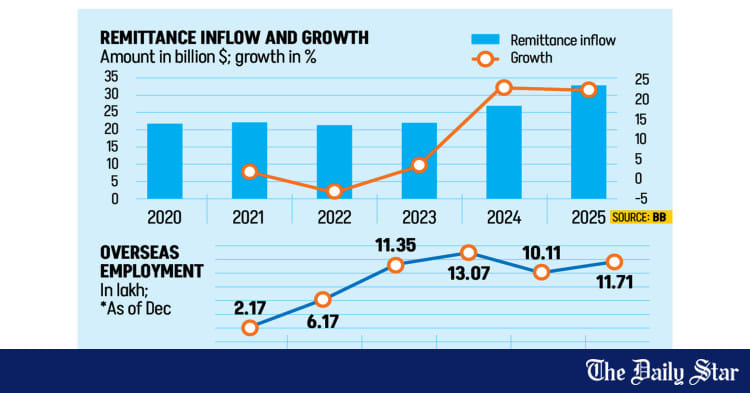
Bangladeshis abroad sent home a record $32.8 billion in 2025, according to central bank data, as economists say more expatriates are now using formal banking channels, with informal routes siphoning off less since the August political changeover.

The historic-high inflows offered a much-needed tonic to the country's fragile external balance.


The amount is 22 percent higher than the $26.88 billion recorded in the previous year, according to Bangladesh Bank (BB) data released yesterday.


In December alone, remittances reached $3.22 billion, the highest monthly inflow in nine months, up 22 percent from the same month last year.


Foreign currency streaming in helped lift gross reserves to $33.18 billion on December 30, up from $25 billion a year earlier.

"Remittances have been a key driver for the recent increase in reserves, indicating improved performance of the external sector," said Mohammed Nurul Amin, former chairman of the Association of Bankers Bangladesh (ABB).


After the fall of the previous government, remittance inflows started to rise every month. Previously, demand for hundi was growing amid large sums of money reportedly being siphoned abroad


"Forex reserve figures are now closely watched, as a rise strengthens confidence and attracts foreign interest," he said.


He hoped that the trend could ease pressure on the external sector in the months ahead.


During the July-December period last year, expatriates sent home $16.26 billion, an 18.1 percent increase on the same period in 2024, according to the BB data.


Industry insiders said government incentives, banks' efforts to attract foreign funds, and the decline of the hundi system -- an illegal yet popular cross-border transfer mechanism -- helped push inflows higher after the political changeover in August 2024.


After the fall of the previous government, remittance inflows started to rise every month. Previously, demand for hundi was growing amid large sums of money reportedly being siphoned abroad. That stopped under the interim government.


Mohammed Nurul Amin, former independent director and chairman of Global Islami Bank, said incentives have played a major role in boosting the inflow. "As a result, people are sending more money through formal channels," he added.

Remittance senders currently get a 2.5 percent government incentive.


He also pointed to a psychological change after the fall of the previous government. "People believe that corruption is no longer as prevalent as before," he said, adding that overseas employment has risen, with more skilled workers leaving home for jobs abroad.


Between January and December 28 last year, as many as 1,116,725 men and women went overseas. In 2023, 1,303,453 workers went abroad, while 1,011,969 left the country for overseas jobs in 2024, according to official data.


According to the Bureau of Manpower, Employment and Training, Saudi Arabia welcomed 744,619 Bangladeshi workers, Qatar 106,805, and Singapore 69,491 during the first 11 months and 28 days of the year.


Zahid Hussain, former lead economist at the World Bank's Dhaka office, said more expatriates are using official channels because less money is now being siphoned abroad, reducing demand for hundi transfers.


"Higher reserves boost confidence in the exchange rate, thereby limiting depreciation," said the economist. "Although investment may rise after the election, the strong reserve position should prevent pressure on the exchange rate."


In December, Islami Bank Bangladesh received the highest inflow at $671 million, followed by Bangladesh Krishi Bank with $353 million, Janata Bank $281 million, and BRAC Bank $261 million, showed BB data.


With rising remittances easing demand for US dollars, the central bank purchased over $3 billion in the current fiscal year, a reflection of ongoing efforts to shore up foreign exchange reserves.​
 
Analyze

Analyze Post

Add your ideas here:
Highlight Cite Fact Check Respond
  • Like (+1)
Reactions: Bilal9
Bangladesh economy in 2025 and expectations for 2026

1767317194954.webp

VISUAL: ANWAR SOHEL

When the interim government formed following the July 2024 uprising, macroeconomic stability was weak, with several major economic indicators performing poorly. The accumulated costs of governance failures, corruption, and prolonged financial mismanagement had undermined the economy's potential. Since then, the free fall of the economy has been halted, and some negative trends have been reversed. However, the economy now experiences slower growth, elevated inflation, weakened investment sentiment, and rising vulnerabilities in the financial sector.


The macroeconomic environment in Bangladesh in the fiscal year (FY) 2025 (July 2024 - June 2025) and early FY2026 reflects a fragile and uneven recovery. Real growth of Gross Domestic Product (GDP) moderated sharply, registering only 3.97 percent in FY2025. While this represents a partial rebound from the disruptions caused by political unrest, it remains significantly below the country's historical average and far from the levels required to generate adequate employment for a rapidly growing labour force. Industrial production trends suggest that the recovery is underway. However, the pace is slow and insufficient to compensate for earlier losses or to drive a broad-based industrial resurgence.


Inflation remains one of the most persistent macroeconomic challenges. However, headline inflation eased to 8.29 percent in November 2025, largely driven by a deceleration in food prices rather than a comprehensive easing of price pressures across the economy. Although food inflation fell to 7.36 percent during this period offering some relief to households, it is still not at comfort levels as wage growth has failed to keep pace with rising living costs. The wage rate index was 8.04 in November 2025, slightly increased from 8.01 in October 2025. This implies stagnant real wages and eroding purchasing power for large segments of the population, rising vulnerability among low-income groups, and subdued consumer demand.

Weak private investment is another defining feature of the current macroeconomic landscape. Private sector credit growth fell to 6.23 percent in October 2025, reflecting subdued credit demand and tighter lending conditions in the banking system. This contraction signals investor uncertainty, driven by political instability, policy unpredictability, and longstanding governance failures in the financial sector. By contrast, public sector credit growth surged to 24.11 percent over the same period, indicating a growing reliance by the government on domestic borrowing to finance its operations. While such borrowing may be necessary in the short term to maintain fiscal stability, it risks crowding out private investment and exacerbating pressures on the banking system if not carefully managed.


In the banking sector, several banks have struggled to mobilise deposits amid declining public confidence, while non-performing loans (NPLs) have continued to rise. The NPL was 35.73 percent of total disbursed loans as of September 2025, mostly due to the recent scrutiny of several banks' health by the Bangladesh Bank. Earlier, several non-compliant commercial banks would hide the actual amount of NPLs. This alarming figure is not merely a cyclical phenomenon but the result of years of weak regulation, political interference, and repeated loan rescheduling that masked underlying insolvency. The persistence of such vulnerabilities threatens financial stability and undermines the transmission of monetary policy.

Fiscal performance has also weakened. With a tax-to-GDP ratio of only 6.8 percent in FY2025, Bangladesh continues to lag behind its regional peers, limiting the government's capacity to finance development spending without resorting to borrowing. At the same time, growth in public expenditure, particularly development expenditure, declined sharply throughout FY2025, raising concerns about the sustainability of infrastructure investment, human capital formation, and long-term growth potential. The combination of weak revenue mobilisation and constrained development expenditure poses a serious challenge to fiscal sustainability.

External sector indicators present a mixed picture. Export growth was 8.6 percent in FY2025. However, during July–November FY2026, export growth remained sluggish, registering only a marginal increase of 0.62 percent. In contrast, imports rebounded strongly, growing by 5.2 percent during July–November FY2026, driven primarily by higher imports of intermediate goods. While this may signal a gradual revival of industrial activity, it also underscores renewed pressures on the balance of payments.


Remittance inflows have provided a critical stabilising force. During July–November FY2026, remittances reached $13.04 billion, representing a year-on-year increase of over 17.1 percent and reflecting both increased overseas employment and policy measures to receive remittances through formal channels. While this marks a notable improvement from earlier lows, reserves remain vulnerable to external shocks and shifts in global financial conditions.

Other structural challenges compound economic pressure. Private investment fell to 22.48 per cent of GDP in FY2025, its lowest level in five years, raising concerns about future growth and job creation. The energy sector continues to impose heavy fiscal burdens due to high generation costs, unplanned capacity expansion, and excessive capacity payments. Most critically, Bangladesh is set to graduate from Least Developed Country (LDC) status in November 2026, which entails the gradual withdrawal of trade preferences, currently covering approximately 70 percent of global exports. Without adequate preparation, this transition could erode export competitiveness and expose structural weaknesses.

Looking ahead, the outlook for FY2026 indicates a modest recovery, although some risks remain. The Medium Term Macroeconomic Policy Statement of June 2025 by the Ministry of Finance projectd GDP growth to be 5.5 percent and inflation 6.5 percent in FY2026. On the other hand, the Bangladesh Bank forecasts real GDP growth to be 5.38 percent and average inflation to come down to 7.26 percent in FY2026.


Clearly, in the short term, stabilising the macroeconomic environment must be the top priority. Inflation control will require a careful balance between monetary tightening and supportive fiscal measures to protect vulnerable groups. Addressing NPLs and strengthening bank governance are critical to restoring confidence in the financial system and reviving private investment. Policy consistency, regulatory transparency, and political stability will be essential to improve the investment climate.

Over the medium to long term, deeper structural reforms are unavoidable. Strengthening the institutional independence and capacity of the central bank is crucial for effective monetary management. Industrial policy must focus on productivity, skills development, and technological upgrading to diversify exports beyond garments. Social safety nets need to be expanded and better targeted to protect those left behind by structural change. Skills development programmes must be aligned with market needs, particularly for youth and women. Broadening the tax base and reducing reliance on indirect taxation are essential for fiscal sustainability. Investment in climate resilience and disaster preparedness is increasingly urgent in a climate-vulnerable economy. Above all, transparent and accountable governance must be restored to rebuild trust and unlock long-term growth potential.

Dr Fahmida Khatun is executive director at the Centre for Policy Dialogue.​
 
Analyze

Analyze Post

Add your ideas here:
Highlight Cite Fact Check Respond
  • Like (+1)
Reactions: Bilal9
Remittances hit record high in 2025

Overseas workers send a historic $32.82b, easing pressure on external accounts


FE REPORT
Published :
Jan 02, 2026 08:27
Updated :
Jan 02, 2026 08:27

1767401994194.webp


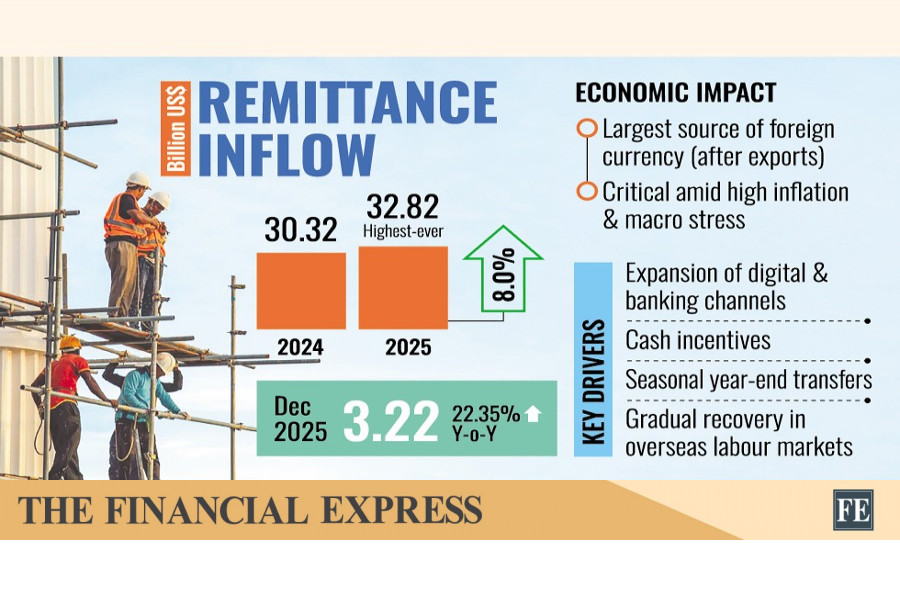
Remittance inflows to Bangladesh surged to an all-time high of US$32.82 billion in the calendar year 2025, underscoring the growing role of migrant workers in supporting the country's economy at a time of persistent domestic and global challenges.


The record inflows have provided crucial relief to the external sector, bolstering the current-account balance, strengthening foreign- exchange reserves and stabilising the forex market, even as concerns lingered over global uncertainty and tighter immigration policies in key host countries.

The 2025 figure marks an increase of more than 8.0 per cent from the US$30.32 billion received in 2024, according to Bangladesh Bank data released on Thursday.

December capped the year on a strong note, with inward remittances reaching US$3.22 billion during the month, up 22.35 per cent year-on-year.

The strong performance contrasts with earlier concerns that global economic uncertainty and tighter immigration policies in some host countries, including the United States, could dampen inflows.

Remittances remain the country's single largest source of foreign currency, surpassing foreign direct investment and official development assistance, except for export earnings.

Central bankers and commercial bankers attribute the rise to a combination of factors, including cash incentives for remitters, the seasonal tendency of overseas workers to send more money in December, and a gradual recovery in labour markets across several major destination countries.

"Banks have expanded digital and banking channels for overseas workers, making formal transfers cheaper, easier and more convenient," said Syed Mahbubur Rahman, managing director and chief executive officer of Mutual Trust Bank PLC.

He said the wider use of digital platforms is helping divert remittance flows from the informal hundi system to regulated channels, improving transparency and lifting official inflow figures.

The increase in remittances is particularly significant as the central bank and the government seek to restore macroeconomic stability, amid persistently high inflation, said Dr Zahid Hussain, an independent economist.

He noted that stronger inflows have placed the external sector in a more comfortable position.

"However, the sustainability of remittance growth will depend on labour market conditions abroad and a stable political and economic environment at home," he added.

According to the Bureau of Manpower, Employment and Training (BMET), more than 4.0 million Bangladeshis left the country for overseas employment over the four years up to fiscal year 2024-25, reinforcing the critical role of migrant workers in the national economy.​
 
Analyze

Analyze Post

Add your ideas here:
Highlight Cite Fact Check Respond
  • Like (+1)
Reactions: Bilal9
I am flabbergasted that Sheikh Bashiruddin of Akij Bashir group (as interim govt. aviation adviser) led the decision to purchase Boeing aircraft and almost cent percent positive that he had no corrupt personal gains whatsoever. When (oh when?) will we get ministers as honest and incorruptible as Bashir Saheb?
Here is Bashir Saheb with his team - ready with Polo shirts and not staid suits. A new generation of worldly leaders.
View attachment 23393
Here are some of their stellar products.
Just a few videos will give everyone some idea of how refined their manufacturing approach is, clearly some of the finest operations in South Asia and price competitive to boot for global exports.


Last edited:
Analyze

Analyze Post

Add your ideas here:
Highlight Cite Fact Check Respond
Political stability vital to sustain economic momentum: DCCI

FE REPORT
Published :
Jan 04, 2026 07:40
Updated :
Jan 04, 2026 07:40

1767505787512.webp


Dhaka Chamber of Commerce & Industry (DCCI) has called for prudent, timely and effective economic measures to safeguard Bangladesh's economic momentum in 2026, amid political tension ahead of the 13th national election scheduled to be held on 12 February.
FE

In this context, DCCI urges the interim government, political parties and all relevant stakeholders to ensure a peaceful, inclusive and credible election process, as political stability is the key to sustainable economic recovery and investment growth.

Dhaka Chamber believes that a stable political environment during the post-election period will boost the confidence of the local entrepreneurs and foreign investors, according to a statement issued on Saturday.


To accelerate economic recovery this year, DCCI calls upon the government to prioritise the improvement of overall law and order situation, ensure uninterrupted and affordable energy supply to industries, enhance ease of doing business, reduce the cost of doing business and strengthen infrastructure and policy frameworks to attract both domestic and foreign investment.

DCCI further stressed the need for export diversification, targeted support for potential export sectors, easier access to finance for CMSMEs and the development of a skilled workforce to complement the process.

The ongoing energy crunch and high energy prices continue to disrupt manufacturing and industrial production, eroding Bangladesh's competitiveness in international markets.

DCCI reiterates the need for a long-term, predictable energy pricing policy, alongside accelerated gas exploration, diversification of energy import sources, and the expansion of long-term energy supply agreements.

The persistent foreign exchange pressure and currency depreciation have further negatively impacted the financial sector, also affecting imports of fuel, raw materials, and intermediate goods for export-oriented industries, as per the statement.

DCCI is of the opinion that currency swap can be considered on a priority basis for essential import payments. Besides enhanced incentives for remittance inflows are necessary to stabilise foreign exchange reserves.

At the same time, fiscal discipline, improved project implementation efficiency, reduced reliance on bank borrowing and good governance are essential to ease liquidity pressure in the financial sector, it stated.


DCCI also expresses concern that excessive government borrowing from the banking sector could shrink private-sector credit growth. This tendency also contracts the investment and employment growth of the local manufacturing and CMSMEs.

Dhaka Chamber also underscores the importance of full automation of revenue management, modernisation of tax laws, expansion of the tax base and strict measures to prevent harassment of compliant taxpayers.​
 
Analyze

Analyze Post

Add your ideas here:
Highlight Cite Fact Check Respond

Members Online

⤵︎

Latest Posts

Latest Posts