Donate ☕
201 Military Defense Forums
[🇧🇩] - Textile & RMG Industry of Bangladesh | Page 84 | PKDefense
Home Post Alerts Inbox Watch Videos

[🇧🇩] Textile & RMG Industry of Bangladesh

Reply (Scroll)
Press space to scroll through posts
G Bangladesh Defense
[🇧🇩] Textile & RMG Industry of Bangladesh
420
16K
More threads by Saif

Spinners, apparel exporters differ over extra duty on yarn imports

To decide the way forward, Trade and Tariff Commission is meeting today with spinners, garment makers and knitwear manufacturers

1767836521126.webp


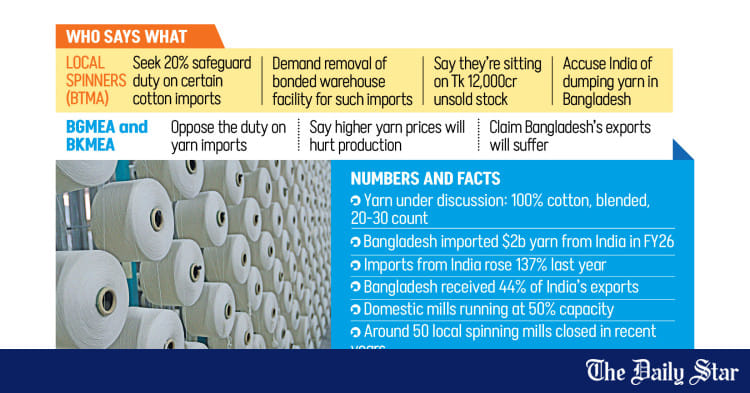
Apparel and knitwear manufacturers have opposed a proposed 20 percent safeguard tariff after local spinners asked the Bangladesh Trade and Tariff Commission to recommend it on imports of 100 percent cotton and blended yarns in the 20-30 count range.


The manufacturers said such a tariff would force them to buy local yarn at higher prices, hurt production, and ultimately affect exports.


Local spinners, however, argued that the safeguard duty is necessary to protect the domestic industry. In the last week of December, they accused India of dumping cheap yarn in Bangladesh and said they were sitting on Tk 12,000 crore of unsold stock.

Domestic spinners claim they can meet the entire national demand for 100 percent cotton and blended yarns, including PC, CVC, PV, and grey melange.


In addition to the tariff, the Bangladesh Textile Mills Association (BTMA) requested the cancellation of the bonded warehouse facility for these yarns, according to multiple sources familiar with the matter.

Against this backdrop, the Bangladesh Trade and Tariff Commission, the statutory body responsible for preventing dumping of foreign goods, convened a meeting with spinners, garment makers and knitwear manufacturers today.

The commission had already held a session earlier this week on the proposed safeguard measure.


The proposal has drawn opposition from the Bangladesh Garment Manufacturers and Exporters Association (BGMEA) and the Bangladesh Knitwear Manufacturers and Exporters Association (BKMEA).

In separate letters to the commission, both trade bodies said imposing a 20 percent safeguard duty on yarn imports would put the export-oriented garment sector in serious trouble.

They said the sector will lose its global competitiveness if yarn prices rise as a result of the safeguard duty. They called on the government to improve gas and power supply to industrial units so mills can produce sufficient yarn, and requested incentives to make the domestic mills more competitive.

In the last week of December, Showkat Aziz Russell, president of the BTMA, said at a press conference in Dhaka that local spinning mills were left with Tk 12,000 crore of unsold yarn as cheap imports from India flooded the market.

He said that yarn imports from India rose 137 percent last year, being sold below domestic prices, and that nearly 50 local spinning mills have closed in recent years after failing to survive the competition.

While apparel makers and knitwear manufacturers in their letters said that the government cannot impose such a measure on any particular country under World Trade Organization (WTO) rules, Russell also said the BTMA does not want a 20 percent safeguard duty targeting any single country.

"It is not possible to impose such a tariff on a particular country under the WTO rules," he said. Instead, he called for subsidies on the use of local yarn to make the sector more competitive.

He told The Daily Star yesterday that the amount of stockpiled yarn has decreased somewhat as spinning mills have reduced production due to low demand.

Local spinners are operating at around 50 percent capacity because of low gas pressure, he added.

According to Russell, the total investment in the garment and primary textile sectors is more than $75 billion, including $23 billion in the primary textile sector. Combined, the two sectors contribute $40 billion in exports.

BTMA leaders said Bangladesh imported $2 billion worth of yarn from India in fiscal year 2025-26, with local mills consuming 1,600 tonnes daily. From April to October 2025, imports reached $950 million.

They said Bangladesh has become the largest destination for Indian yarn exports, receiving 44 percent of the total, while Cambodia ranks second at 21 percent.​
 
Analyze

Analyze Post

Add your ideas here:
Highlight Cite Fact Check Respond
Garment exports to US grew 15% in Jan-Oct

Show US Department of Commerce data


11 January 2026, 00:00 AM
By Refayet Ullah Mirdha

1768115321689.webp

Garment.jpg

Bangladesh’s readymade garment exports to the United States, the country’s largest single-market destination, grew more than 15 percent year-on-year to $7.08 billion in the January-October period, according to US government data.


Local apparel makers say the surge was largely driven by front-loaded shipments ahead of the Trump administration’s reciprocal tariff enforcement.


A temporary 10 percent baseline tariff was applied by the US from part of April to the entire July before higher country-specific rates took effect on August 7 last year. It added with the existing 16 percent, taking the total rate to around 26 percent.

During the low baseline tariff period, local apparel makers say American buyers brought in larger-than-usual consignments. Apparel exporters said this rush pushed overall shipments in the January-October window above normal levels, somewhat masking the basic trend for the rest of the year.


For Bangladesh, a punishing 35 percent reciprocal rate was initially announced in April last year. It was later revised to 20 percent after bilateral negotiations.

The growth came amid a largely flat US apparel market. Total imports from the world by the United States declined 0.61 percent year-on-year to $66.63 billion during the January-October period last year, according to the Office of Textiles and Apparel (OTEXA), an agency under the US Department of Commerce.

Similar to Bangladesh, most other major exporting countries also saw positive growth in the American market during the period.


Vietnam’s exports to the US rose 11.5 percent to $14.16 billion, India’s 8.6 percent to $4.39 billion, Pakistan’s 12.3 percent to $2.02 billion, Indonesia’s 10.1 percent to $3.98 billion, and Cambodia’s 25.5 percent to $4.04 billion.

China was the exception, with exports to the US falling 32.4 percent to $9.49 billion.


During the period, unit prices of Bangladeshi garments declined slightly, reflecting intense competition and cautious buying by US retailers, according to OTEXA data.

The unit price for Bangladeshi items declined 0.63 percent. The decline for Vietnam was 0.46 percent and 10.47 percent for China. Cambodia’s price declined by 7.26 percent, Pakistan’s 6.85 percent and Indonesia’s 2.72 percent, show OTEXA data.

In the case of India, the unit price increased by 1.57 percent during January-October.

Despite the strong headline growth, exporters said momentum began to ease after August. Shipments weakened in October and November, following the enforcement of the higher tariffs.

Anwar-ul Alam Chowdhury (Parvez), former president of the Bangladesh Garment Manufacturers and Exporters Association (BGMEA), said the January-October figures do not fully reflect the year’s underlying trend.

“The growth was concentrated in the early months, when shipments were rushed ahead of tariff enforcement,” he said.

Parvez added that export performance slowed after August but expects shipments to stabilise after Bangladesh’s general election next month, as international buyers are likely to place full work orders once the heated political atmosphere cools off.

Meanwhile, retail sales in the United States posted solid year-on-year growth in November, with early holiday-season activity keeping results on track to meet the National Retail Federation’s (NRF) 2025 spending forecast, the organisation said in a statement recently.

It means the retail buying is likely to consume the fashion inventory, prompting the US buyers to place fresh orders.

“Retail sales showed healthy year-over-year gains in November, while month-on-month data was largely flat,” NRF President and CEO Matthew Shay said.

For large apparel manufacturers like Bangladesh, it is positive news on the export front.

Shay said, “Shoppers looking for online deals may have held back a bit until Cyber Monday, which fell in December this year due to a late Thanksgiving, likely shifting some spending. Consumers are focusing on value and spending carefully during the holiday period, and retailers are offering products at competitive prices to fit every budget.”

“We remain confident in our holiday forecast as well as our retail sales projections for the full year,” he concluded.

 
Analyze

Analyze Post

Add your ideas here:
Highlight Cite Fact Check Respond
Khaleda Zia played pioneering role in RMG growth: BGMEA leaders

By Star Business Report

1768268137744.webp


Khaleda Zia, a three-time prime minister of Bangladesh, played a pioneering role in the growth of the country’s ready-made garment (RMG) sector, according to leaders of the Bangladesh Garment Manufacturers and Exporters Association (BGMEA).


The leaders recalled her contributions at a doa mahfil held yesterday at the trade body’s office in Uttara, Dhaka, attended by several hundred garment entrepreneurs.


In 1991, recognising the potential of the garment industry, Khaleda Zia introduced an innovative policy that allowed BGMEA to issue the crucial Utilisation Declaration (UD) and Utilisation Permission (UP) certificates.

The UD permits the production of a certain quantity of imported fabrics under the bonded warehouse system, while the UP allows the import of raw materials for the export-oriented garment sector.


Before this change, these certificates were issued by the government’s Export Promotion Bureau (EPB), often causing delays that led international clothing brands to shift orders to other countries.

Khaleda Zia’s decision to delegate this authority to BGMEA streamlined the process, supporting private entrepreneurs and accelerating exports.

Thanks to her pragmatic decisions, Bangladesh’s apparel exports crossed the $1 billion mark for the first time during her tenure, BGMEA leaders recalled.


The sector, which had struggled since its inception in 1978 due to limited government support, gained momentum under her leadership.

Khaleda Zia also introduced a high percentage of cash incentives, further enhancing the country’s competitiveness in global markets.


Today, Bangladesh is the world’s second-largest apparel exporter after China, with nearly 8 percent of the global market share.

Over the past five decades, the RMG industry has employed over four million workers, empowered women, contributed 13 percent to the national GDP, and attracted combined investments of $75 billion -- $23 billion in primary textiles and $52 billion in garments.

At the event, Salim Rahman, acting president of BGMEA, said Khaleda Zia played a crucial role during the phase-out of the World Trade Organization’s Multifibre Arrangement in 2004, which ended the quota system on garment exports. She formed the National Coordination Committee and took critical steps to help the industry adjust to the new global trading environment.

“She facilitated ease of doing business, reduced costs, and provided stipends for female education. These decisions brought significant societal changes,” he added.

The event also featured a video documentary highlighting Khaleda Zia’s contributions to reviving the economy, promoting democracy, empowering women, and developing the garment sector.

BGMEA Senior Vice-President Inamul Haq Khan and former president Quazi Moniruzzaman also spoke at the programme.

During Khaleda Zia’s tenure, Bangladesh was ranked the 11th fastest-growing country globally in 2005, and an estimated 1.8 crore people were lifted above the poverty line, BGMEA leaders said, adding that her VAT reforms were widely recognised.​
 
Analyze

Analyze Post

Add your ideas here:
Highlight Cite Fact Check Respond
Bangladesh to showcase global textile leadership at Heimtextil 2026

BSS
Published :
Jan 13, 2026 22:05
Updated :
Jan 13, 2026 22:05

1768351113636.webp

Bangladesh is set to reinforce its position as a global powerhouse in the textile sector by participating in Heimtextil 2026, the world’s largest trade fair for home and contract textiles.

Scheduled to take place from January 13–16, 2026, in Frankfurt, Germany, the event serves as a critical platform for setting the year’s design trends and fostering international business growth.

As a key supplier in the global textile market, Bangladesh’s participation is strategically designed to help exporters engage with European buyers, explore new markets, and gain insights into emerging international trends.

The fair provides a global stage to highlight the country’s skill and quality, ranging from traditional products like towels and bedding to specialized items such as carpets, bath products, and sun-protection materials.

The Bangladeshi delegation will consist of a robust mix of direct exhibitors and companies supported by the Export Promotion Bureau (EPB).

The direct exhibitors include leading industry names such as ACS Textile (Bangladesh) Limited, Artisan House BD Ltd, Debonair Padding & Quilting Solution Ltd, Hossain Dyeing and Printing Mills Ltd (Unit-2), Karupannya Rangpur Ltd, Naheed Fine Tex Ltd, Noman Terry Towel Mills Ltd, Shabab Fabrics Ltd, Towel Tex Ltd and Zaber & Zubair Fabrics Limited / NICE Group.

Additionally, Jaantex Industries Ltd, Maanuri Textile Mills, and Stylus Towels Ltd will participate under the support of the EPB, ensuring a comprehensive representation of the nation’s textile diversity.

Heimtextil 2026 will not only focus on finished goods but also on the future of manufacturing.

Bangladeshi companies will have the opportunity to align with new technologies, including AI-assisted design and sustainable production methods, which are increasingly vital for maintaining a competitive edge in the global market.

This participation is expected to strengthen Bangladesh’s global presence, allowing local manufacturers to connect with new customers and demonstrate the high-quality craftsmanship that defines the nation’s textile industry.​
 
Analyze

Analyze Post

Add your ideas here:
Highlight Cite Fact Check Respond
Bangladesh's textile machinery sector blends strong domestic manufacturing (S. Alam Group, Square Textile) with significant international imports (Rieter, Picanol), driven by its massive RMG industry, creating high demand for machinery in spinning, weaving, dyeing, and garment production, with trends towards automation and smart tech for efficiency. The market is expanding rapidly, positioning the nation as a key hub for both machine sales and modern textile production, notes Fabric Lagbe and SUNTECH Textile Machinery.

Key Aspects of Machinery Production & Supply
  • Domestic Manufacturers: Local companies like S. Alam Group, Square Textile, Textech Industries, and Pacific Associates provide machinery tailored to local needs.
  • International Suppliers: Global leaders such as Rieter, Trützschler, Toyota, Picanol, and Loptex supply advanced technology, ensuring competitiveness.
  • Key Players/Suppliers: Other significant entities include Roots Sourcing, Viyellatex Group, and local dealers listed on platforms like Textile Infomedia.
  • Market Growth: The machinery market is experiencing significant growth (around 20% annually), driven by increased productivity demands and shifts in global apparel production.
Industry Demand & Trends
  • High Demand: The booming Ready-Made Garment (RMG) sector creates substantial demand for all types of textile machinery, from yarn to finished garments, notes sagartexbd.net and afshanrehman.com.
  • Automation & Industry 4.0: Bangladesh is increasingly adopting smart technologies, data analytics, and automation to boost efficiency in spinning and other processes.
  • Integrated Solutions: Vertical integration (from yarn to garment) is common, with companies like Viyellatex Group handling multiple stages.
Market Dynamics
  • Import Reliance: While local production exists, Bangladesh relies heavily on imported, advanced machinery to stay competitive globally, according to Posh Garments Ltd. and China Bangla Engineers & Consultants Ltd.
  • Export Hub: The country's status as the world's second-largest apparel exporter underpins a vast need for machinery, attracting global tech providers, according to SUNTECH Textile Machinery.
 
Analyze

Analyze Post

Add your ideas here:
Highlight Cite Fact Check Respond

Members Online

⤵︎

Latest Posts

Latest Posts