Donate ☕
201 Military Defense Forums
[🇧🇩] - Textile & RMG Industry of Bangladesh | Page 83 | PKDefense
Home Post Alerts Inbox Watch Videos

[🇧🇩] Textile & RMG Industry of Bangladesh

Reply (Scroll)
Press space to scroll through posts
G Bangladesh Defense
[🇧🇩] Textile & RMG Industry of Bangladesh
420
16K
More threads by Saif

DUMPING-RATED YARN INFLUX IMPERILS DOMESTIC INDUSTRY
Manufacturers fret over Tk120b unsold apparel raw material

Neighbouring traders pushing in knitting threads at rates deep down market value, millers say

1766970569929.webp

Published :
Dec 29, 2025 00:22
Updated :
Dec 29, 2025 00:22

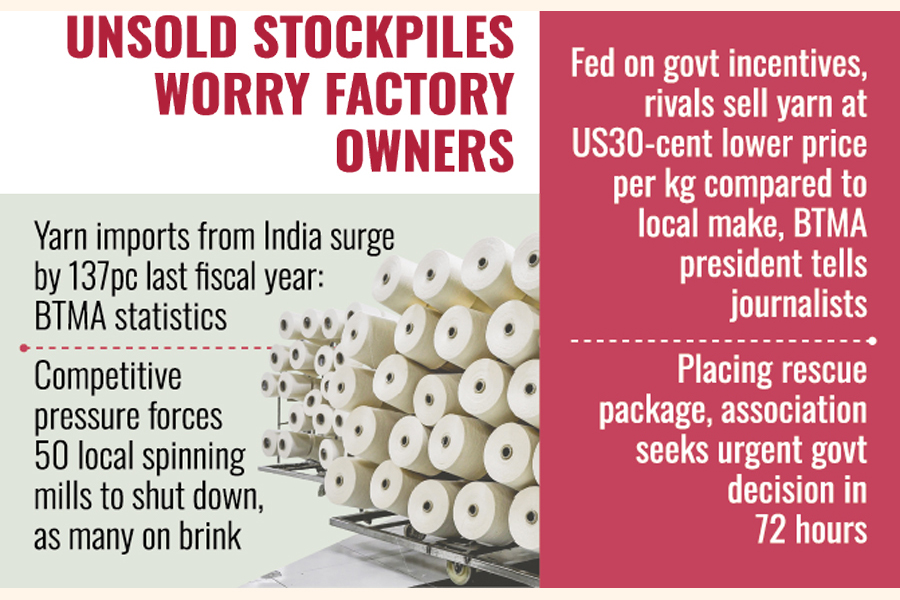
Millers fret over a stockpile of unsold local yarn worth Tk 120 billion amid massive influx of the cheap-rated clothing raw material, allegedly meant to undercut domestic industry, manufacturers say.

The country's primary textile millers, especially spinners, say yarn imports from India increased 137 per cent last fiscal year as traders over there are dumping the raw material at significantly cut-down prices.

This competitive pressure has already forced 50 local spinning mills to shut down while another 50 are on the verge of closure, threatening the stability of the country's garment sector and its reliance on foreign raw materials.

Bangladesh Textile Mills Association (BTMA) president Showkat

Aziz Russell made the remarks at a press conference held Sunday at Gulshan Club in Dhaka.

The BTMA president alleged that Indian traders kept dumping yarns into Bangladesh at US30-cent lower price per kg than that of local make as their government provides a number of incentives.

Citing the closure of one of his cotton mills out of five, he said another one was going the same way.

"Reopening those closed mills where Tk 5.0 billion to Tk 7.0 billion has been invested is difficult," the association chief says, adding that some 0.2 million workers lost their employment following the shutdown.

He mentions that yarns worth of Tk 100 billion, if price is calculated at Indian rates, remained unsold in the spinning mills due to the influx of Indian yarns. He hastens to add that the original price of the unsold yarn would be Tk 120 billion.

The mill owner, however, makes it clear they are not against yarn import from the neighbouring country rather they want a reduction in gaping trade deficit.

"We should reduce such huge dependency on Indian yarn," the BTMA leader told the reporters, recalling the past instances when India had halted cotton and yarn export to Bangladesh.

The association comes up with a number demands meant for a remedy, by way of helping local spinning mills to reduce cost of production and sustain competitiveness.

They seek urgent government decision within 72 hours to salvage the crisis-hit textile sector.

The BTMA demands include 10-percent cash incentives on local yarn use, reducing gas price and bank interest rates, an extension in loan- repayment periods, enhancing the Export Development Fund and providing the funds at 1.0-percent interest.

Speaking there, A Matin Chowdhury, former president of BTMA, stressed stopping import of Indian yarns which are locally available and demanded financial supports to reduce the production cost to be competitive.

"Local yarn prices compared to that of Indian variety are not that high," he said, explaining that India offers a number of benefits, including incentives, to keep their yarn prices low.

Former BTMA director Rajib Haider demands safeguard measures against imported yarns which local spinners have the capability to produce.

Speaking at the news conference, former president of the association Mohammad Ali Khokon demanded separate window at the central bank for textile industry and an increase in the loan-repayment schedule with two years' grace period.​
 
Analyze

Analyze Post

Add your ideas here:
Highlight Cite Fact Check Respond
Textile sector needs urgent support

MIR MOSTAFIZUR RAHAMAN
Published :
Dec 29, 2025 23:18
Updated :
Dec 29, 2025 23:18

1767055632059.webp

The country's textile sector, the backbone of export economy and the foundation on which the garment industry stands, is facing an existential crisis. Nowhere is this more evident than in the country's spinning mills, where mounting losses, policy inertia and external pressures are pushing an entire industry to the brink. The Bangladesh Textile Mills Association (BTMA) on Sunday issued a stark warning: unless the government takes effective decisions within the next 72 hours, domestic yarn and textile production could suffer irreversible damage.

This is not the language of routine lobbying. It is the alarm of an industry that has exhausted its buffers and is now fighting for survival.

According to industry leaders, the situation is no longer tolerable. Many mills have already shut down, while others are operating far below capacity. If current trends continue, they warn, the entire sector could collapse. Bangladesh currently has more than 500 spinning mills, yet a significant number are now being forced to sell yarn below production cost -- an unsustainable practice that guarantees losses rather than recovery.

At the heart of the crisis lies a deadly combination of rising production costs and distorted market competition. Energy prices, particularly gas, remain a critical burden. Textile entrepreneurs point out a glaring inconsistency in policy: when global gas prices rise, domestic tariffs are promptly increased; but when international prices fall to historic lows, local industries see no relief. For an energy-intensive sector such as spinning, this asymmetry is devastating.

The result is predictable. Mills bleed cash. Working capital dries up. Debt mounts. And confidence evaporates.

The problem is compounded by dumping practices, particularly yarn imports from India at prices that domestic producers simply cannot match. Industry insiders allege that Indian exporters are selling yarn in Bangladesh at around 30 cents less per unit than in their own domestic market. Such pricing, whether driven by subsidies, excess capacity or strategic market capture, has wreaked havoc on local production.

This is not merely a question of trade competition; it is a question of industrial sovereignty. Bangladesh has been here before. Industry leaders recall that in the past, when domestic textile mills collapsed, India suspended exports of cotton and yarn, exposing Bangladesh's dangerous dependence on imports. To allow the same vulnerability to re-emerge would be a strategic failure.

An import-dependent textile base is a contradiction in terms for a country whose global reputation rests on its garments industry. The spinning and textile sectors are not peripheral players; they are the supply chain's foundation. Undermine them, and the entire apparel ecosystem -- from small factories to multinational buyers -- becomes hostage to external shocks.

The scale of distress is visible in the numbers. Spinning mills are currently holding unsold yarn worth approximately Tk 120 billion. This idle inventory represents frozen capital, rising interest costs and shrinking liquidity. For many entrepreneurs, it is the final straw.

Yet this crisis is not inevitable. It is the outcome of policy choices -- and policy neglect.

Bangladesh's economic success over the past three decades has been built on a simple but powerful strategy: value addition at home. The textile sector allowed the country to move beyond basic assembly into integrated production, reducing lead times, stabilising costs and increasing competitiveness. To let this achievement unravel would be to reverse decades of progress.

The government's response so far has been cautious, even hesitant. But caution, at this moment, risks becoming complicity. What the sector requires is not sympathy, but decisive intervention.

First, energy pricing must be rationalised. Domestic gas tariffs for export-oriented and backward-linkage industries should reflect global market realities. If international prices fall, domestic industries should benefit. Without competitive energy costs, no spinning mill can survive -- regardless of efficiency or scale.

Second, dumping must be confronted head-on. Bangladesh has the legal and institutional tools to impose anti-dumping duties and safeguard measures under World Trade Organization rules. What has been missing is the political will to deploy them swiftly and credibly. Protecting domestic industry from unfair trade practices is not protectionism; it is responsible governance.

Third, targeted financial relief is essential. Temporary support mechanisms -- whether in the form of low-interest working capital loans, rescheduling of existing debt or tax relief -- could provide breathing space for mills struggling under unsold inventories and cash flow shortages. Without liquidity, even viable businesses collapse.

Fourth, policy coherence must replace fragmentation. The textile sector sits at the intersection of energy policy, trade policy, fiscal policy and industrial strategy. Treating these in isolation has produced the current crisis. A coordinated, whole-of-government approach is long overdue.

The closure of some factories is not a market correction driven by inefficiency, but a systemic failure caused by distorted inputs and unfair competition. Allowing mass closures under these conditions would destroy productive capacity that cannot be easily rebuilt.

The consequences would extend far beyond spinning mills. Garment manufacturers would face higher input costs and longer lead times. Employment would be lost -- not just in factories, but across logistics, transport and services. Export earnings would come under pressure. And Bangladesh's hard-earned reputation as a reliable sourcing destination would suffer.

There is also a political dimension. Industrial decline fuels social instability. Idle factories mean idle workers, rising loan defaults and growing resentment. At a time when the country is navigating political transition and economic uncertainty, allowing such a strategic sector to implode would be reckless.

The BTMA's 72-hour ultimatum should not be dismissed as exaggeration. It reflects the urgency felt on factory floors, in boardrooms and in bank offices across the country. Decisions delayed today will be closures tomorrow.

Saving the textile sector is not about favouring one industry over another. It is about safeguarding the structural integrity of Bangladesh's economy. It is about recognising that backward linkage industries are national assets, not disposable entities.

History will judge this moment. Either the government steps in with clarity, courage and speed -- or it presides over the slow dismantling of one of the country's most critical industrial pillars.

Bangladesh built its development story on textiles. Abandoning that foundation now would be an unforgivable mistake.​
 
Analyze

Analyze Post

Add your ideas here:
Highlight Cite Fact Check Respond
RMG exporters to shoulder EU tariffs in post duty-free era
Study warns of pressure on profits
1767056946364.webp

Photo: Amran Hossain

Bangladeshi apparel exporters are likely to absorb much of the future EU tariffs by cutting their own prices once duty-free access ends, according to a new study that warns of pressure on profits and long-term competitiveness.

If the EU imposes a 10 percent tariff on Bangladeshi garments after the end of trade preferences, exporters will need to cut their pre-tariff export prices by about 4 percent to remain competitive, according to the study on tariff and exchange rate pass-through in apparel exports to the EU. Tariff pass-through refers to the extent to which exporters transfer new tariffs to buyers in their selling price.

This means that nearly 40 percent of the tariff cost would be absorbed by exporters themselves, rather than being fully passed on to European buyers or consumers.

The study, presented at an event in Dhaka organised by the Research and Policy Integration for Development (RAPID) in collaboration with the International Growth Centre (IGC), examines how exporters are likely to respond to higher tariffs and exchange rate movements after Bangladesh graduates from least developed country (LDC) status in 2026.

Duty-free and quota-free access to the EU under the Everything But Arms (EBA) scheme is set to end in 2029, following a transition period.

Once preferences expire, apparel exports, more than 90 percent of which consist of low-value garments, could face Most Favoured Nation (MFN) tariffs of about 12 percent.

Using a counterfactual pricing model based on comparator exporting countries, the researchers find that tariff pass-through is likely to be incomplete in such a scenario.

Instead of transferring higher tariffs to buyers, exporters are expected to lower their own prices to protect market share in the EU, a strategy that may help sustain export volumes in the short term but would significantly compress profit margins.

The study cautions that prolonged price absorption could weaken firms' capacity to invest, upgrade technology and move into higher-value segments.

The research also suggests that exchange rate depreciation will provide only partial relief after preference erosion.

"About half of changes in the exchange rate are passed through to export prices, suggesting that currency depreciation alone cannot neutralise the impact of higher tariffs," said Md Deen Islam, research director of the RAPID, while presenting the keynote paper.

This is particularly relevant as Bangladesh has moved toward a more market-based exchange rate regime since mid-2024, increasing volatility for exporters.

Despite recent nominal depreciation of the taka, Bangladesh experienced a prolonged period of real exchange rate appreciation between 2012 and 2022, making its exports progressively more expensive relative to competitors such as China, Vietnam and Cambodia, said Islam.

Combined with rising tariffs, this trend has further squeezed exporters who already compete primarily on price.

The study identifies significant variation across product categories, with woven garments emerging as more vulnerable than knitwear.

At the event, Munir Chowdhury, national trade expert of the Bangladesh Regional Connectivity Project-1 under the commerce ministry, said non-tariff barriers can often be more restrictive than tariffs, underscoring the need for early preparation.

He warned that growing requirements related to human rights, labour standards and environmental, social and governance (ESG) compliance could increasingly shape the future sustainability of Bangladesh's export markets.

Echoing the same, Badrun Nessa Ahmed, senior research fellow at BIDS, said Bangladesh's competitiveness in the EU market depends not just on price but also on compliance, standards, logistics, and branding.

She noted that Bangladesh has 4-5 years before full preference erosion, giving time for policy and firm-level adjustments. Some larger firms are already investing in innovation, automation, and market diversification.

Ahmed stressed that the apparel sector must shift from low-priced products to higher-value segments, as preferential access cannot last indefinitely, and LDC graduation is inevitable.​
 
Analyze

Analyze Post

Add your ideas here:
Highlight Cite Fact Check Respond
Green revolution in RMG: Leave no factories behind

Atiqul Kabir Tuhin
Published :
Jan 04, 2026 00:34
Updated :
Jan 04, 2026 00:34
Share this news


1767507212861.webp


For apparel makers, 2025 has been an exceptionally challenging year. In the aftermath of the July-August 2024 uprising that ended Sheikh Hasina's authoritarian rule, the sector had hoped for a fresh start. Instead, a series of setbacks has pushed the industry into renewed crisis. Frequent labour unrest, a sharp rise in banks' lending rates that has driven up production costs, and a tougher US tariff regime have combined to squeeze manufacturers from all sides. Factory closures, weakening demand in key export markets and a near twofold increase in financing costs due to soaring interest rates have left the apparel sector grappling with one of its most difficult periods in recent years.
FE

However, 2025 was not entirely bleak. Despite the multifarious challenges, the readymade garment (RMG) sector recorded a notable achievement in sustainability. During the year, 38 garment factories received international recognition as green factories - the highest number of such certifications achieved in a single year so far. This milestone has taken the total number of LEED-certified green garment factories in Bangladesh to 270, with another 600 reportedly in the pipeline for certification. The growing shift towards green factories highlights the industry's commitment to environmentally responsible manufacturing, even amid persistent economic headwinds.

It is worth noting that LEED (Leadership in Energy and Environmental Design) is the world's most widely used green building rating system. Awarded by the United States Green Building Council (USGBC), LEED certification is a globally recognised symbol of sustainability excellence. To qualify, factories must meet stringent criteria on carbon emissions, energy and water efficiency, waste management and indoor environmental quality, all under the rigorous evaluation and supervision of the USGBC.

Bangladesh RMG industry's stride towards environmental sustainability is arguably unmatched anywhere in the world. Notably, nine of the world's top 10 greenest garment factories are located in Bangladesh. Moreover, 48 of the 100 highest-scoring green garment factories globally are based in the country, firmly positioning Bangladesh as a global leader in environmentally sustainable apparel manufacturing.

Green factories can play a crucial role in addressing the challenges of climate change as Bangladesh is among the countries most vulnerable to its impacts. At the same time, LEED certification is not merely a sustainability benchmark; it has emerged as a strategic competitiveness tool for the apparel industry. As international buyers, regulators and consumers increasingly demand lower environmental footprints, Bangladeshi manufacturers are proactively aligning with evolving standards on carbon efficiency, efficient use of water and energy, and climate-resilient infrastructure.

However, as large factories move towards green transformation, small-scale entrepreneurs risk being left behind as going green requires huge initial investment. Moreover, securing green financing from banks is often a lengthy and complex process involving high transaction costs, which many small and medium enterprises find difficult to meet.

Feasible solutions are therefore needed to support smaller manufacturers. One option could be the introduction of coalition-based schemes, allowing small-scale entrepreneurs to team up and submit collective applications to banks and financial institutions for green financing. The shared objective should be to elevate the RMG industry to the next level of sustainability through a comprehensive and inclusive approach.

At the same time, factories must strengthen partnerships with international buyers and brands to deliver on environmental commitments. Achieving meaningful progress will require not only stronger commitment from manufacturers, but also a greater willingness on the part of brands to pay a premium for products made in green factories.

Finally, it needs to be kept in mind that sustainability is a marathon, not a sprint. Setting higher benchmarks is therefore essential to make the industry truly environment-friendly. The next objective could be a transition towards a circular economy. Such a shift will be crucial in building a resilient, competitive and sustainable apparel industry for the future.​
 
Analyze

Analyze Post

Add your ideas here:
Highlight Cite Fact Check Respond
2025 was a testing year for RMG sector

1767662968521.webp

Bangladesh's export engine, long powered by the ready-made garment (RMG) sector, slowed in 2025 amid overlapping domestic and external shocks. After a strong rebound in 2024, when RMG exports reached $38.48 billion, a 7.23 percent year-on-year increase, exports in 2025 edged up to $38.82 billion, marking growth of just 0.89 percent.


Several interlinked factors explain this slowdown. Externally, trade tensions played a critical role. Tariff threats and order suspensions from major markets, especially the United States, created deep uncertainty. Buyers became cautious in placing orders and, in some cases, temporarily shifted sourcing to other suppliers. For an industry dependent on stable, long-term relationships with global brands, such volatility disrupts planning, investment, and production.

Last year, India withdrew the long-standing transhipment facility it had provided to Bangladesh for exports to third countries. As a result, export lead times have increased, deliveries have been delayed, and some foreign buyers have moved orders to alternative suppliers.

Domestically, political instability weakened business confidence and disrupted normal trade flows. Political tensions frequently triggered logistical bottlenecks, further exposing the fragility of the overall business climate. In such conditions, both local and foreign investors delayed decisions, while exporters became more cautious in importing raw materials or expanding capacity.


Labour unrest intensified in 2025, with serious consequences for the RMG sector. Road blockades, factory shutdowns, and repeated production disruptions directly reduced output and damaged Bangladesh's reputation as a reliable sourcing hub. Since global buyers value timeliness alongside low cost, recurring delays or sudden stoppages encourage them to diversify away from a country.

An extraordinary shock came from the complete shutdown of the customs house, an event almost unheard of globally. In a country where most export earnings come from RMG, such a shutdown was unprecedented and deeply damaging. On top of this, despite the huge financial losses suffered by factories, exporters, and insurers due to a major cargo fire at the airport, the incident further undermined buyer confidence.

The withdrawal of export incentives and persistent domestic inflation raised production costs and eroded price competitiveness. These pressures further constrained export growth in 2025, preventing it from matching the previous year's performance. Structural challenges and global competition added to the strain. Tougher competition in Europe squeezed Bangladesh's share in a key market, while weak performance in non-traditional markets highlighted the risks of relying heavily on a few destinations such as the European Union and the United States. Limited product diversification remains evident, particularly when compared with rivals like Vietnam, which is moving faster into higher value-added products and broader market coverage.


Even so, important positive developments emerged. Recent labour law amendments aim to strengthen workers' rights and align the RMG sector with international standards, a vital step for long-term sustainability, although they also raise compliance costs and responsibilities for factory owners. In 2025, Bangladesh's RMG industry set a global benchmark in sustainable manufacturing by adding 38 new LEED-certified green factories. This reinforced its leadership in environmentally responsible apparel production and signalled a shift from basic compliance to an excellence-driven green transformation.

Bangladesh's competitiveness will depend on how quickly it can close infrastructure gaps, ease internal bottlenecks, and move up the value chain. Stronger logistics, political and social stability, higher factory-level efficiency, and greater investment in research, innovation, and marketing are essential. The country must address the root causes of factory closures and strengthen the financial sector capacity to support both distressed firms and viable enterprises with growth potential. At the same time, it needs a critical assessment of least developed country graduation prospects and implications, alongside effective monitoring to ensure new factories contribute to broader industrial development goals.

Despite current headwinds, Bangladesh retains strong advantages in scale, capacity, and buyer relationships, and has emerged as a pioneer in sustainable apparel. With a coherent strategy, coordinated action, and sustained policy commitment, it can restore export momentum and reinforce its position in global trade.

The writer is a former director of the Bangladesh Garment Manufacturers and Exporters Association (BGMEA)​
 
Analyze

Analyze Post

Add your ideas here:
Highlight Cite Fact Check Respond

Members Online

⤵︎

Latest Posts

Latest Posts