Saif
Senior Member
- Joined
- Jan 24, 2024
- Messages
- 16,291
- Likes
- 8,084
- Nation

- Axis Group

Green revolution in RMG: Leave no factories behind
For apparel makers, 2025 has been an exceptionally challenging year. In the aftermath of the July-August 2024 uprising that ended Sheikh Hasina's authoritarian rule, the sector had hoped for a fresh start. Instead, a series of setbacks has pushed the industry into renewed crisis. Frequent labour un
Green revolution in RMG: Leave no factories behind
Atiqul Kabir Tuhin
Published :
Jan 04, 2026 00:34
Updated :
Jan 04, 2026 00:34
Share this news
For apparel makers, 2025 has been an exceptionally challenging year. In the aftermath of the July-August 2024 uprising that ended Sheikh Hasina's authoritarian rule, the sector had hoped for a fresh start. Instead, a series of setbacks has pushed the industry into renewed crisis. Frequent labour unrest, a sharp rise in banks' lending rates that has driven up production costs, and a tougher US tariff regime have combined to squeeze manufacturers from all sides. Factory closures, weakening demand in key export markets and a near twofold increase in financing costs due to soaring interest rates have left the apparel sector grappling with one of its most difficult periods in recent years.
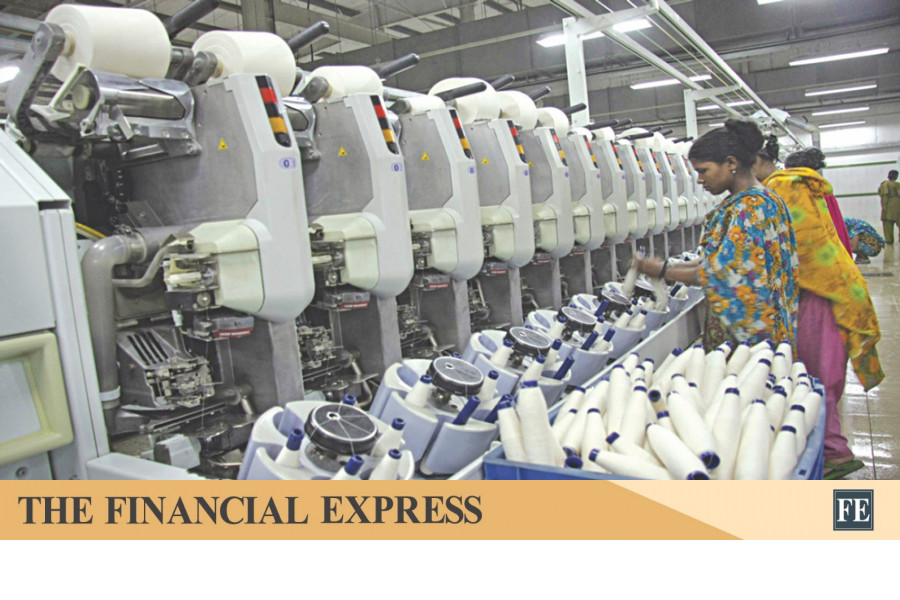
FE
However, 2025 was not entirely bleak. Despite the multifarious challenges, the readymade garment (RMG) sector recorded a notable achievement in sustainability. During the year, 38 garment factories received international recognition as green factories - the highest number of such certifications achieved in a single year so far. This milestone has taken the total number of LEED-certified green garment factories in Bangladesh to 270, with another 600 reportedly in the pipeline for certification. The growing shift towards green factories highlights the industry's commitment to environmentally responsible manufacturing, even amid persistent economic headwinds.
It is worth noting that LEED (Leadership in Energy and Environmental Design) is the world's most widely used green building rating system. Awarded by the United States Green Building Council (USGBC), LEED certification is a globally recognised symbol of sustainability excellence. To qualify, factories must meet stringent criteria on carbon emissions, energy and water efficiency, waste management and indoor environmental quality, all under the rigorous evaluation and supervision of the USGBC.
Bangladesh RMG industry's stride towards environmental sustainability is arguably unmatched anywhere in the world. Notably, nine of the world's top 10 greenest garment factories are located in Bangladesh. Moreover, 48 of the 100 highest-scoring green garment factories globally are based in the country, firmly positioning Bangladesh as a global leader in environmentally sustainable apparel manufacturing.
Green factories can play a crucial role in addressing the challenges of climate change as Bangladesh is among the countries most vulnerable to its impacts. At the same time, LEED certification is not merely a sustainability benchmark; it has emerged as a strategic competitiveness tool for the apparel industry. As international buyers, regulators and consumers increasingly demand lower environmental footprints, Bangladeshi manufacturers are proactively aligning with evolving standards on carbon efficiency, efficient use of water and energy, and climate-resilient infrastructure.
However, as large factories move towards green transformation, small-scale entrepreneurs risk being left behind as going green requires huge initial investment. Moreover, securing green financing from banks is often a lengthy and complex process involving high transaction costs, which many small and medium enterprises find difficult to meet.
Feasible solutions are therefore needed to support smaller manufacturers. One option could be the introduction of coalition-based schemes, allowing small-scale entrepreneurs to team up and submit collective applications to banks and financial institutions for green financing. The shared objective should be to elevate the RMG industry to the next level of sustainability through a comprehensive and inclusive approach.
At the same time, factories must strengthen partnerships with international buyers and brands to deliver on environmental commitments. Achieving meaningful progress will require not only stronger commitment from manufacturers, but also a greater willingness on the part of brands to pay a premium for products made in green factories.
Finally, it needs to be kept in mind that sustainability is a marathon, not a sprint. Setting higher benchmarks is therefore essential to make the industry truly environment-friendly. The next objective could be a transition towards a circular economy. Such a shift will be crucial in building a resilient, competitive and sustainable apparel industry for the future.
Atiqul Kabir Tuhin
Published :
Jan 04, 2026 00:34
Updated :
Jan 04, 2026 00:34
Share this news
For apparel makers, 2025 has been an exceptionally challenging year. In the aftermath of the July-August 2024 uprising that ended Sheikh Hasina's authoritarian rule, the sector had hoped for a fresh start. Instead, a series of setbacks has pushed the industry into renewed crisis. Frequent labour unrest, a sharp rise in banks' lending rates that has driven up production costs, and a tougher US tariff regime have combined to squeeze manufacturers from all sides. Factory closures, weakening demand in key export markets and a near twofold increase in financing costs due to soaring interest rates have left the apparel sector grappling with one of its most difficult periods in recent years.
FE
However, 2025 was not entirely bleak. Despite the multifarious challenges, the readymade garment (RMG) sector recorded a notable achievement in sustainability. During the year, 38 garment factories received international recognition as green factories - the highest number of such certifications achieved in a single year so far. This milestone has taken the total number of LEED-certified green garment factories in Bangladesh to 270, with another 600 reportedly in the pipeline for certification. The growing shift towards green factories highlights the industry's commitment to environmentally responsible manufacturing, even amid persistent economic headwinds.
It is worth noting that LEED (Leadership in Energy and Environmental Design) is the world's most widely used green building rating system. Awarded by the United States Green Building Council (USGBC), LEED certification is a globally recognised symbol of sustainability excellence. To qualify, factories must meet stringent criteria on carbon emissions, energy and water efficiency, waste management and indoor environmental quality, all under the rigorous evaluation and supervision of the USGBC.
Bangladesh RMG industry's stride towards environmental sustainability is arguably unmatched anywhere in the world. Notably, nine of the world's top 10 greenest garment factories are located in Bangladesh. Moreover, 48 of the 100 highest-scoring green garment factories globally are based in the country, firmly positioning Bangladesh as a global leader in environmentally sustainable apparel manufacturing.
Green factories can play a crucial role in addressing the challenges of climate change as Bangladesh is among the countries most vulnerable to its impacts. At the same time, LEED certification is not merely a sustainability benchmark; it has emerged as a strategic competitiveness tool for the apparel industry. As international buyers, regulators and consumers increasingly demand lower environmental footprints, Bangladeshi manufacturers are proactively aligning with evolving standards on carbon efficiency, efficient use of water and energy, and climate-resilient infrastructure.
However, as large factories move towards green transformation, small-scale entrepreneurs risk being left behind as going green requires huge initial investment. Moreover, securing green financing from banks is often a lengthy and complex process involving high transaction costs, which many small and medium enterprises find difficult to meet.
Feasible solutions are therefore needed to support smaller manufacturers. One option could be the introduction of coalition-based schemes, allowing small-scale entrepreneurs to team up and submit collective applications to banks and financial institutions for green financing. The shared objective should be to elevate the RMG industry to the next level of sustainability through a comprehensive and inclusive approach.
At the same time, factories must strengthen partnerships with international buyers and brands to deliver on environmental commitments. Achieving meaningful progress will require not only stronger commitment from manufacturers, but also a greater willingness on the part of brands to pay a premium for products made in green factories.
Finally, it needs to be kept in mind that sustainability is a marathon, not a sprint. Setting higher benchmarks is therefore essential to make the industry truly environment-friendly. The next objective could be a transition towards a circular economy. Such a shift will be crucial in building a resilient, competitive and sustainable apparel industry for the future.