☕ Support Us
[🇧🇩] - Monitoring Bangladesh's Economy | Page 130 | PKDefense

[🇧🇩] Monitoring Bangladesh's Economy

Reply (Scroll)
Press space to scroll through posts
G Bangladesh Defense
[🇧🇩] Monitoring Bangladesh's Economy
909
23K
More threads by Saif

I am flabbergasted that Sheikh Bashiruddin of Akij Bashir group (as interim govt. aviation adviser) led the decision to purchase Boeing aircraft and almost cent percent positive that he had no corrupt personal gains whatsoever. When (oh when?) will we get ministers as honest and incorruptible as Bashir Saheb?
Here is Bashir Saheb with his team - ready with Polo shirts and not staid suits. A new generation of worldly leaders.
View attachment 23393
Here are some of their stellar products.
Just a few videos will give everyone some idea of how refined their manufacturing approach is, clearly some of the finest operations in South Asia and price competitive to boot for global exports.


Last edited:
Cite Fact Check Highlight Respond
Political stability vital to sustain economic momentum: DCCI

FE REPORT
Published :
Jan 04, 2026 07:40
Updated :
Jan 04, 2026 07:40

1767505787512.webp


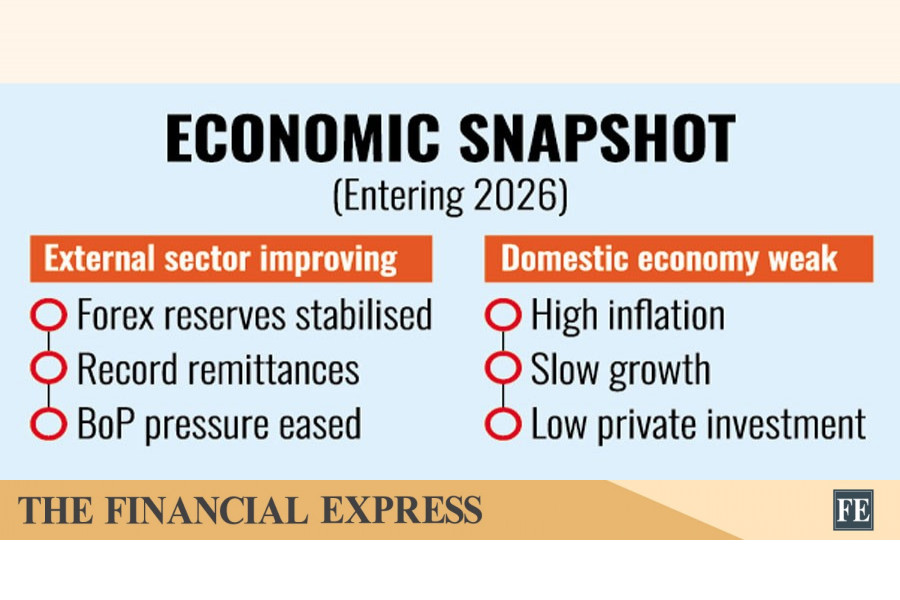
Dhaka Chamber of Commerce & Industry (DCCI) has called for prudent, timely and effective economic measures to safeguard Bangladesh's economic momentum in 2026, amid political tension ahead of the 13th national election scheduled to be held on 12 February.
FE

In this context, DCCI urges the interim government, political parties and all relevant stakeholders to ensure a peaceful, inclusive and credible election process, as political stability is the key to sustainable economic recovery and investment growth.

Dhaka Chamber believes that a stable political environment during the post-election period will boost the confidence of the local entrepreneurs and foreign investors, according to a statement issued on Saturday.


To accelerate economic recovery this year, DCCI calls upon the government to prioritise the improvement of overall law and order situation, ensure uninterrupted and affordable energy supply to industries, enhance ease of doing business, reduce the cost of doing business and strengthen infrastructure and policy frameworks to attract both domestic and foreign investment.

DCCI further stressed the need for export diversification, targeted support for potential export sectors, easier access to finance for CMSMEs and the development of a skilled workforce to complement the process.

The ongoing energy crunch and high energy prices continue to disrupt manufacturing and industrial production, eroding Bangladesh's competitiveness in international markets.

DCCI reiterates the need for a long-term, predictable energy pricing policy, alongside accelerated gas exploration, diversification of energy import sources, and the expansion of long-term energy supply agreements.

The persistent foreign exchange pressure and currency depreciation have further negatively impacted the financial sector, also affecting imports of fuel, raw materials, and intermediate goods for export-oriented industries, as per the statement.

DCCI is of the opinion that currency swap can be considered on a priority basis for essential import payments. Besides enhanced incentives for remittance inflows are necessary to stabilise foreign exchange reserves.

At the same time, fiscal discipline, improved project implementation efficiency, reduced reliance on bank borrowing and good governance are essential to ease liquidity pressure in the financial sector, it stated.


DCCI also expresses concern that excessive government borrowing from the banking sector could shrink private-sector credit growth. This tendency also contracts the investment and employment growth of the local manufacturing and CMSMEs.

Dhaka Chamber also underscores the importance of full automation of revenue management, modernisation of tax laws, expansion of the tax base and strict measures to prevent harassment of compliant taxpayers.​
 
Cite Fact Check Highlight Respond
Challenge of curbing inflation

Asjadul Kibria
Published :
Jan 04, 2026 00:35
Updated :
Jan 04, 2026 00:35

1767507051590.webp


For the last three years, the country has been experiencing high inflation, eroding the real income of fixed-income people as money loses its value and becomes a melting asset. So, the key question now is whether inflation will continue to rise in the new year. Though inflation witnessed a modest downward trend in the last half of the past year, it has not subsided significantly, giving people adequate respite.

Official statistics showed that the annual average rate of inflation was 9.48 per cent in December 2023, which increased to 10.34 per cent at the end of 2024. The rate, however, modestly came down to 8.96 per cent in November 2025. It also showed that the inflation rate fell below 10 per cent in July and remained below 8.50 per cent until November last year. The December figure is yet to be available, and it can be presumed that the rate would remain above 8 per cent.

Bangladesh Bank, in its half-yearly monetary policy statement (MPS) for July-December 2025, asserted to bring down the inflation rate to 7 per cent by the end of the year. To achieve the target, the central bank continued the tight monetary stance. "BB is likely to maintain its tight monetary policy in H1FY26 to contain inflation below 7.0 per cent, while still supporting productive economic activities," said the statement announced in July last year. It now appears that monetary tightening does not work entirely, and in the MPS for the January-June period in the current year, the central bank may maintain the tight monetary stance.

Monetary tightening is a contractionary policy conducted by the central bank that raises interest rates to increase the cost of borrowing from banks and attract people to park money in banks. In this process, the supply of money in the market is gradually reduced, leading to a cut in aggregate demand and finally pulling down the inflation.

Inflation is the rate of increase in prices over a given period of time, and it is generally a broad measure, such as the overall increase in prices or the increase in the cost of living in a country. Inflation ultimately 'represents how much more expensive the relevant set of goods or services has become over a certain period, most commonly a year.'

Macroeconomic theory links the money supply and inflation conversely, meaning a rise in money supply pushes inflation, and a decline in money supply reduces inflation. So, it is necessary for the central bank to contain the growth of the money supply.

By reducing the money supply or the growth of the money supply, Bangladesh Bank has been trying to contain the inflationary pressure for the last two years. The money supply is usually measured by M2, or broad money. It includes: currency outside banks, demand deposits, time deposits and deposits with the central bank other than deposit money banks (DMB). If time deposits are excluded, the combination of the three others becomes the M1 or narrow money. Around three-fourths of M2 is time deposits or fixed deposits in banks having various maturity periods.

At the end of FY23, money supply stood at Tk 2.27 trillion, which was more than 10 per cent of the amount in the same period of FY22. In FY24, the growth of the money supply moderated to 7.50 per cent, reaching Tk 2.40 trillion. It increased to Tk 2.55 trillion in FY25, up 7 per cent. On a monthly basis, M2 dropped by only 0.23 per cent in October last from September. The figure for November and December is still not available.

The central bank has also kept the policy rate, repo rate to be precise, unchanged at 10 per cent since the announcement of the H1MPS in July last. It is because the rate of inflation has yet to fall to the desired level of 7 per cent, despite a downward trend. The downward trend also supports the central bank to not enhance the policy rate, which again helps the commercial banks to offer credit without hiking the interest rates significantly. Nevertheless, the growth of private credit is still modest, only 6.23 per cent in October last year compared to the previous year, reflecting sluggish demand by businesses.

Two decades ago, when Bangladesh Bank started to announce the monetary policy publicly by issuing written statements, it also declared the policy framework. Under the framework, to achieve the goal of price stability coupled with economic growth, a number of policy tools were designed, including repo and reverse repo auctions, bank rate, and SLR and CRR. Reserve money was set as the operating target, and M2 as the intermediate target. Two decades later, Bangladesh Bank has shifted from a monetary targeting approach to an Interest Rate Corridor (IRC) framework to fight inflation. Nevertheless, the ultimate objective to contain inflationary pressures and support economic growth remains unchanged.

Curbing excessive inflation, however, is not the sole responsibility of the Bangladesh Bank, and the central bank cannot achieve the goal without support from the government. Though the central bank can adjust its tools to fight demand-pull inflation, those tools are less effective against cost-push or supply-driven inflation. Again, due to growing complexity, it becomes challenging to determine the nature of inflation precisely, as cost-push inflation may overlap with a demand-pull inflation.

To contain the cost push inflation, forms of inflation caused by an increase in the cost of inputs, it is necessary to take measure like cut in taxes or relax the imports to increase the supply of the products. The finance ministry has the authority to cut or hike up tax, while import relaxation is the commerce ministry's job. For the central bank, it is difficult to intervene as higher inflation requires rate hike although in regards to cost push inflation, doing so may bounce back. That's why persistent coordination between fiscal and monetary policies is necessary to check the inflation under control.

As Bangladesh is going to witness the 13th general election on February 12 this year, the economy has already entered the election-centric political business cycle. Whether inflation will stay at the current level or rise during the cycle is difficult to say. It is widely believed that inflation is unlikely to decline by a notable extend before the election.

 
Cite Fact Check Highlight Respond
Optimal use of remittance

1767510372472.webp


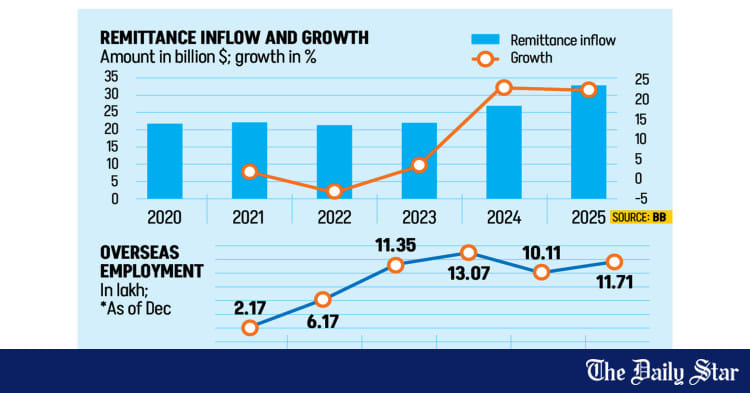
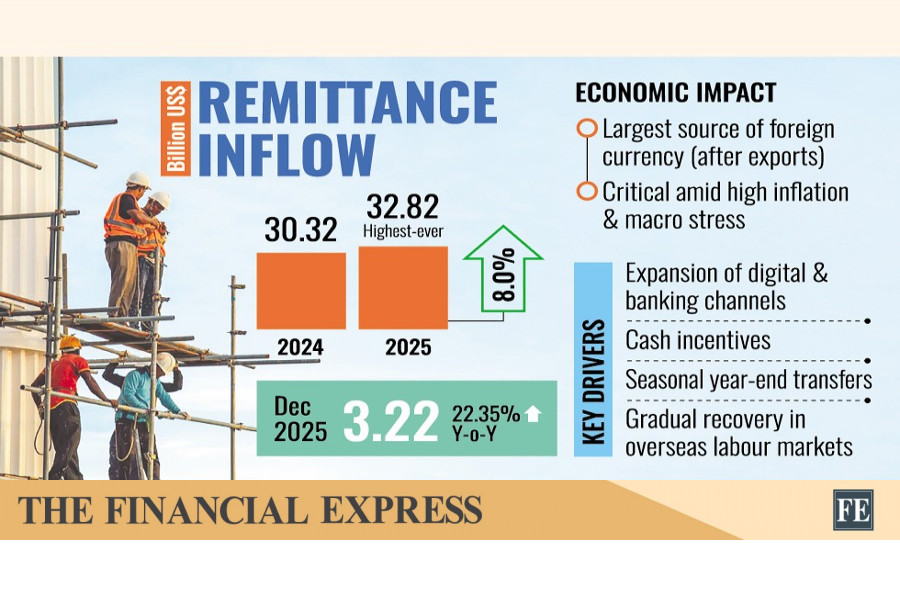
THE inflow of remittances by millions of Bangladeshis working abroad, which contributed to the foreign exchange reserves now exceeding $33 billion, has robustly propped the interim government since its journey began in August 2024. While financial and macroeconomic policy experts intend to put the credit down to improved formal channels and incentives offered to remitters, a serious matter that is often sidelined is actual benefits gained from this money by migrant workers and their families back home.

It has been experienced that due to a lack of formal education or knowledge of financial management or training in small-scale investment, many families find it difficult to use the hard-earned remittance in sustainable, profitable ventures. The money is spent mostly on erecting not-so-necessary buildings for accommodation with impressive gates, the purchase of automobiles, ornaments, furniture and lavish expenditure in family affairs. Savings do not happen to come to mind for many while exuberance becomes a symbol of distinction from other neighbours. People can identify from a distance whose house is which.


In this backdrop, the Wage Earners’ Welfare Board under the guidance and supervision of the expatriates’ welfare and overseas employment ministry has implemented a project with financial assistance from the International Fund for Agricultural Development along with technical assistance from the International Organisation for Migration that conducted 10 days’ short training course on small-scale investment and financial literacy for the trainees: members of the families of the migrants.

From across the country, 300 members completed the capacity-building training under financial literacy component and received Tk 100,000 each to implement a business initiative in their locality, submitted and approved as selection criteria through a committee, from which they could get a regular income over the years. If needed, they could also add some capital of their own from savings of the remittances that they receive from outside the country. The recipients of such support were very excited and showed their commitment to using the seed money received from the project. Although the result of this asset transfer is yet to be seen, the adviser to the ministry committed that whether supported by development partners or not, the project would continue to be financed by the government. The pledge has kindled hopes among the members of the migrants’ families. The senior secretary to the ministry called on the recipients to religiously use the money for income-generating activities rather than spending it on unnecessary things.

While uninterrupted and handsome remittance inflow is indicative of the soundness of national macroeconomic health, especially in terms of the state capacity for foreign debt payment, it is high time we paused a bit, counting only the bills and ignoring the long-term well-being of the earners. And here lies the importance of making financial literacy available to them and members of their family.


From this perspective, the Bangladesh Bank and other banks and financial institutions under its supervision need to come forward to offer need-based training, counselling and technical knowhow on the maximum use of the remitted amount by the migrants’ families. Moreover, along with the Wage Earners’ Welfare Board, the Bangladesh Investment Development Authority could also pave a suitable path for the expatriates’ families, facilitating micro-level, start-up business investment for them. The SME Foundation and the Bangladesh Small and Cottage Industries Corporation could extend technical and financial assistance to the migrants’ families, planning and translating locally suited, feasible small businesses such as block and hand-painted fabrics and dressmaking, running small shops, poultry farming, et cetera.

An optimal use of remittances has two meanings: using it at micro and macro levels. For the latter, the state is equipped with agencies, models and modus operandi. But regarding the micro level, the gaping area is obvious as none of relevant players are unified neither is there any single umbrella. They eye each other, keeping at bay who does what and what not. To get rid of this riddle, foreign exchange earners and their families sustainable economic inclusion can be ensured only if the relevant stakeholders sat together, being on board and willing to provide necessary platforms for the left-behind members and relatives of the never-at-rest migrant workers abroad.

The issue is more important than ever before because while we are yet to mindfully decide who to educate migrants’ families in finance, savings and investment so that the expatriates do not end up their whole life working abroad at a high social cost, devoid of family and relatives, the prime time of life spent on earning bread only, countries such as the Philippines have for long been successful in availing diaspora investment even in major infrastructures such as hospitals, schools and bridges.


Md Mukhlesur Rahman Akand is a joint secretary to the expatriates’ welfare and overseas employment ministry.​
 
Cite Fact Check Highlight Respond
Decision to cut savings certificate profit rates withdrawn, previous rates retained

Staff CorrespondentDhaka
Updated: 04 Jan 2026, 21: 06

1767575529229.webp


The government has withdrawn its decision to reduce the profit rates on savings certificates and has reinstated the previous rates.

The Finance Division requested the Internal Resources Division (IRD) to issue a gazette notification cancelling the newly announced profit rates and maintaining the earlier rates today, Sunday.

The IRD will now issue the relevant notification in this regard.

As a result, investors in savings certificates will continue to receive profits at the same rates that were in effect from 1 July to 31 December 2025 for the next six months as well.


On 28 December, through a gazette notification, the government had reduced the profit rates on all types of savings certificates for the period from 1 January to 30 June 2026.

This decision caused significant hardship for middle-class and limited-income investors. In view of the situation, the government has decided to retain the previous rates.

What are the profit rates?

Profit rates are comparatively higher for smaller investments and lower for larger investments. In this case, the threshold has been set at Tk 750,000.

Investments of up to this amount attract higher profit rates, while investments exceeding Tk 750,000 receive lower rates.

As part of its income and debt management strategy, the government regularly determines profit rates on savings certificates.

Among all types of savings certificates issued under the National Savings Directorate, the most popular is the Family Savings Certificate.

Until now, for investments of less than Tk 750,000, the profit rate upon completion of the five-year term stood at 11.93 per cent; this rate has been retained. For investments exceeding Tk 750,000, the profit rate was 11.80 per cent, which also remains unchanged.

For the Pensioners’ Savings Certificate, the profit rate for investments of less than Tk 750,000 at the end of the fifth year, upon maturity, was 11.98 per cent; this rate has also been retained. For investments exceeding Tk 750,000, the profit rate remains unchanged at 11.80 per cent.

For the five-year Bangladesh Savings Certificate, the profit rate upon maturity for investments of less than Tk 750,000 was 11.83 per cent; this rate will remain in effect for the next six months. For investments exceeding Tk 750,000, the profit rate was 11.80 per cent, which has also been retained.

In addition, for the three-monthly profit-bearing savings certificates, the profit rate upon maturity is 11.82 per cent for investments of less than Tk 750,000, while for investments exceeding Tk 750,000, the rate stands at 11.77 per cent.

Savings certificate investors are primarily drawn from the country’s ordinary middle-class households. In times of financial distress, families often encash savings certificates to manage emergencies.

Moreover, a portion of monthly household expenditure for many families is met from the profit earned on these certificates.

Due to rising commodity prices, the country has been experiencing high inflation for more than two years. Although inflation has eased somewhat in recent months, it remains within the range of 8 to 9 per cent.

Profit rates are reviewed every six months. As the decision to reduce the profit rates has been withdrawn, savings certificate profit rates will remain unchanged for nearly a year.​
 
Cite Fact Check Highlight Respond
‘The interim has failed to curb inflation and unemployment’: A rebuttal

1767576684580.webp

FILE VISUAL: SALMAN SAKIB SHAHRYAR

I write this in response to an article recently published by The Daily Star, titled The interim has failed to curb inflation and unemployment. The article, written by Dr Birupaksha Paul, evaluates the interim government's economic performance primarily through the conventional inflation-unemployment trade-off, concluding that policy failure explains the persistence of both. In my view, while the argument is internally coherent in a textbook sense, it rests on analytical assumptions that no longer hold and omits critical institutional realities. These omissions are serious enough to mislead public understanding and, therefore, warrant rebuttal.


One may recall that the interim government assumed responsibility amid a nationwide breakdown of law and order, where weakened enforcement and administrative paralysis disrupted commerce, supply chains, and investor confidence, constraining economic stabilisation at the outset.


The central problem with the article is not its use of economic theory, but its choice of theory and its abstraction from context. It treats Bangladesh's economy as though it were operating under normal macroeconomic conditions, where interest rates transmit smoothly through banks, markets are broadly competitive, and inflation and employment respond predictably to policy signals. This premise is unfair. The truth is, the interim government inherited an economy marked by deep financial-sector impairment, excess liquidity without accountability, cartelised supply chains, and severely weakened regulatory credibility. Any assessment that ignores this inheritance risks confusing structural damage with contemporaneous policy failure.


The article's analytical backbone is the inflation-unemployment trade-off commonly associated with the Phillips curve. This framework, once influential in mid-20th-century industrial economies, has long lost empirical relevance in modern economic systems. Over the past four decades, the Phillips curve has flattened or broken down across both advanced and developing economies. Low unemployment has frequently coexisted with stable inflation, while inflationary episodes have occurred without tight labour markets. This is not a temporary anomaly but a structural shift in how inflation and employment are generated in contemporary economies.


Modern inflation is no longer driven primarily by domestic demand pressures interacting with labour scarcity. It is increasingly shaped by supply-side shocks, exchange-rate pass-through, energy and commodity price volatility, market concentration, administered pricing, speculative behaviour, and institutional failures. In Bangladesh's case, syndicate control over essential commodities and distribution networks has played a decisive role in price formation. When inflation is driven by market power rather than excess demand, monetary tightening becomes largely ineffective. Raising interest rates does not dismantle cartels or discipline supply-chain manipulation. The article in question does not engage with this distinction, yet it is central to understanding why inflation has proved persistent during the interim period.

Unemployment, likewise, has become structurally decoupled from short-run monetary adjustments. Employment outcomes today depend far more on investment confidence, financial-sector health, regulatory predictability, and credit availability than on marginal changes in policy interest rates. Firms do not hire because rates move slightly; they hire when they trust banks, contracts, competition policy, credible enforcement against cartels and syndicates, and the broader institutional environment. An economy emerging from years of politically protected loan default, balance-sheet opacity, and regulatory erosion cannot generate employment through textbook stimulus channels. The article's framing obscures these realities by attributing employment outcomes primarily to the interest-rate policy.

A further weakness lies in the article's treatment of monetary policy transmission as intact. The Phillips-curve logic presumes a functioning banking system capable of translating policy signals into credit allocation. But Bangladesh's banking sector, at the time the interim government took over, was severely compromised. Large volumes of liquidity circulated outside productive channels. Loan discipline had been eroded, supervision weakened, and public confidence damaged. Under such conditions, neither tightening nor easing operates cleanly. Monetary policy becomes a blunt instrument, producing weak, delayed, or perverse effects. Evaluating outcomes as if transmission were normal is analytically unsound.


The article also fails to distinguish between policy optimisation and crisis stabilisation. Interim governments do not inherit clean slates; they inherit trajectories. Their primary task is to arrest deterioration, prevent systemic collapse, and restore minimal functionality. Expecting simultaneous reductions in inflation and unemployment within a short horizon—using non-crisis macroeconomic benchmarks—imposes an unrealistic standard. Even advanced economies with intact institutions experience long and uneven lags between policy action and labour-market outcomes. In Bangladesh's case, those lags are longer because institutional damage had to be addressed before policy levers could regain effectiveness.


Another notable omission is the absence of temporal analysis. The article implicitly treats outcomes as contemporaneous products of interim decisions, rather than as lagged consequences of earlier distortions. Inflationary momentum, excess liquidity, and investment paralysis do not dissipate instantly when governance changes. They unwind slowly, often asymmetrically. By ignoring these dynamics, the article compresses time and assigns responsibility without acknowledging deeply rooted institutional inertia.

Of course, none of this implies that the interim government should be immune from criticism. In fact, criticism is both necessary and appropriate where warranted. But accountability requires proportionality and analytical precision. Criticism grounded in outdated frameworks and incomplete context does not enhance public understanding. When economics is stripped of institutional realism, it risks becoming elegant but misleading. The issue here is not whether inflation and unemployment has declined fast enough, but whether the analytical lens used to judge performance is appropriate to the reality being assessed. Applying a mid-20th-century trade-off model to a 21st-century economy marked by financial fragility, market capture, and governance breakdown is a category error. It evaluates the patient with the wrong diagnostic tool.

A more credible assessment would begin with what the interim government inherited: a weakened banking system, distorted markets, eroded regulatory credibility, and broken transmission mechanisms. It would then ask whether deterioration was halted, whether minimal discipline was restored, and whether conditions for future policy effectiveness began to re-emerge. Only after those foundations are rebuilt does it make sense to judge performance against conventional macroeconomic benchmarks.

This is why a rebuttal is necessary. My disagreement here is not ideological but analytical. Inflation and unemployment today are multi-causal, institutionally mediated, and globally augmented phenomena. Treating them as mechanically linked through an obsolete curve risks mistaking inherited structural decay for present-day policy failure. A serious public debate deserves better diagnostic tools and better contextualisation.

Dr Abdullah A. Dewan is professor emeritus of economics at Eastern Michigan University, USA, and former physicist and nuclear engineer at Bangladesh Atomic Energy Commission.​
 
Cite Fact Check Highlight Respond
Economic stability returning, but full recovery will take time: PRI

1767576941619.webp

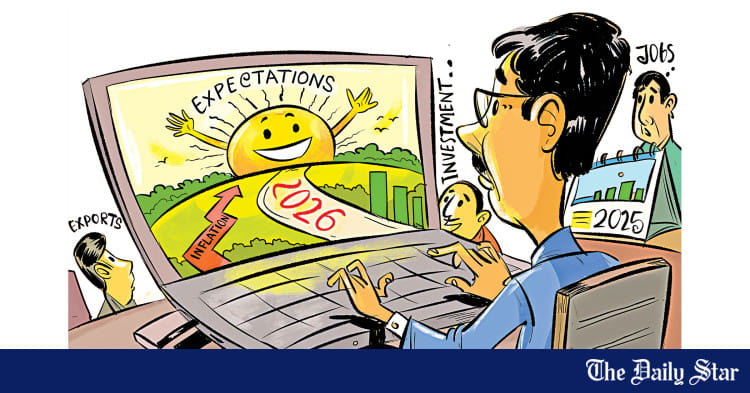
Despite moderate improvements in inflation, commodity prices have remained elevated, posing a challenge for the economy. Photo: Star/file

Bangladesh has made modest progress toward economic stabilisation, but it may take time for all indicators to stabilise, as many challenges remain, according to the private think-tank Policy Research Institute (PRI).


The progress is reflected in a stable exchange rate, a build-up of foreign reserves, and moderate improvements in inflation. However, PRI said fiscal and banking sector reforms have been limited. The adjustment has come with slow economic growth, stagnant investment, rising unemployment, and declining real wages.

Google News LinkFor all latest news, follow The Daily Star's Google News channel.
"Economic policymaking in 2026 cannot assume that stability will return soon," said Ashikur Rahman, principal economist at PRI, during a keynote presentation at PRI's monthly macroeconomic insights event yesterday, jointly organised with the Australian Department of Foreign Affairs and Trade at the PRI office.

He added that policy must embrace uncertainty and build strategies around it. "Policy frameworks must be flexible. Institutions must be capable of mobilising real-time responses. Decisions must be timely, credible, and anchored in preparedness," Rahman said.


Looking ahead to 2026, he said, "Perpetual instability -- both external and domestic -- is no longer an exception; it has become the new normal. Global geopolitical shocks, wars, trade disruptions, climate volatility, and shifting international economic dynamics will continue to test our resilience.

"At the same time, internal political uncertainty, institutional stress, and governance challenges will keep shaping macroeconomic management."

Rahman also likened the economy to a forest, saying, "In many ways, we must behave like a deer in a forest -- always alert, aware of our environment, attuned to early warning signals, and ready with a crisis-time economic playbook.


"What seems stable today can become chaotic tomorrow. Survival and progress in this new world will depend on vigilance, adaptability, discipline, and readiness to act decisively."

According to PRI, Bangladesh's GDP growth slowed to 3.4 percent in Q4 of FY25, mainly due to weaker performance in industry and services. Private consumption and government spending eased, while investment growth remained low at 1.8 percent due to high borrowing costs and political uncertainty.

Strong remittances and higher foreign reserves support macroeconomic stability and could boost consumption and investment as inflation eases. However, political instability and policy uncertainty ahead of elections remain major downside risks, PRI said.

Sustained recovery will depend on political stability, credible elections, and structural reforms to restore investor confidence and boost productivity, the think-tank added.

The external sector continues to improve. Between July and October FY26, Bangladesh's Balance of Payments showed a $1.1 billion surplus, mainly from a stronger financial account. Remittance inflows rose 20 percent during July-November of FY26.

"There has been some stability in foreign exchange reserves and the exchange rate. However, the country's economic growth and investment have slowed," said Kamran T Rahman, president of the Metropolitan Chamber of Commerce and Industry.

He added, "High inflation, uncontrolled non-performing loans in the banking sector, and a very low tax-to-GDP ratio remain key challenges for the economy."

Rahman also highlighted the importance of political stability, energy security, and policy certainty in restoring business confidence.

At the seminar, speeches were also delivered by PRI Executive Director Khurshid Alam and Research Director Bazlul Haque Khondker, among others.​
 
Cite Fact Check Highlight Respond

Members Online

Latest Posts

Latest Posts