Donate ☕
201 Military Defense Forums
[🇧🇩] - Cottage Industry in Bangladesh | Page 5 | PKDefense
Home Post Alerts Inbox Videos

[🇧🇩] Cottage Industry in Bangladesh

Reply (Scroll)
Press space to scroll through posts
G Bangladesh Defense
[🇧🇩] Cottage Industry in Bangladesh
47
3K
More threads by Saif


New SME policy with no new strategies deplorable
15 January, 2025, 00:00

THIS is unfortunate that the proposed National Small and Medium Enterprise Policy 2025 offers almost no new strategies to facilitate the growth of the sector. The proposal appears to echo the strategies of the 2019 policy that failed to help the sector grow. Such a repetition of failed strategies reflects, as experts say, the government’s lack of commitment to addressing the systemic challenges that continue to hinder the growth of the medium enterprises. The policy proposal puts almost the same emphasis on the establishment of a 37-member SME council and recommends the continuation of a task force under the industries ministry. It also proposes 83 time-bound metrics, from the 63 metrics, to be implemented by ministries and divisions in 2025–2030 for the implementation of the policy. All this appears a mere bureaucratic expansion, devoid of any innovative solutions to the problems that small and medium entrepreneurs face. A lack of access to finance is one of the biggest obstacles to the growth of the sector, composed of about 7.8 million enterprises that employ about 80 per cent of workers in the informal sector. A World Bank report says that only 36 per cent of SMEs have access to formal credit, compared with 48 per cent in South Asia and 68 per cent in East Asia and Pacific.

Small entrepreneurs largely rely on loans from microfinance institutions at higher interest rates. Economists and policymakers have for long asked the authorities to ensure SME access to loans from banks and non-bank financial institutions and asked the regulatory authorities to cut the maximum interest rate in microfinance institutions, but to no avail. During the Covid-induced economic slowdown, financial institutions, as studies show, failed to disburse loans to them. Only 27 per cent of Tk 20,000 crore incentive announced by the Bangladesh Bank was disbursed. The proposed policy fails to offer any comprehensive solution to this issue. Instead, it simply iterates the need for an improved access to finance without offering clear, actionable strategies. The regulatory environment has also remained burdensome, further stymieing their growth. Issues such as complex tax structures, difficulties in trade licence renewals and the absence of one-stop services create unnecessary obstacles. The SME Foundation says that more than a half of SMEs blame complicated tax system and trade licence procedures as major hindrances. Entrepreneurs need to run to at least 34 departments to start a business. The proposed policy’s failure to address these systemic issues and continued reliance on failed strategies would leave SMEs with little hope to overcome challenges.

The government should, therefore, review the proposed policy with not only a new name but also with strategies. The policy should prioritise SME’s access to finance, simplify regulations, incentivise financial institutions for SME-friendly credit schemes and foster an ecosystem where SMEs can thrive.​
 
Analyze

Analyze Post

Add your ideas here:
Highlight Cite Fact Check Respond

SMEs lose credit appetite in economic turbulence

1737503709214.webp


How have local private sector businesses fared in recent years?

To gain a micro-level understanding, ask the question to house yard workshops, rural handicraft units, tiny grocery stores and small leather and footwear ventures.

These businesses have been struggling for over three years, gasping for air amid a challenging economic climate.

This is because high prices have eroded consumer demand, while increased power and utility bills have increased operating costs.

Access to bank loans has also become increasingly difficult for these small ventures, officially categorised as cottage, small, and medium enterprises (CMSMEs).

Instead of easing, the situation for around 78 lakh CMSMEs across the country, which contribute one-fourth of the gross domestic product (GDP) and employ 40 percent of the total workforce, has worsened in late-2024.

On top of the stubbornly high inflation, nationwide protests, violence, curfews, recurrent flooding and punishingly high interest rates on bank loans have brought the CMSMEs to their knees.

Credit data from the central bank also shows the economic disaster facing the CMSMEs.

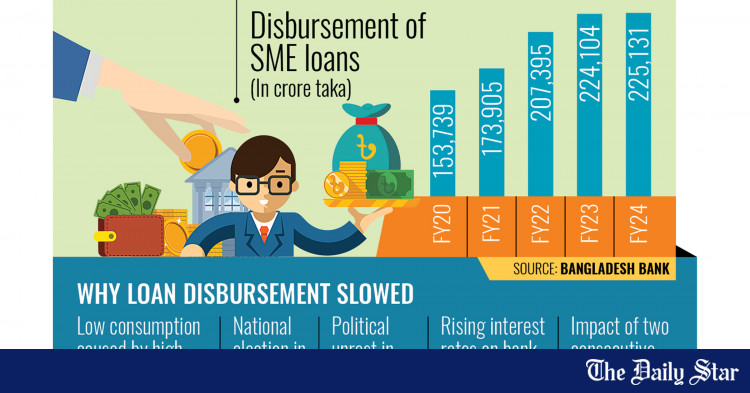
During the April-June period of fiscal year 2023-24, small businesses received Tk 54,526 crore in bank loans. This figure plummeted to Tk 42,950 crore in the subsequent quarter, according to Bangladesh Bank (BB) data.

Compared to the same period in FY23, loan disbursement in April-June of FY24 witnessed a 13.10 percent decline.

BB data also shows that CMSMEs borrowed Tk 2.25 lakh crore in FY24, a mere 0.46 percent increase compared to the previous year's Tk 2.24 lakh crore.

Meanwhile, private sector credit growth in November of last year reached a three-year low due to weakened credit demand, a dearth of new investment, and a surge in government T-bills and bonds.

According to Syed Abdul Momen, deputy managing director and head of SME Banking at BRAC Bank, businesses mainly seek loans for two purposes: managing operations and expanding their businesses.

"Given the current economic situation, there is little to no demand for loans aimed at business expansion," said the banker.

"Entrepreneurs are now focused on securing the minimal financial support required to meet their working capital needs," he added.

Similar to Momen, Sanjib Kumar Dey, the head of the SME and Agri-banking division at Mutual Trust Bank, said that high inflation and costly loans have compelled small businesses to shelve their expansion plans over the past three years.

"Business owners have been primarily focused on survival rather than growth," Dey said. "Banks, too, are exercising caution in lending amid the prevailing economic uncertainties."

'SITUATION IMPROVING SLOWLY'

Compared to July or August of last year, when a nationwide protest culminated in a government ouster, the current business climate and credit outlook have improved, according to Mohammad Salekeen Ibrahim, head of asset at Eastern Bank.

"Banking activities were almost shut in July and August of last year. During that period, curfews and general holidays were frequent," recalled the banker.

"Banks were unable to reach customers, and customers were likewise unable to access bank services," he added. "While the overall situation in the country has shown signs of recovery since August, it has not fully stabilised."

Ibrahim said they are looking for potential clients. However, the current business climate and high interest rates remain major obstacles.

"The loan disbursement rate may remain sluggish until the client confidence stabilises," he commented.

The high-interest rate environment is a direct consequence of the central bank's prolonged battle against stubbornly high inflation, which has been dragging on for more than two years.

In the first half of FY25, inflation averaged 10.87 percent, according to the Bangladesh Bureau of Statistics.

To curb spiralling prices, the BB has been steadily increasing the policy rate, the rate at which it lends to banks, since May 2022.

This has resulted in a gradual rise in loan interest rates, particularly after the central bank lifted the lending rate cap in July of last year.

In October of last year, the central bank raised the policy rate by 50 basis points to 10 percent. This marked the eleventh upward adjustment since May 2022, when the policy rate stood at only 5 percent.

'BUSINESSES NEED GOVERNMENT SUPPORT'

Current consumer confidence is at an all-time low, a level unprecedented in the past 30-35 years, according to Rizwan Rahman, former President of the Dhaka Chamber of Commerce and Industry.

He told The Daily Star that businesses are also grappling with rising costs, and inflation remains unmanageable.

In such an uncertain and confidence-deficient environment, businesses are hesitant to assume loan obligations, he added.

The business environment since June 2024 has been far from conducive to investment, and loan disbursement in this sector is expected to decline significantly in fiscal year 2024-25 compared to the previous year, he added.

"Without timely monetary or fiscal support from the government, reviving loan disbursement and encouraging investments in this challenging economic scenario will be almost impossible," he commented.

Melita Mehjabeen, a professor at the Institute of Business Administration at the University of Dhaka, told The Daily Star that the significant SME loan disbursements observed in 2021 and 2022 were due mainly to refinance schemes and Covid stimulus packages.

However, loan disbursements witnessed a decline in 2023 and 2024, attributed to increased prudence exercised by banks and financial institutions, she noted.

A restrictive loan ceiling of 30 percent of working capital further limited borrowers' ability to apply for fresh loans if they exceeded this limit, she added.

Moreover, the central bank's actions against loan misuse (for example, using working capital loans to repay existing debts) and the reduced lending appetite of commercial banks towards smaller borrowers have also contributed to the decline in disbursements, she added.

Khondaker Golam Moazzem, research director at the Centre for Policy Dialogue (CPD), said that while private sector credit growth remains sluggish, SMEs are the most vulnerable in the current economic climate.

He said rising production costs, fueled by increased gas and electricity prices, coupled with high inflation, have largely eroded sales and profit margins for SMEs.

"They are struggling to meet loan instalment obligations on time," he noted, adding that these challenges are not being adequately addressed.

"With the exception of a few specific banks, SMEs are unable to access loans due to varying terms and conditions," said the economist.​
 
Analyze

Analyze Post

Add your ideas here:
Highlight Cite Fact Check Respond

SMEs: Start locally, think globally

1737503833557.webp


Since the country's independence in 1971, small and medium enterprises (SMEs) have played a pivotal role in GDP growth, employment, income generation, and local development. However, despite their substantial potential, most Bangladeshi SMEs struggle to transition from local markets to global trading platforms. It is embarrassing that, despite having immense potential to shine on the global stage, our entrepreneurs remain constrained by local limitations and fail to become formidable players in the international market.

Now, at the beginning of 2025, Bangladesh stands at a critical crossroads in its history. The nation must refocus its attention on SMEs from a fresh perspective. First and foremost, government support must be leveraged to help SMEs represent themselves globally. The government should expand policy support and incentivise entrepreneurs to promote SME exports on a broader scale. Entrepreneurs, in turn, should take advantage of initiatives such as export subsidies, training programmes, and trade fairs and similar entities. Additionally, the government should develop a robust business plan encompassing export strategies, target markets, and potential challenges.

Capacity building and skill development remain major barriers to global expansion. Training programmes focused on global trade, export procedures, digital marketing, and letters of credit (LC) can equip entrepreneurs with the necessary skills to succeed globally. Collaborating with institutions like the SME Foundation and trade associations can facilitate such training. In terms of capacity building, more emphasis should be placed on audiovisual content available on digital platforms. This approach can help overcome geographical barriers and support better time management for entrepreneurs. Digital tools and e-commerce platforms can also enable SMEs to reach a global audience. Entrepreneurs should invest in user-friendly websites, enhance their online presence on social media, and leverage global marketplaces.

Most Bangladeshi enterprises face significant challenges in securing adequate financing. High interest rates, lack of collateral, and limited access to alternative funding sources hinder their ability to invest in global expansion. To address these challenges, the government, NGOs, and international donors should offer more financing schemes and grants tailored specifically for SME exports. Additionally, mitigating currency risks should be a strategic priority in international trade.

For global acceptance, obtaining internationally recognised certifications, such as ISO standards, can significantly boost buyer confidence. SMEs in Bangladesh should focus on improving production processes, operational efficiency, adopting green business practices, ensuring superior quality control, and achieving high packaging standards to compete with top global players. Collaborating with international merchants, agents, and trade intermediaries can also help SMEs access new markets. Participation in global trade fairs and business matchmaking events can open doors to valuable connections.

In the context of global trade, branding with a unique selling proposition (USP) distinguishes one enterprise from another and creates demand for its products or services. SMEs should invest in building a distinctive brand identity that resonates with international audiences.

Through determination, innovation, and visionary strategic planning, Bangladeshi SMEs can overcome barriers and become competitive players on the global stage. By fostering synchronisation between the government, financial institutions, donors, NGOs, and the private sector, Bangladesh's SMEs have the potential to transform the nation into a global trading powerhouse. If we do not start thinking big now, it may never happen.

The writer is a banker​
 
Analyze

Analyze Post

Add your ideas here:
Highlight Cite Fact Check Respond

SMEs’ share in GDP 35pc by 2030 in focus
FE REPORT
Published :
Jan 23, 2025 08:47
Updated :
Jan 23, 2025 08:47

1737615833292.webp


Industries ministry has initiated framing the National SME Policy 2025, aiming to boost the contribution of small and medium enterprises (SMEs) to GDP to 35 per cent by 2030 from the current 27 per cent.

The 2019 policy is the last such guideline for the SME sector.

The implementation of the latest policy concluded last June, with no government funding allocated to meet the demand for approximately Tk 105 billion to support the sector.

The observations were made at a workshop styled 'SME Policy-2025: Opportunities and Challenges, and the Role of Media' hosted by the SME Foundation in collaboration with the Economic Reporters' Federation (ERF) in ERF Auditorium on Wednesday.

SME Foundation chairperson Md Mushfiqur Rahman attended the event as the chief guest with ERF president Doulot Akter Mala in the chair.

Anwar Hossain Chowdhury, managing director of the SME Foundation, and Taskeen Ahmed, president of the Dhaka Chamber of Commerce and Industry (DCCI), spoke as special guest.

Speakers say data shortage, lack of financing, high interest rates, informal operations and limitations in marketing are challenges for the SME sector. Proper execution of the new policy will help boost the sector.

They also highlight that while SME's contribution to GDP in Bangladesh is about 27 per cent, it stands at 40 per cent in Pakistan, 52 per cent in Sri Lanka, 60 per cent in China and 37 per cent in India.

However, they called for implementing the new policy by boosting funds of the SME Foundation and facilitating regular meetings and decisions by committees like the National SME Development Council (NSDC) and the SME Task Force.

The workshop, moderated by ERF secretary Abul Kashem, featured a keynote address by SME Foundation general manager Mohammad Jahangir Hossain.

According to the keynote, only three out of the 10 projected meetings of the NSDC were held under the chairmanship of the then industries minister, during the implementation of the last policy.

On the other hand, only six of the 20 meetings of the National SME Task Force under the industries secretary took place.

With no funds allocated despite a demand for Tk 105.13 billion for the development of the sector, two business incubation centres were established in Dhaka and Chittagong with the Asian Development Bank's support.

A national SME training institute was set up in Agargaon, Dhaka, a national SME e-database was created and operated with own funding, and a development project proposal of Tk 229.5 million was prepared and sent to the Planning Commission, said Mr Hossain.

He said the proposed policy has 83 strategic tools and 310 activities under 10 strategic goals for the development of the SME sector.

To implement this policy, it is necessary to organise regular meetings, allocate funds, monitor the execution process, establish an office of the Foundation outside Dhaka, and strengthen the entity financially.

SME Foundation chair Mushfiq said like in many countries, the cottage, micro, small and medium enterprise (CMSME) sector is vital to Bangladesh's economy, accounting for 85 per cent employment of the industrial sector.

The Foundation has been instrumental in advancing government policies and strategies to foster the sector's growth, organising 11 national and 91 regional SME product fairs, four heritage handloom festivals, and supporting over 200 entrepreneurs at international fairs.

It has established the first-ever common facility centre at Kaluhati Footwear Cluster in Rajshahi and facilitated more than Tk 10 billion in loans for around 10,000 entrepreneurs through its credit wholesaling programme.

Meanwhile, Mr Anwar highlighted that the poor contribution of Bangladesh's CMSME sector to GDP compared to neighbouring countries.

Referring to the economic census of the BBS conducted in 2013, he said there were more than 7.81 million CMSME entrepreneurs in the country.

Since its establishment in 2007, the SME Foundation has helped around 2.0-million entrepreneurs. Despite the 2019 SME Policy, the lack of funding forced it to implement programmes with its own resources.

Taskin Ahmed highlighted financing, high interest rates, informal operations, and marketing challenges in the SME sector, and thus sought solutions.​
 
Analyze

Analyze Post

Add your ideas here:
Highlight Cite Fact Check Respond

Aarong unveils the world’s largest craft store in Dhanmondi
Business Desk 08 March, 2025, 22:35

1741673265486.webp

Aarong executives unveil the world’s largest craft store in Dhanmondi recently. | Press release photo

Bangladesh’s leading fashion and lifestyle brand Aarong has unveiled its flagship outlet in Dhanmondi with 60,000 square feet eight spacious floors.

According to a press release, it is the world’s largest craft store which will treat the visitors with a series of monumental art installations, including a 4-storey nakshi kantha, clay pottery wall, and alchemy.

The press statement also said that every corner of this flagship outlet has been thoughtfully curated to delight shoppers, from the widest selection of handcrafted textiles to exclusive artisanal decor.

The outlet also has a restaurant named ‘Orange Parrot’ on the 7th floor of the building to serve Bangladeshi fusion cuisine.

Tamara Abed, managing director of Brac Enterprise, said that this groundbreaking destination store is a proud testament of Bangladesh moving boldly into the future.

She also said that it embodies their mission to preserve and celebrate Bangladesh’s rich artisanal heritage while delivering a world-class shopping experience.​
 
Analyze

Analyze Post

Add your ideas here:
Highlight Cite Fact Check Respond

Members Online

⤵︎

Latest Posts

Latest Posts