Donate ☕
[🇧🇩] - Monitoring Bangladesh's Economy | Page 57 | PKDefense

[🇧🇩] Monitoring Bangladesh's Economy

⤵︎
Reply (Scroll)
Press space to scroll through posts
G Bangladesh Defense
[🇧🇩] Monitoring Bangladesh's Economy
927
24K
More threads by Saif


Challenges to achieving the export target

Asjadul Kibria
Published :
Aug 17, 2025 00:37
Updated :
Aug 17, 2025 00:37

1755560438151.webp


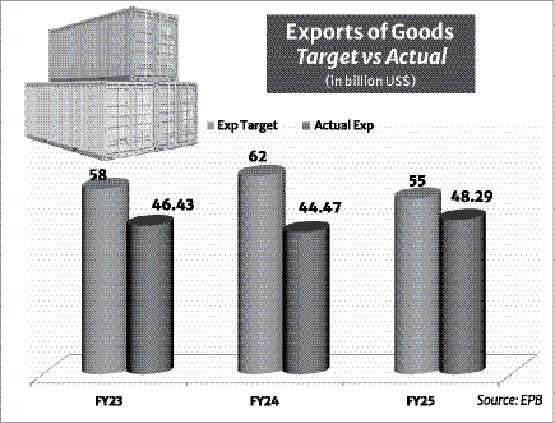
Setting the annual target of exports is a tradition for long in the country though there is no official target for imports. As earnings from export is an important source to support the country's balance of payments (BoP) as well as the economic growth, the strategic target of annual export is considered as a benchmark to determine the performance of the export-oriented industries. Following the tradition, after a modest rise in exports in the last fiscal year, the interim government has set a double digit growth target in earnings from exports of goods and services for the current fiscal year (FY26). The target for merchandise exports is set at US$55 billion for FY 2026 against the actual earnings of $48.28 billion in FY25 when the target was $50 billion. The target for services exports set at $8.50 billion against the target of $7.50 billion in the last fiscal year. Thus, the overall exports target is set at $63.50 billion for the current fiscal year.

After a decline in two consecutive fiscal years, exports of goods surged by 8.50 per cent in the last fiscal year indicating a modest rebound in the economy despite a massive political unrest and changeover in the country. The first quarter of FY25 passed through a sluggish economic activity due to student-led mass uprising in the country that led to downfall of the authoritarian regime of Hasina on August 5 last year. Nevertheless, receipts from exports of goods stood at $11.65 billion in the first quarter which increased to $12.88 billion in the second quarter of the last fiscal year. The third quarter, however, witnessed a slight drop of exports to $12.65 billion and the last quarter ended with the lowest quarterly earnings of $11.12 billion in FY25.

When the domestic economic condition started to rebound, the return of external turbulence did cast a shadow on export growth. In April, Donald Trump, president of the United States (US), announced his reciprocal tariff policy and imposed high rate of tariffs on various trading partners. On Bangladesh, he imposed 37 per cent tariff making the exports from the country excessively costly. The initial reciprocal tariffs were, however, suspended for three months as Trump administration provided a room for negotiation. After a hectic negotiation along with offering a number of benefits, the US has finally agreed to impose 20 per cent reciprocal tariff on all the imports of Bangladesh. It means, the country has to pay 20 per cent additional duty on the existing duties on different products. The tariff blitz has shocked the world and exports from the different countries to the US market also suffered. Bangladesh's export to the US also dropped slightly to $2.35 billion in the last quarter of FY25 from $2.52 billion of the third quarter.

Now, the new export target for FY26 is around 14 per cent higher than the actual earnings of the last fiscal year. The government is optimistic that lower reciprocal tariff will help maintain the exports to the US market. Moreover, the higher reciprocal tariffs on competitors like India will be a boon for Bangladesh.

There is a reason to be slightly optimistic about the global trade, as per the World Trade Organization (WTO). The economists of the WTO at the latest update of the trade forecast said that global merchandise trade is to grow 0.9 per cent in 2025, up from the 0.2 per cent contraction forecasted in April. The latest projection of tiny trade growth is, however, significantly down from the 2.7 per cent growth estimated before the Trump's tariff blitz.

Two factors drive the WTO to make a modest growth projection for the current year. First is the surge of the US imports in the first half of 2025 by 11 per cent in terms of volume due to 'frontloading and inventory accumulation.' Simply put, frontloading means the practice of importing goods in large quantitities or earlier than usual time to avoid possible challenges that may rise in costs or obstruct supply chains. Second is the better macroeconomic outlook than predicted in April last. Nevertheless, the WTO projection also pointed out that recent tariff changes are expected to have an overall negative impact on the outlook for global trade compared to the April forecast. It was of the view that the US-China truce and exemptions for motor vehicles are contributing positively. At the same time higher reciprocal tariff rates, introduced on 7 August, are likely to weigh increasingly on imports in the US and depress exports of its trading partners in the second half of 2025. Bangladesh is one of the US trading partners which is set to face at least 35 per cent tariff on average due to 20 per cent reciprocal tariff besides the current 15 per cent average tariff.

European Union (EU) is another big market for Bangladesh and the country is likely to enhance its exports to the market as there is no tariff barrier. The challenge is that those who are facing the higher tariffs in the US will try to redirect some of the exports to the EU market and that may put Bangladesh into some extra competition. Moreover, as India has already signed a free trade agreement (FTA) with the United Kingdom (UK), there will be a competitive pressure for Bangladesh in near future. It is also not unlikely that India will try to re-export to the US through UK.

For Bangladesh, Indian market is also set to shrink as New Delhi has already put a number of trade barriers since the fall of Hasina regime which was a close ally of the Indian government. The trade barriers are clearly political although some economic justifications have been given. Though the interim government has requested for consultation to resolve the issue of trade restriction, Modi government continues to cold-shoulder the gesture and hinted that more trade restrictions on Bangladesh are in the offing.

Finally, the country is likely to enter into the election business cycle by the end of the second quarter of the current fiscal year, and the cycle would continue in the third quarter, provided that the national election takes place in February next year. As the previous election business cycles showed, it will be marked by sluggish economic growth, and so exports may not gear up as expected. So, achieving the target will no doubt be challenging.​
 
Analyze

Analyze Post

Add your ideas here:
Highlight Cite Fact Check Respond

Bangladesh’s economic performance has been unique post-uprising

1755563846373.webp

FILE VISUAL: SALMAN SAKIB SHAHRYAR

Last year, after the violent change in power through the mass uprising, when the interim government assumed the responsibility of salvaging the economy from the brink of total collapse, the task to bring it back on track seemed almost impossible. As the true state of the economy emerged from reports of various commissions, people came to know the real depth of destruction that the economy suffered during the previous regime. The unchecked spiral of inflation, dwindling foreign exchange reserves, persistent large trade deficits, gross financial irregularities leading to a near collapse of the banking system, and deeply corrupted governance that destroyed almost all institutions, among others, were identified as the main challenges for the interim government. To stop the freefall of the economy and bring it back on course, we had to take some bold steps. Monetary and fiscal policies were tightened, stricter austerity measures were put in place, corrective measures were taken to restore discipline in the financial sector, and maximum efforts were employed to fight against corruption.

Major steps under the bold reform and recovery programmes included a detailed asset quality review, structural reform guidelines for ensuring discipline in the financial sector, initiating a process of recovery of the assets stolen from the financial system, and ensuring sufficient liquidity in the banking system. To strengthen fiscal governance, the government employed best efforts to enhance revenue collection, such as by phasing out special tax privileges and separating tax policy from tax administration. To tame inflation, the policy rate has been increased to 10 percent, which can help stabilise the exchange rate.

Looking back after a year, we are pleased to share Bangladesh's unique macroeconomic success and the story of how we have been able to turn the tide and overcome the seemingly impossible task. Recent figures and macroeconomic indicators available now tell the story.

1755563900425.webp

SOURCE: COURTESY

Almost every country in the world that underwent a violent change of regime experienced output declines and a rise in inflation immediately afterwards. This has been true, for example, in the case of Sri Lanka recently, also in Indonesia when the Soeharto regime fell, in Iran during the early 1980s, and in Russia during the early 1990s. In Indonesia, poverty rate jumped from around 15 percent to around 33 percent in one year. In Sri Lanka, around 26 percent of people lived in poverty in 2023, a year after the violent fall of the previous regime. Between 1991 and 1993, Russia's inflation exceeded 800 percent, and it took nearly 10 years for the country to recover. Meanwhile, male life expectancy fell six years between 1991 and 1994 in the country. The former Soviet republics and Eastern Europe experienced a similar decline in life expectancy during this same period.

But this did not happen in Bangladesh, where rather inflation fell and GDP growth remained in the positive territory.

This remarkable macroeconomic resilience, supported by our government's policies, is being reflected in growing investor confidence. For example, Dhaka Stock Exchange's (DSEX) rally in July, surging by 12.5 percent, ranked third among major global market performers, behind only Vietnam's VN30 (+13.93 percent) and Thailand's SET (+12.54 percent). The index soared 605 points to close at 5,443, the highest level in nine and a half months.

1755563927907.webp

SOURCE: COURTESY

The right policies taken by the interim government have stopped the bleeding of the Bangladesh economy, which is showing signs of rebound. Due to incentives and confidence improvements, the expatriates are sending out record levels of remittances through proper channels, leading to a significant improvement in the foreign exchange reserves. Confidence in the financial system has also been regained through improved governance. The local currency has become stable even after adopting a market-based exchange rate regime.

However, challenges still remain, especially in the financial sector. It will require a careful mix of salvage operations and difficult decisions to reduce risks in the financial sector to acceptable levels. Special care will be needed to avoid expenditures against unnecessary projects and to improve the project implementation rate. Innovative measures are being taken in the power sector to reduce subsidies. We are also continuing necessary support to critical areas such as food security and social safety.

What seemed impossible a year ago is now under control and we hope to further improve the state of the economy in the coming months. While the inflation is now showing a downward trend, we will continue our policies to bring it down below seven percent. Based on strong fundamentals and macroeconomic stability, supported by well-coordinated fiscal, monetary, exchange rate, and capital market policies, we expect further improvements. In other words, we expect growth to pick up, inflation to decline further, as well as buoyancy of the stock market.

Salehuddin Ahmed is adviser of Ministry of Finance and Ministry of Science and Technology.

Anisuzzaman Chowdhury is special assistant to the chief adviser at the Ministry of Finance.​
 
Analyze

Analyze Post

Add your ideas here:
Highlight Cite Fact Check Respond

Bangladesh Exports hit 32-month high in July


1755895862033.webp

Photo: Rajib raihan

The country's exports rose to $4.77 billion in July, up nearly 25 percent from $3.82 billion a year earlier, according to the Export Promotion Bureau (EPB), marking the highest monthly earnings from merchandise shipment since November 2022.

Key contributors to the growth in the first month of the new fiscal year included pharmaceuticals, leather goods, engineering products and an increase in ready-made garment (RMG) shipments.

Frozen fish, vegetables and tobacco also performed well, while tea and glassware exports fell.

This development came just a day after the Bangladesh Bank reported a 29 percent year-on-year increase in remittance income in July, maintaining buoyancy as more than 40 lakh Bangladeshis have gone abroad for work over the past four years.

After the political changeover in August last year, exports and remittances together have helped ease pressure on the foreign exchange reserve.

The country's external balance returned to surplus in the recently concluded fiscal year 2024-25, following three years of persistent deficits.

Anwar-ul-Alam Chowdhury Parvez, president of the Bangladesh Chamber of Industries (BCI), said the export growth did not come from exceptional demand or from front-loading, a practice where exporters rush shipments in anticipation of tariffs or other supply chain issues.

"The nearly 25 percent export growth in July was not a response to looming American tariffs, but rather a result of seasonal factors and a low base in that month last year," said the business leader.

He pointed out that political unrest in July last year had disrupted production, with many factories unable to operate fully. "This year, production did not face similar incidents," he said.

"So, the growth reflects a seasonal rebound rather than extraordinary demand."

Although the July figures appear promising, Parvez urged caution. "US and European buyers are still hesitant. Some were holding back orders until early August."

He added that exports might fall in August and September, typically a lean period. "Things should begin improving again from October."

Parvez also talked about the potential impact of the United States reducing reciprocal tariffs to 20 percent from 35 percent. He said there was no immediate effect.

"But, if retail prices rise by even $2 to $3, hypermarkets like Walmart and Target may cut volume. Sales could drop 30 percent to 35 percent."

Most current shipments are part of the winter collection and are expected to continue through mid-August. Summer and Christmas products will begin shipping from September.

"Many orders were booked earlier, but final confirmation was delayed. This week is key. It may take three to four more months for full clarity," he said.

Asif Ibrahim, vice chairman of Newage Group and a former director of the Bangladesh Garment Manufacturers and Exporters Association (BGMEA), said the strong performance in July was driven by a mix of global and domestic factors.

"One major driver was the front-loading of orders by international buyers, especially from the United States," Ibrahim told The Daily Star. "Concerns over potential tariff hikes led many brands to speed up their shipments, pushing a large volume of orders into July."

He added that geopolitical tensions and trade uncertainties, particularly around China, had reshaped global sourcing strategies. As buyers looked to diversify, Bangladesh gained ground as a reliable option.

Ibrahim said traditional markets such as the European Union, United States and Canada continued to show strong demand, while non-traditional markets, including Japan, India and Australia, saw rapid growth.

He also commented that Bangladesh's improved compliance in factories, greater efficiency and rising focus on sustainability had made the sector more competitive globally.

"These combined dynamics created an unusually high volume of exports in July," he said. "It is a positive signal for the sector's performance in the quarters ahead."

Pharmaceutical exports saw the highest growth, jumping 61.85 percent year-on-year to reach $19 million, up from $12 million in July last year.

Wasim Haider, international marketing manager at Beximco Pharmaceuticals, said the surge likely resulted from multiple overlapping factors.

"This kind of jump is unusual for July," he told The Daily Star, pointing to delayed June documentation and new product approvals as possible reasons.

In July, leather footwear exports rose by 26 percent. But Nasir Khan, chairman and managing director of Jennys Shoes, said the gains could have been far greater if not for delays and corruption.

"Our shipments often stall at ports due to slow bond clearances," he said, adding that exporters face demands for "bribes up to Tk 5 lakh just to move files."

Khan claimed that a network of "unofficial lobbying quarters" and influential officials had taken control of key export approvals, holding back one of the most promising sectors outside the RMG industry.

Despite rising global demand, he said red tape, middlemen and "grease money" continue to undercut the sector's full potential.
 
Analyze

Analyze Post

Add your ideas here:
Highlight Cite Fact Check Respond

FDI in Bangladesh rose 20% in FY25

Economists say growth positive but still falls short of long-term needs
1755896033867.webp

Bangladesh saw a rebound in foreign direct investment (FDI) in the fiscal year (FY) 2024-25, with net inflows reaching $1.71 billion.

The figure marks an increase of nearly 20 percent compared with the previous year, following a three-year low in FY24 amid a heated political climate centred on the national elections and subdued investor confidence, according to central bank data.

Economists and business leaders welcomed the recovery as a sign of renewed investor confidence. Still, they warned that the overall volume remains far below what is needed to support the country's long-term development ambitions.

They said sustained reforms, political stability, reliable infrastructure, and investor-friendly policies are essential to attract new greenfield investments and diversify the FDI base.


"It is good to see this uptick, but it is important to understand how much came from new investors versus reinvestments by those already operating in Bangladesh," said Syed Akhtar Mahmood, former lead private sector specialist in the Trade & Competitiveness Global Practice of the World Bank Group (WBG).
"Reinvestment could reflect growing confidence, but it may also be a response to rising local borrowing costs," he added.

Mahmood said attracting new foreign investors is critical for long-term growth and diversification. "While existing investors are important, Bangladesh must actively seek fresh investment, especially in export-oriented sectors and emerging industries."

He also called for examining the sectoral distribution of FDI, especially in areas that support exports such as energy, logistics, and new product development.

He noted that much of the FDI recorded in a given year often reflects decisions made earlier. "So, while the current figures are encouraging, the full impact of recent reforms may not yet be visible."

Rupali Chowdhury, former president of the Foreign Investors' Chamber of Commerce and Industry (FICCI), said the current level of FDI is insufficient to meet Bangladesh's long-term growth goals.

"To increase our GDP growth by 1 percent per year and become a high-income country, we need at least $8 billion in FDI annually. But inflows have remained between $1.5 billion and $3 billion," she said.

She pointed to persistent uncertainty as a major deterrent for foreign investors. "Concerns over the overall business environment are holding back investment," said Chowdhury, urging the government to prioritise resolving the gas and power shortage and improving logistics.

She compared Bangladesh with regional peers. "Vietnam attracted around $36 billion in FDI commitments in 2024, while India secured more than $28 billion. Even smaller Southeast Asian economies like Cambodia have often outpaced Bangladesh in winning large greenfield projects."

She added that consistent, investor-friendly policies are essential to attract and retain quality investment. Chowdhury cited the Japanese economic zone as a promising model for drawing FDI.

Ashraf Ahmed, former president of the Dhaka Chamber of Commerce and Industry (DCCI), described the recent rise in FDI as encouraging, crediting efforts from both the public and private sectors.

"This is certainly a positive sign and the result of a lot of hard work," he said. Ahmed, however, added that the overall volume remains far below what is needed to achieve Bangladesh's growth ambitions.

"The aggregate FDI still stands at a very low base," he said, noting that much more needs to be done to attract both domestic and foreign private investors.

The business leader stressed that progress must be made in political stability, macroeconomic management, infrastructure, regulation, and the broader business environment.

"Only a consistent and comprehensive reform strategy will enable Bangladesh to unlock its full investment potential and remain globally competitive," he added.

M Masrur Reaz, chairman and CEO of Policy Exchange of Bangladesh, also welcomed the FDI increase, describing the year-on-year rise as encouraging.

However, he cautioned that inflows remain far below what is required to sustain long-term growth.

Read more

FDI hits 2-year high in Jan-Mar

"While the numbers look good on the surface, they are still quite low compared with our needs," he said, adding that much of the investment is concentrated in export-processing activities.

Reaz added that much of the recent FDI has come from reinvestments by existing foreign investors rather than new greenfield projects or entry into new sectors. "If this pattern continues, we should not be overly satisfied with the headline figures," he said.

The economist called for time-bound reforms to attract new investors, diversify sectors, and improve transparency. "Without a sector-wise breakdown of FDI, it is difficult to assess the quality and sustainability of these inflows," Reaz said.
 
Analyze

Analyze Post

Add your ideas here:
Highlight Cite Fact Check Respond

Bangladesh, Pakistan to form commission on trade, investment


1755896222380.webp


Bangladesh and Pakistan have agreed to establish a new joint trade and investment commission to boost bilateral trade, Commerce Adviser Sk Bashir Uddin said yesterday.

The two sides will also revitalise the existing Joint Economic Commission (JEC), which has remained inactive for the past decade and a half, to enhance cooperation in trade, investment, and economic exchanges, he told reporters after a meeting with visiting Pakistani Commerce Minister Jam Kamal Khan at the commerce ministry in Dhaka.

During the talks, Bashir urged Pakistan to withdraw the anti-dumping duty it has imposed on Bangladesh's hydrogen peroxide exports.

He also sought duty-free access for one crore kilogrammes of Bangladeshi tea, a facility that had previously existed. In addition, he called for Pakistani cooperation in Bangladesh's leather and sugar industries.


The adviser noted that Bangladesh imports around $80 billion worth of goods annually, of which $15 billion goes to food items. Pakistan, he said, could be a reliable source to meet part of this demand.

Replying to a query from journalists regarding the import of goods from Pakistan, the adviser said that Bangladesh considers "almost all countries," including the USA and India, as potential suppliers.

Trade between the two countries is heavily tilted towards Pakistan, as Bangladesh imports industrial raw materials, rice, and intermediary goods for industrial use.
Bangladesh has scope to import stones and mineral resources from Pakistan.

Commerce Secretary Mahbubur Rahman added that both countries are now "engaging to ease trade and commerce" after years of limited progress.

Both Bangladesh and Pakistan may finalise some memorandums of understanding on trade and investment over the next three days during the stay of the Pakistani commerce minister in Dhaka.

Khan arrived in Dhaka yesterday on a four-day visit to discuss bilateral trade and investment between the two countries.

Meanwhile, in a separate development, Khan met with Taskeen Ahmed, president of the Dhaka Chamber of Commerce & Industry (DCCI), at the chamber's office in Dhaka yesterday.

During the meeting, the Pakistani minister said the two countries have significant potential to work together in diversifying their export baskets to capture major markets in Europe, Canada, and the United States.

He noted that both countries currently rely heavily on the apparel and textile sectors for exports.

He pointed out that in Europe, Canada, and even in the United States, demand for reused clothing has recently surged and is gaining popularity.

Entrepreneurs from both Pakistan and Bangladesh, he suggested, could collaborate to tap into this growing market.

He also announced that a "Single Country Exhibition" of Pakistani products will soon be organised in Bangladesh to strengthen private-sector ties between the two nations.
 
Analyze

Analyze Post

Add your ideas here:
Highlight Cite Fact Check Respond
 
Analyze

Analyze Post

Add your ideas here:
Highlight Cite Fact Check Respond
  • Wow (+2)
Reactions: Mainerik
 
Analyze

Analyze Post

Add your ideas here:
Highlight Cite Fact Check Respond
The Silent Surge - How Bangladesh Could Outrun Asia's Giants

 
Last edited:
Analyze

Analyze Post

Add your ideas here:
Highlight Cite Fact Check Respond
Industrial growth prospects in Bangladesh and India

----------------------------------------------------------------------------------------

Even given the events of July 2024 in Bangladesh and the current economic trajectories, Bangladesh's industrialization is expected to continue strong growth driven by its established export-oriented manufacturing, especially in ready-made garments (RMG), as well as expanding sectors like ICT, pharmaceuticals, and light engineering.

Bangladesh has shown resilience and steady industrial growth, supported by major infrastructure projects such as the Padma Bridge and digital transformation initiatives.

India, on the other hand, has a larger and more diversified economy with significant growth in service sectors like IT, finance, and tourism, but its manufacturing sector has underperformed relative to expectations due to infrastructure bottlenecks, regulatory challenges, and slower industrial job creation.

India is focusing on reforms to accelerate industrialization, but the pace remains moderate.

Projections suggest:

  • Bangladesh will maintain an average GDP growth rate of around 6.5% over the next decade, accelerating its industrial output and export capacity, which could lift it to the world's 25th largest economy by 2035.
  • India’s economy will grow steadily, with industrialization supported by reforms and innovation, but challenges in manufacturing remain. India will likely continue to grow faster in services, making it the 3rd largest economy by 2030.
In summary, Bangladesh's industrialization is likely to do very well in the next ten years, potentially outpacing India in manufacturing sector growth rates and industrial export expansion due to its focused development model and demographic advantages.

However, India’s larger diversified economy and service sector growth will keep it far ahead in total economic size.

The two countries are pursuing somewhat different development models—Bangladesh through traditional export-led industrialization and India through service-oriented growth supplemented by industrial reforms.

Therefore, Bangladesh may largely outperform India in industrial growth percentage terms in the next decade, especially post-July 2024 events, but India’s overall economic scale and service sector will remain strong defining factors. This difference highlights Bangladesh’s rising industrialization success in South Asia amid evolving global economic conditions.

Given the events of July 2024 and current data, Bangladesh's industrialization is expected to grow at a faster pace than India's industrial sector over the next decade. Bangladesh's export-oriented manufacturing, especially in ready-made garments, along with expanding sectors such as ICT and pharmaceuticals, are driving steady industrial growth backed by infrastructure investments and digital transformation initiatives. It is projected to become the world's 25th largest economy by 2035 with robust industrial expansion.

India, although having a larger and more diversified economy, has experienced slower growth in manufacturing relative to expectations due to infrastructure and regulatory challenges. Its economic growth is more driven by services rather than manufacturing. India is working on reforms to boost its industrial base but may not match Bangladesh's high industrial growth rates in the near term.

In summary, Bangladesh is likely to outperform India in industrial sector growth rates and export expansion in the next ten years, especially after July 2024 events, but India will maintain larger overall economic size and service sector dominance.

The development models differ: Bangladesh focuses on traditional export-led industrialization, while India pursues service-led growth supplemented by industrial reforms.

This dynamic positions Bangladesh as a rising industrialization success in South Asia amid evolving global economic conditions.
 
Analyze

Analyze Post

Add your ideas here:
Highlight Cite Fact Check Respond
As of 2025, Bangladesh's manufacturing-value-added as percent of GDP accounts for approximately 21.89% of its GDP, while India's is around 13%, and Pakistan's is about 10%. This indicates that Bangladesh has a much higher proportion of manufacturing contribution to its economy compared to both India and Pakistan as opposed to agriculture. This is a revolutionary change where Bangladesh was considered a backward agricultural country even two decades ago. The figure for Vietnam, Thailand, Malaysia and Indonesia are around 24%, 24%, 22.5% and 19% respectively.

ssti.org Trading Economics

For Bangladesh, still a long slog. Dilli door ast.
 
Last edited:
Analyze

Analyze Post

Add your ideas here:
Highlight Cite Fact Check Respond
Bangladesh Vision 2041 (Vision '41) is a national strategic plan to further develop the socio-economic standing of Bangladesh, formulated by the National Economic Council. As a part of four 5-year perspective plans to be undertaken between 2022 and 2041, Bangladesh aims to achieve high income status through industrialization. The initiative encourages expansion of manufacturing capacity and investment in human capital development to develop exports.

 
Analyze

Analyze Post

Add your ideas here:
Highlight Cite Fact Check Respond

Dhaka, Ctg draw four-fifths of Jul-Sept remittances

1763084131862.webp


Dhaka and Chattogram, two major divisions of Bangladesh, received 80 percent of the total remittance of the first quarter of fiscal year 2025-26, reflecting a regional disparity.

The remaining six divisions received only one-fifth of the $7.58 billion in remittances during the July-September period of the current year, according to the latest monthly report on workers' remittance inflows by Bangladesh Bank (BB).

During the period, the South Asian country, which is highly reliant on remittances to meet its external obligations, recorded a 16 percent year-on-year growth in inflows, rising from $6.54 billion in the same period a year ago.

Dhaka division received $4.22 billion during the July-September quarter of FY26, which was 33 percent higher year-on-year.

Chattogram division registered only a 5 percent growth in remittance inflows to $1.89 billion in the first three months of this fiscal year.

In other words, Dhaka accounted for more than half of the inflows, while Chattogram received one-fourth of total remittances, according to BB data.

Towfiqul Islam Khan, additional director (research) at the Centre for Policy Dialogue, said Dhaka and Chattogram have remained the main recipients of remittances for many years.

"People usually get jobs and go abroad based on family links. So, we see inflows are high in certain districts such as Madaripur and Noakhali," he said.

The BB data showed that during the first quarter of FY26, remittance inflows to all divisions except Dhaka and Chattogram declined. However, the share of remittance receipts increased only in Dhaka and Mymensingh.

Rangpur division received the lowest amount, followed by Mymensingh, Barishal and Rajshahi divisions during the July–September period.

Syed Mahbubur Rahman, managing director and CEO of Mutual Trust Bank PLC, said the outflow of migrant workers is high from Chattogram. "But it appears that the beneficiaries of many migrant workers live in Dhaka," he said.

"Another possible reason could be the ticket size (the monetary value of a single transaction) of remittances. It may be that the average ticket size is higher in Dhaka than in other divisions," he added.

Mohammad Ali, managing director and CEO of Pubali Bank PLC, said mobile financial services (MFS) have become a medium for remittance transfers. "We transfer most of the remittances coming to our bank through mobile financial services," he said.

"This could be one reason," he added.

The BB data showed that Saudi Arabia, which employs more than 20 lakh Bangladeshi migrant workers, was the main source of remittances, followed by the United Kingdom, the United Arab Emirates, and Malaysia.

Migrant workers sent the highest amount of their earnings to Bangladesh through Islami Bank Bangladesh PLC.

The BB said in recent years, workers' remittance inflows have been crucial in enabling Bangladesh to maintain economic stability, particularly in the face of global economic uncertainties and domestic challenges.

"In the current political and economic landscape, marked by inflationary pressures, exchange rate fluctuations, and rising import costs, remittances have provided much-needed relief by bolstering foreign currency reserves and supporting millions of households across the country," it said.

The report said as a stabilising factor, the steady flow of remittances has been contributing to poverty reduction, improving living standards, and regional development.

"In the context of the ongoing post-pandemic economic recovery, coupled with political transitions, remittances are even more decisive in sustaining economic growth, ensuring liquidity in the banking sector, and reducing reliance on external borrowing," it said.

The BB, citing the Bureau of Manpower, Employment and Training (BMET), said 1.58 crore people have obtained BMET licences for overseas work from 1976 to September 2025.​
 
Analyze

Analyze Post

Add your ideas here:
Highlight Cite Fact Check Respond
  • Like (+1)
Reactions: Bilal9

Paying heed to IMF's revenue warning

Published :
Nov 15, 2025 22:57
Updated :

1763256451898.webp


The persistent challenge of elevating revenue collection remains the central economic puzzle that Bangladesh has attempted to solve for many years. From enacting a new income tax law in 2023 to expanding and reorganising both the Income Tax wing and the Customs and VAT wing, the government has introduced a series of initiatives designed to strengthen the institutional capacity of the National Board of Revenue (NBR) and raise collections. These steps will require time before their impact becomes visible, yet the way the revenue system is currently functioning suggests that such manoeuvres may not be enough to address long-standing weaknesses. The government continues to face increasing expenditure pressures, and without meaningful improvements in revenue performance, it risks relying even more heavily on deficit financing. In this setting, the recent call by the International Monetary Fund (IMF) for Bangladesh to place far greater emphasis on revenue mobilisation serves as a timely reality check. The warning is clear that repeated failures in revenue performance will undermine the quality of public services and delay essential infrastructure building.

The revenue shortfall described by the IMF is already a recognised and alarming issue. It is a serious concern that Bangladesh now has one of the lowest tax-to-GDP ratios in the region at about 6.56 per cent, far below the Asia Pacific average of 19.5 per cent. At IMF's counsel, the government has begun separating policy formulation from enforcement within the NBR by splitting it into two divisions, a reform expected by December that aims to change the entrenched practices within the institution. While the principle of separating these functions to avoid conflicts of interest is conceptually sound, it may very well prove inadequate to address the fundamental weaknesses in revenue mobilisation. Without a substantial expansion of the tax base and improved collection efficiency, such incremental adjustments will be insufficient to escape a perilous fiscal trap the country is entangled with. The strain is visible in the government's diminished capacity to make essential investments in infrastructure and to respond decisively to the prolonged spell of high inflation. A government's ability to function well and invest in the future of its people depends entirely on its success in collecting taxes fairly and efficiently. When tax income falls this low, resources for critical spending shrink and borrowing becomes the only viable fallback.

Furthermore, as the IMF rightly noted, an underfunded treasury makes it nearly impossible to address the deep vulnerabilities within the banking sector. Recapitalising state-owned banks, reducing non-performing loans and improving financial governance are now a priority but they all require significant public money. Without these, the financial system continues to pose a latent threat to macroeconomic stability. The IMF's specific mention of strengthening anti-corruption measures and improving the Anti-Money Laundering framework is particularly telling. Corruption by a section of NBR officials and their willing partners among taxpayers is well known, and their actions have punctured the public purse from within and deprived the state of much needed revenue. Plugging this hole is essential for achieving collection targets and restoring public confidence that taxes are used responsibly.

The future of Bangladesh's economy depends on its ability to break free from the low-revenue trap. This is why the enhancement of revenue collection must be treated as a national responsibility rather than an external demand. Key measures must include expanding the tax net to encompass sectors with long-standing privileges and aggressively promoting digital systems for VAT and income tax to improve compliance and fairness. The IMF has warned that the window for meaningful action is narrow. Bangladesh should respond with the urgency this warning deserves and adopt measures that can lift the country out of its revenue constraints with resolute political commitment.​
 
Analyze

Analyze Post

Add your ideas here:
Highlight Cite Fact Check Respond
  • Like (+1)
Reactions: Bilal9

No turning back on economic reforms
An elected government can use its mandate to finish unfinished tasks

1763257094790.webp

VISUAL: STAR

Bangladesh is approaching a moment of political and economic reckoning. The upcoming general election, now twinned with a referendum on constitutional reforms, is expected to provide the incoming government with the mandate and momentum necessary to act swiftly on crucial and long-overdue matters, including the task of putting the economy firmly back on track. The International Monetary Fund's recent decision to pause a crucial review under the $5.5 billion loan programme, and engage with the "newly elected authorities," only reaffirms the importance of a smooth transition.

The economic anxieties, including stubbornly high inflation and flagging growth, are not cyclical hiccups but rather the consequence of past failures to address deep-seated vulnerabilities. The core demands of the IMF—a simpler, fairer tax system and urgent banking sector reforms—are precisely what the Awami League government long avoided. Following its ouster, the interim government has "made notable progress in maintaining macroeconomic stability," as the IMF has acknowledged. To ease external imbalances and contain inflation, the authorities tightened both fiscal and monetary policies. Importantly, foreign exchange reserves have begun to rebuild following the exchange rate reform launched in May. However, the economy "continues to face significant macro-financial challenges" stemming from weak tax revenue and undercapitalisation in the financial sector.

The next administration will understandably inherit these and other economic challenges. That's precisely why it must embrace necessary but often painful reforms to drive recovery. The political transition following the election must not become a pretext for delay. Bangladesh can no longer afford to postpone the difficult decisions required to clean up state-owned banks, implement tax reforms, and enforce strict monetary discipline. Economic complacency is exactly what the IMF cautions against, and any indulgence at this stage would be a costly mistake.

Bangladesh is required to act on three fronts. First, it must launch the ambitious tax reform demanded by the IMF, eliminating non-essential exemptions and subsidies. The new government must be ready to take on the powerful lobbies that thrive on tax loopholes. Generating more revenue means the state will be capable of expanding social safety nets and infrastructure, key requirements for inclusive growth. Second, the new leadership must take banking reforms forward. That requires political courage, as it will inevitably mean confronting powerful figures and vested interests. Finally, the central bank's independence in conducting monetary policy must be safeguarded. The transition period must not be allowed to undermine the recent progress made in adopting a flexible exchange rate regime.

Delayed or inadequate policy action in addressing fiscal and banking challenges would weaken growth, raise inflation, and increase macro-financial risks. Any success in these cases will be measured by the government's willingness to make hard, politically uncomfortable choices. It's a crucial test, one in which we must not fail.​
 
Analyze

Analyze Post

Add your ideas here:
Highlight Cite Fact Check Respond

What's holding back growth of cashless transactions?

Atiqul Kabir Tuhin
Published :
Nov 20, 2025 00:03

1763600062709.webp


Digital financial transactions have increased by leaps and bounds over the past decade in Bangladesh, primarily driven by the impressive growth in the number of Mobile Financial Service (MFS) users. Estimates suggest that there are now more than 90 million active MFS users in the country, collectively conducting daily transactions worth nearly Tk 50 billion. With such rapid expansion in digital transaction, one would expect the dominance of cash to ebb gradually and the economy to move steadily towards a less-cash system.

However, the dominance of cash is showing no sign of abating. As the latest Bangladesh Payment Systems Report 2024 published by Bangladesh Bank reveals, although digital transactions - covering payments through mobile wallets, internet banking, and other electronic channels grew in volume in 2024, their share of total payments actually declined. The report shows that traditional, non-digital payments are now expanding faster than digital channels, while MFS are experiencing a drop in transactions.

According to the report, digital payments rose from 366.7 million transactions in December 2023 to 403.1 million a year later. However, their share of total payments dropped from 51 percent to 47 percent. In value terms, too, digital channels posted only marginal growth, increasing from Tk 751.4 billion to Tk 763.4 billion - a decline in share from 29 percent to 28 percent of total transaction value. In sharp contrast, non-digital payments expanded rapidly, growing 31.4 per cent in volume and capturing an even larger share of the total value.

This reversal underscores that a majority of people remain accustomed to traditional transaction systems, while it also reveals structural challenges within MFS that policymakers must address if the momentum towards a less-cash economy is to be sustained.

Bangladesh Bank attributes this trend to the increasing preference of MFS users for cash-out services over digital-to-digital transfers. This means that most users are relying on MFS primarily to send money from one place to another, rather than using their mobile wallets for day-to-day financial transactions. If users are increasingly withdrawing cash instead of keeping money within the digital ecosystem, the ambition of moving towards a cashless or less-cash economy is bound to falter.

This is particularly concerning at a time when policymakers have been emphasising the need to expand cashless systems, especially given that the country spends an estimated Tk 200 billion annually on cash management. This staggering expenditure covers the printing of currency, security, managing idle cash and operating ATM networks. Experts suggest that shifting towards a less-cash economy by expanding MFS usage and incentivising digital payments would significantly reduce these costs, and also enhance financial transparency.

In this regard, Bangladesh can take a leaf from neighbouring countries' playbooks on how they succeeded in popularising digital transactions. India's Unified Payments Interface (UPI), launched in 2016, has become one of the world's most successful real-time payment platforms, handling nearly 20 billion transactions a month with a transaction value approaching USD 290 billion. A key driver of India's success in popularising cashless transaction is that UPI offers completely free P2P transfers and most QR-based payments at zero cost, making digital payments more attractive than cash.

Sri Lanka, meanwhile, introduced its national QR standard, LankaQR, in 2018 and formally launched it in 2019 to promote interoperable, low-cost digital payments, including for feature-phone users. Pakistan's Raast platform, launched in 2022, offers free P2P transfers and has recently been supported by a government subsidy covering a portion of merchant QR transaction costs to accelerate adoption. These regional examples demonstrate the importance of cost-free transactions, interoperability, and government-supported incentives in driving mass adoption of digital payments.

Bangladesh's digital payments landscape is shaped largely by the dominance of MFS. Customers can receive funds free of cost, but cash withdrawals incur service charges. According to a study by Transparency International Bangladesh (TIB) Bangladesh has the highest MFS service charges among neighbouring countries. For instance, withdrawing Tk25,000 via bKash costs Tk372.5 to Tk462.5, compared to Tk355.7 in Pakistan (Easypaisa), Tk231.3 in Myanmar (Wave Pay), and no charge in India (Phone Pay).

Apart from high service charges, the universal Quick Response (QR) code payment system introduced by Bangladesh Bank, known as Bangla QR, is yet to gain popularity. Launched in January 2023, Bangla QR was designed to standardise QR-based payments across all banks and platforms. However, even nearly after three years, it remains absent from most storefronts. Many banks don't even have the updated mobile apps to support Bangla QR. Instead, stickers from mobile financial service providers like bKash and Nagad dominate the market, leaving the unified system struggling to gain a foothold.

The situation is similar for TakaPay, the local currency debit card introduced in late 2023 to reduce reliance on global payment networks such as Visa and Mastercard. Despite being the first of its kind, only eight banks currently offer it, and most consumers remain unaware of its existence.

Against this backdrop, experts argue that even if 5 per cent of Bangladesh's annual cash-management expenditure - estimated at around Tk 200 billion - were invested in promoting digital payments, the long-term economic gains would be substantial. Effective coordination among Bangladesh Bank, commercial banks, MFS operators and payment service providers is crucial to ensure seamless transfers from bank accounts to MFS wallets and to facilitate interoperability across all MFS platforms. Besides, Bangla QR and Taka Pay systems need to be promoted to increase digital payment system. Bangla QR and TakaPay also need stronger promotion to expand digital payment usage.

The authorities can begin by mandating the use of Bangla QR for all merchants and shops. Obtaining or renewing a trade licence could require displaying a valid QR code. QR codes may also be issued to all bank, MFS and PSP users to enable quick person-to-person transfers. In addition, QR-based payments can be integrated into government service platforms, including electricity bills and Metro Rail ticketing. Such measures would significantly boost public awareness, increase the use of digital transactions, and accelerate the country's transition towards a modern, transparent, and efficient digital economy.​
 
Analyze

Analyze Post

Add your ideas here:
Highlight Cite Fact Check Respond
  • Like (+1)
Reactions: Bilal9

Members Online

No members online now.

Latest Posts

Latest Posts

Post