Bangladesh Defense
Saif
Senior Member
- Joined
- Jan 24, 2024
- Messages
- 20,895
- Likes
- 9,685
- Nation

- Residence
- Axis Group

Govt sees early signs of economic recovery
The government has painted a relatively stable picture of the economy in a report to the United Nations, saying early signs of recovery appeared in the middle of this year.
Govt sees early signs of economic recovery
Report to UN claims stabilisation and improving indicators, but economists highlight inflation, unemployment, weak investment and mounting debt concerns.

The government has painted a relatively stable picture of the economy in a report to the United Nations, saying early signs of recovery appeared in the middle of this year.
Some economists, however, remain critical of key macro indicators and say that the outlook is far from assured.
Google News LinkFor all latest news, follow The Daily Star's Google News channel.
"The complacent views shown in the report are not consistent with the facts," said Zahid Hussain, former lead economist of the World Bank Dhaka office.
He said that of the three major macroeconomic factors, foreign exchange, inflation and financial distress, only foreign exchange shows improvement. Inflation and financial distress continue to pose serious concerns.
Submitted early this month to the United Nations Committee for Development Policy (UN-CDP), the annual report itself acknowledged several challenges highlighted by economists.
Even so, it argued that the macroeconomic performance of Bangladesh is "unique" compared to countries where regime change occurred through violent overthrow or mass uprising.
Drawing comparisons with Sri Lanka and Indonesia, the finance ministry report claimed that several economic indicators in those countries failed to recover after government changeovers, unlike the development trajectory of Bangladesh.
It said those economies saw sharp declines in output and foreign direct investment, along with rising inflation, while Bangladesh maintained positive output and FDI growth and reported declining inflation.
"As a result, Bangladesh could avoid any significant development setbacks," said the report, continuing the narrative of the past four years ahead of the country's scheduled graduation from the least developed country club next year.
Indonesia saw its poverty rate jump from around 15 percent to 33 percent within a year after the changeover, while around 26 percent of the population in Sri Lanka lived in poverty in 2023, a year after the violent fall of the regime, according to the report.
In support of the claim of "early signs of recovery" by mid-2025, the report cited higher GDP growth, easing inflation, a stabilised exchange rate and improvements in foreign exchange reserves and the balance of payments.
The government attributed these gains to measures such as the introduction of a pegged exchange rate system, market-based interest rates, reduced subsidies and rationalised public expenditure. A temporary freeze on non-essential spending also created fiscal space for priority sectors, including health, agriculture and social protection.
The report highlighted a 12.5 percent rise in the Dhaka Stock Exchange Broad Index (DSEX) in July as evidence of growing investor confidence. It ranked third among major global market performers that month. The index gained 605 points to close at 5,443, the highest level in nine and a half months.
However, Hussain dismissed the stock market surge as short-lived.
"The rising trend of stock market indicators was temporary, and the surge in the DSEX index did not last long," said the economist. "So, it cannot be said that investor confidence is restored only with this indicator. The daily trading at the Dhaka Stock Exchange is also showing a downward trend."
Growth figures also challenge the somewhat upbeat narrative of the report.
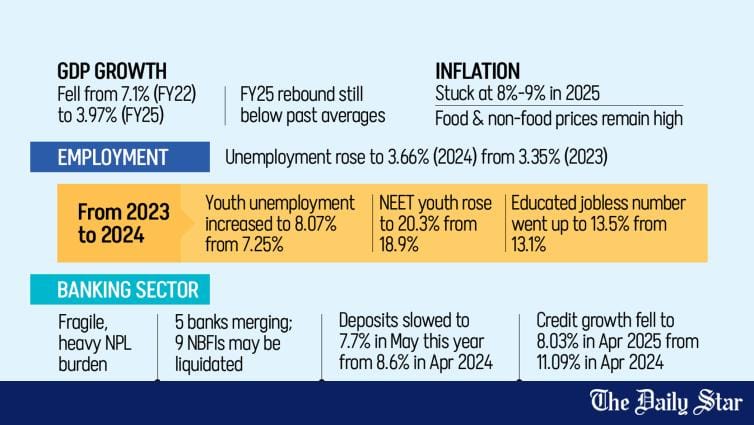
Real GDP growth has declined since FY22, dropping from 7.1 percent to a provisional 3.97 percent in FY25.
After a strong rebound in FY21 to FY22 driven by manufacturing and exports, growth slowed due to rising inflation, foreign exchange shortages and weaker private investment, the report mentioned.
It said the sharper decline reflects continued macroeconomic pressures, subdued demand and slower external trade, indicating a period of adjustment after years of expansion.
According to the report, quarterly data showed modest gains. In the first quarter of FY25, agricultural output grew by only 0.76 percent, while industry and services expanded by 2.44 percent and 2.41 percent.
Bangladesh is still struggling to manage the high inflationary pressure following the outbreak of the Russia-Ukraine war.
Although the general rate eased from 9.05 percent in May 2025 to 8.48 percent in June this year, it hovered around 8 percent in subsequent months.
"Although the inflation is not in double digits now, it is still high in Bangladesh," said Hussain.
Meanwhile, employment also offers little comfort.
Unemployment rose to 3.66 percent in 2024 from 3.35 percent in 2023. Youth unemployment increased to 8.07 percent and the share of NEET (Not in Education, Employment, or Training) youth climbed to 20.3 percent. Educated joblessness also increased to 13.5 percent from 13.1 percent.
Hussain said poverty is growing due to stagnant employment and declining welfare conditions.
The report said that the International Monetary Fund (IMF) in 2023 categorised Bangladesh as a "low risk" country in terms of debt distress, but a recent staff mission indicated the risk may be elevated to "medium" due to evolving domestic conditions.
Moreover, the report said energy shortages continue to hamper the industry. The government is also struggling to revive the banking sector, weighed down by a massive volume of non-performing loans (NPLs).
Hussain said the central bank has not published updated NPL data since March this year, and the level remains high. Private sector credit growth is weakening due to monetary tightening.
Selim Raihan, an economics professor at Dhaka University, said inflation has fallen sharply in many countries but remains elevated in Bangladesh.
He also said investor confidence has not improved, pointing to one of the lowest private sector credit growth rates in the region.
"There are many uncertainties in the economy, such as politics, employment and economics. The government could have become more critical in portraying the country's economy in the annual report to show the real picture. But it opted for a rosy picture," he commented.
M Masrur Reaz, chairman of Policy Exchange Bangladesh, said it is true that the economy was in a crisis situation and that some indicators, such as foreign exchange reserves, are now improving.
"However, it is still a far cry to say the economy is doing well, even if some bounce back has taken place. Employment has decreased, the poverty rate is rising, private sector credit growth is falling, debt obligations are increasing, and energy imports are growing to meet demand."
"We are not in a comfort zone now," said Reaz.
Report to UN claims stabilisation and improving indicators, but economists highlight inflation, unemployment, weak investment and mounting debt concerns.
The government has painted a relatively stable picture of the economy in a report to the United Nations, saying early signs of recovery appeared in the middle of this year.
Some economists, however, remain critical of key macro indicators and say that the outlook is far from assured.
Google News LinkFor all latest news, follow The Daily Star's Google News channel.
"The complacent views shown in the report are not consistent with the facts," said Zahid Hussain, former lead economist of the World Bank Dhaka office.
He said that of the three major macroeconomic factors, foreign exchange, inflation and financial distress, only foreign exchange shows improvement. Inflation and financial distress continue to pose serious concerns.
Submitted early this month to the United Nations Committee for Development Policy (UN-CDP), the annual report itself acknowledged several challenges highlighted by economists.
Even so, it argued that the macroeconomic performance of Bangladesh is "unique" compared to countries where regime change occurred through violent overthrow or mass uprising.
Drawing comparisons with Sri Lanka and Indonesia, the finance ministry report claimed that several economic indicators in those countries failed to recover after government changeovers, unlike the development trajectory of Bangladesh.
It said those economies saw sharp declines in output and foreign direct investment, along with rising inflation, while Bangladesh maintained positive output and FDI growth and reported declining inflation.
"As a result, Bangladesh could avoid any significant development setbacks," said the report, continuing the narrative of the past four years ahead of the country's scheduled graduation from the least developed country club next year.
Indonesia saw its poverty rate jump from around 15 percent to 33 percent within a year after the changeover, while around 26 percent of the population in Sri Lanka lived in poverty in 2023, a year after the violent fall of the regime, according to the report.
In support of the claim of "early signs of recovery" by mid-2025, the report cited higher GDP growth, easing inflation, a stabilised exchange rate and improvements in foreign exchange reserves and the balance of payments.
The government attributed these gains to measures such as the introduction of a pegged exchange rate system, market-based interest rates, reduced subsidies and rationalised public expenditure. A temporary freeze on non-essential spending also created fiscal space for priority sectors, including health, agriculture and social protection.
The report highlighted a 12.5 percent rise in the Dhaka Stock Exchange Broad Index (DSEX) in July as evidence of growing investor confidence. It ranked third among major global market performers that month. The index gained 605 points to close at 5,443, the highest level in nine and a half months.
However, Hussain dismissed the stock market surge as short-lived.
"The rising trend of stock market indicators was temporary, and the surge in the DSEX index did not last long," said the economist. "So, it cannot be said that investor confidence is restored only with this indicator. The daily trading at the Dhaka Stock Exchange is also showing a downward trend."
Growth figures also challenge the somewhat upbeat narrative of the report.
Real GDP growth has declined since FY22, dropping from 7.1 percent to a provisional 3.97 percent in FY25.
After a strong rebound in FY21 to FY22 driven by manufacturing and exports, growth slowed due to rising inflation, foreign exchange shortages and weaker private investment, the report mentioned.
It said the sharper decline reflects continued macroeconomic pressures, subdued demand and slower external trade, indicating a period of adjustment after years of expansion.
According to the report, quarterly data showed modest gains. In the first quarter of FY25, agricultural output grew by only 0.76 percent, while industry and services expanded by 2.44 percent and 2.41 percent.
Bangladesh is still struggling to manage the high inflationary pressure following the outbreak of the Russia-Ukraine war.
Although the general rate eased from 9.05 percent in May 2025 to 8.48 percent in June this year, it hovered around 8 percent in subsequent months.
"Although the inflation is not in double digits now, it is still high in Bangladesh," said Hussain.
Meanwhile, employment also offers little comfort.
Unemployment rose to 3.66 percent in 2024 from 3.35 percent in 2023. Youth unemployment increased to 8.07 percent and the share of NEET (Not in Education, Employment, or Training) youth climbed to 20.3 percent. Educated joblessness also increased to 13.5 percent from 13.1 percent.
Hussain said poverty is growing due to stagnant employment and declining welfare conditions.
The report said that the International Monetary Fund (IMF) in 2023 categorised Bangladesh as a "low risk" country in terms of debt distress, but a recent staff mission indicated the risk may be elevated to "medium" due to evolving domestic conditions.
Moreover, the report said energy shortages continue to hamper the industry. The government is also struggling to revive the banking sector, weighed down by a massive volume of non-performing loans (NPLs).
Hussain said the central bank has not published updated NPL data since March this year, and the level remains high. Private sector credit growth is weakening due to monetary tightening.
Selim Raihan, an economics professor at Dhaka University, said inflation has fallen sharply in many countries but remains elevated in Bangladesh.
He also said investor confidence has not improved, pointing to one of the lowest private sector credit growth rates in the region.
"There are many uncertainties in the economy, such as politics, employment and economics. The government could have become more critical in portraying the country's economy in the annual report to show the real picture. But it opted for a rosy picture," he commented.
M Masrur Reaz, chairman of Policy Exchange Bangladesh, said it is true that the economy was in a crisis situation and that some indicators, such as foreign exchange reserves, are now improving.
"However, it is still a far cry to say the economy is doing well, even if some bounce back has taken place. Employment has decreased, the poverty rate is rising, private sector credit growth is falling, debt obligations are increasing, and energy imports are growing to meet demand."
"We are not in a comfort zone now," said Reaz.